About R. Connor Montgomery

R.C. Montgomery is a writer and folklore collector from North Texas, and the creative force and 78 RPM phonograph record collector behind Old Time Blues. Everything found here—for better or worse—is his doing. You may read more about his eccentric proclivities on the site's "About" page.

Brunswick 118 – “Dock” Boggs – 1927

Recognized as one of the great luminaries of old time folk music—thanks in no small part to Harry Smith’s Anthology of American Folk Music—is “Dock” Boggs, whose blend of hillbilly style and Afro-American blues and penchant for “lonesome songs” distinguished him as a unique figure in American music, and lent a window into the melancholic soul of a rural artist.

Moran Lee Boggs was born in West Norton, Virginia on February 7, 1898, named after the town doctor who (presumably) delivered him.  His father gave him the nickname “Dock” while he was a toddler, and the name stuck, Boggs preferring it over his given name.  His music-loving father taught him how to sing, and he soon took up the banjo, which he learned to pick in a clawhammer style he called “knockdown.”  The young Boggs also learned folk songs such as “John Henry” from a local black songster called “Go Lightning” who played by the railroad tracks.  Other influences included his brother Roscoe, an itinerant musician by the name of Homer Crawford, and his brother-in-law, the Holiness preacher Lee Hansucker, as well as many phonograph records.  Like Frank Hutchison and so many of his contemporaries, Boggs was a coal miner by trade, and musician by passion.

In 1927, with a borrowed banjo, Boggs auditioned for the Brunswick-Balke-Collender company at the Hotel Norton.  Out of however many auditioned, only Boggs and John Dykes’ Magic City Trio made the cut, and thereafter he traveled to the Brunswick studios in New York City and cut eight sides, which were all issued.  After returning to Norton in 1928, Boggs organized a band, calling themselves “Dock Boggs and his Cumberland Mountain Entertainers” and playing at local functions.  In spite of his musical success, he was met with opposition from his wife, who wished for her husband to walk the straight and narrow path away from bootlegging, gambling, and the Devil’s music.  Two years after his first recordings, Boggs was contracted by music store owner W.A. Myers to record for his remarkably short-lived record label The Lonesome Ace—”Without a Yodel.”  For Myers, Dock ventured to Chicago to cut four titles, accompanied by Emry Arthur on guitar, for Paramount Records, who was doing the recording and pressing work for The Lonesome Ace. Those four, including the haunting “Old Rub Alcohol Blues”, were to be the final recordings of his original musical career.

When the Great Depression came on, records sales dropped to near zero, putting the hurt on Boggs’ music career.  He had an ill-fated attempt at a radio show in 1930, and in June of 1931, Boggs was offered the opportunity to record for Victor in Louisville, but was unable to raise funds for the journey.  He spent the rest of that decade in the coal mines, eventually giving up on his life as in music.  After living in obscurity for several decades, Dock Boggs was rediscovered in 1963 by Mike Seeger.  Seeger brought Boggs back into music as part of the burgeoning folk revival of the day.  He made appearances at such to-dos the American Folk Festival in Asheville, North Carolina and the Newport Folk Festival, and also recorded fairly extensively for Folkways Records.  Dock Boggs’ health was in decline by the 1970s, and he died on his seventy-third birthday on February 7, 1971.

Brunswick 118 was recorded on March 10, 1927 in New York City by “Dock” Boggs, accompanied on guitar by G.H. “Hub” Mahaffey, a player in John Dykes’ Magic City Trio.  It is Boggs’ first issued record, though his third and fourth recorded sides.  Though the condition of this copy is rather lacking, I’ve tried to get the most out of it, as always.  These things do tend to be quite scarce nowadays.

First up is “Down South Blues”.  Boggs once professed, “lonesome songs always appealed to me.”

Down South Blues, recorded March 10, 1927 by “Dock” Boggs.

On the designated “B” side, Boggs sings what is perhaps his most famous song, “Sugar Baby”, made legendary by its inclusion in Harry Smith’s Anthology of American Folk Music.  “What more can a poor boy do?”

Sugar Baby, recorded March 10, 1927 by “Dock” Boggs.

Updated with improved audio on August 5, 2023.

Musicraft 31 – Negro Sinful Songs Sung by Lead Belly – 1939

In 1942, Woody Guthrie purchased a copy of Negro Sinful Songs, the Musicraft record album by his friend and colleague Lead Belly, as a gift for his wife.  A true poet, he inscribed at follows:

The gift I’d buy, had to be better than perfume and stronger than metal.  It had to be the simplicity of a whole people and the dignity of a race, the honesty of a saloon and the frenzy of a church.  So when I heard Lead Belly’s voice on these records, I thought here is the surprise I’ve been looking for.  Surprise!

Now, as Guthrie honored his wife with the album, we pay tribute to the man himself: Huddie Ledbetter—the legendary Lead Belly.  I’d pursued this set for quite a long while.  It didn’t come cheap, but I have to say, hokey as it might sound, I really am profoundly moved by these records.  I hope that you will be, too.

Negro Sinful Songs Sung by Lead Belly.  Later pressings switched to a (less evocative) design featuring a portrait of Lead Belly, rather than this one of black sharecroppers.

The exact date and year of Huddie William Ledbetter’s birth are uncertain—the date is most often given as January 20, believed to have been in 1888 or ’89 (the latter is officially offered by the Lead Belly Foundation), January 29, 1885 has also been suggested—but it is known that he was born on the Jeter Plantation in northwestern Louisiana, close to Mooringsport, the son of sharecroppers Wesley and Sallie Ledbetter.  When Huddie was five years old, the Ledbetters bought a piece of land in East Texas and moved across the state border, starting a farm of their own.  His first instrument was the accordion (or “windjammer” as he called it), and his uncle Terrell introduced him to the guitar not long after.  By the turn of the century, Huddie was an accomplished musicianer.  When his father would travel into Shreveport to sell their crops, Huddie would “put on long pants” and go down on Fannin Street to play his music.  He set out on his own in his early twenties, making his living as an itinerant songster.  In the early part of the 1910s, Ledbetter was in Dallas, playing the blues with Blind Lemon Jefferson in Deep Ellum.  He reportedly became enamored with the twelve-string guitar after seeing a Mexican musician performing with one.

In 1918, Ledbetter killed a man in a fight over a woman in Dallas (he was later quoted as saying, “a man tried to cut my head off.”), and was sentenced to thirty years imprisonment in Huntsville, Texas.  With no possibility for parole, he wrote a song to Governor Pat Neff, appealing for a pardon—”[If I] had you, Governor Neff, like you got me, I’d wake up in the morning and I’d set your free.”  In his final days in office, Neff granted his pardon on January 15, 1925, Ledbetter having served six years, seven months and eight days of his sentence.  In 1930 however, Ledbetter was back behind bars after a fight with three white men in Mooringsport, Louisiana.  The sheriff saved him from a lynch mob, but he was sentenced to five-to-ten years at Angola Prison Farm   At some point during one of Ledbetter’s prison stays, he acquired the nickname “Lead Belly”.  Exactly how it came to be is uncertain, but the name stuck, and he used throughout all of his professional musical career.  Three years into his sentence at Angola—in July of 1933—the prison was visited by John Avery Lomax and his son Alan, who were traveling the South with a trunkload of recording equipment to capture the folk music of America for the Library of Congress.  There, they captured Lead Belly’s voice on record for the first time.  Lomax returned the following year, eager to record Lead Belly’s extensive repertoire of folk songs; Lead Belly was eager to find someone to deliver his petition for a pardon to Governor O.K. Allen.  Following his release, Lead Belly returned to John A. Lomax, asking that he allow him to assist in his travels, lest his release be rescinded.  Lomax obliged, and Lead Belly accompanied him in his travels from September until the end of 1934.

Lomax, with Lead Belly along, arrived back in New York City around the New Year of 1935, and Lead Belly achieved notoriety, appearing in a March of Time newsreel and radio program made in celebration Lomax’s greatest discovery.  Ledbetter married his sweetheart, Martha Promise, that January, and she became his manager.  Days later, he made his first commercial recordings for American Record Corporation; he was introduced to their A&R man Art Satherly by recording artist Tex Ritter.  From the twenty-third to the twenty-fifth of January, the fifth of February, and twenty-fifth of March of 1935, Lead Belly cut more than forty sides for the ARC, of which only three records (six sides, that is) were released.  Those issued were all blues sides, rather than his folk songs.  These “race records” didn’t prove too popular with black listeners, who by that time were more interested in modern artists like Big Bill Broonzy than Lead Belly’s country blues, and they sold rather poorly.  That March, Lead Belly accompanied Lomax on a lecture in colleges across New England.

A full color spread of Lead Belly, as published in Life magazine on April 19, 1937.

The day after his final ARC session, Lead Belly left for Louisiana—moving to Dallas soon after—and his partnership with Lomax ended rather acrimoniously, with a paycheck for three-hundred dollars—Lead Belly’s cut of the 1,500 dollars they earned during their time together, subtracting “expenses for purchasing a new Stella guitar, clothing, dentist’s fees, etc.”  When he arrived in Shreveport, Lead Belly hired a lawyer and filed suit against John A. Lomax for full payment of his earnings while working for Lomax.  The suit was settled that September for two-hundred-fifty dollars, with Lead Belly asking for a reconciliation between the two.  By the early part of 1936, the Ledbetters had returned to New York, living in an apartment on West 52nd Street.  That November, John and Alan Lomax published Negro Folk Songs as Sung by Lead Belly, and the following April, Lead Belly was publicized in a Life magazine spread.  By the latter half of the 1930s, there was a surge in popularity for folk music burgeoning in New York, championed largely by leftists and union agitators, and Lead Belly was soon to become endeared to their movement.  As early as 1937, he was already being touted as a “people’s artist.”  While those folk singers like Woody Guthrie and Pete Seeger dressed in workingman’s garb—flannel shirts and denim workwear—Lead Belly, no doubt fed up on those styles from his time working on the field and in prison, always wore fine clothes—double breasted suits and bow ties.

On March 5, 1939, Lead Belly was jailed for assault at Riker’s Island, and once bailed, Alan Lomax arranged for a recording session with the “high end” record label Musicraft on the first of April.  These were to be his first commercial recordings since his ARC sessions in 1935, the proceeds of which would help with Lead Belly’s legal expenses.  Ten sides were released by Musicraft in an album titled Negro Sinful Songs Sung by Lead Belly.  As the folk music movement grew, so did Lead Belly’s popularity.  He began to perform on the radio, and achieve greater success.  In June of 1940, Alan Lomax convinced Victor to record Lead Belly, and he produced another album, this time paired with the Golden Gate Quartet to produce the three disc set The Midnight Special and Other Southern Prison Songs.  The next year, he attended the third inauguration of President Roosevelt, and began recording for Moe Asch’s Asch Records.  All the while, he continued to record prolifically for the Library of Congress.  In the middle of the 1940s, Lead Belly traveled to Los Angeles, California while Paramount Pictures optioned John A. Lomax’s autobiography Adventures of a Ballad Hunter as a picture, starring Bing Crosby as Lomax and Josh White as Ledbetter (oh how I wish that had come to fruition).  While there, Lead Belly had a short-lived radio program, and—again thanks to Tex Ritter—recorded twelve sides for Capitol Records.

Throughout the entire decade of the 1940s, Lead Belly’s popularity and success skyrocketed.  From humble beginnings, he was being touted as “quite probably the greatest living American folk singer.”  He toured, appearing in countless concerts, mostly in New York by the ’40s.  But by the end of the decade, Lead Belly started to wind down.  His success was soaring in 1949, and he embarked for a tour of Europe, but he soon fell ill, and was diagnosed with Lou Gehrig’s disease in Paris.  On his return to the states, Lead Belly played his last concert on June 15, 1949 at the University of Texas in Austin, remembering the life of John A. Lomax, who had died from a stroke the previous year.  On December 6, 1949, Huddie Ledbetter succumbed to his illness and died at the Bellevue Hospital in New York City, leaving behind a legacy of well over five hundred recorded songs and a profound impact on all the world’s music for generations to come.

Continue reading

Gold Star 1314/1313-A – Harry Choates and his Fiddle – 1946

In Old Time Blues’ ever-continuing tradition of honoring Texas musicians, the time has come to play our respects to “l’Parrain de la Musique Cajun”—Harry Choates—whose 1946 hit of “Jole Blon” put Cajun music on the charts.

Harry Henry Choates was born on December 26, 1922 somewhere in the southern part of Louisiana, i.e. Cajun country.  Different sources suggest Rayne, New Iberia, and Cow Island.  He moved with his family to Port Arthur, Texas as a child, and spent most of his childhood glued to the jukebox.  Choates took up the fiddle by the age of twelve and began busking around town, also learning to play guitar, steel guitar, and accordion.  Playing alongside such notables as Leo Soileau and Happy Fats’ Rayne-Bo Ramblers while only still a youth, Choates was soon to find great success of his own.  In the mid-1940s, he organized a band of his own—the Melody Boys—and began recording professionally for the Houston-based Bill Quinn’s Gold Star Records (“King of the Hillbillies”), then later for Charles D. and Macy Henry’s Macy’s Recordings (“Queen of Hits”), as well as a few other labels.  They also played around south Texas.  Choates’ Gold Star recording of “Jole Blon” (read all about that below) became a smash hit, and won him his greatest fame.  Unfortunately, that fame was to be short-lived for Choates; he was an alcoholic, and frequently showed up at gigs drunk.  His habitual unreliability got him blacklisted by the local musicians’ union, after which his band broke up.  After moving to Austin in the early 1950s, Choates was jailed for failing to make child support payments to his estranged wife Helen.  While imprisoned and experiencing withdrawals from liquor, he knocked himself unconscious on the cell bars.  After a few days spent comatose, Harry Choates died on July 17, 1951, the official cause listed as “fatty metamorphosis of the liver.”

Gold Star 1314 and 1313-A were recorded at the Quinn Recording Co. at 3104 Telephone Road, Houston, TX, on or around March 31, 1946 for “1314” and around June of 1946 for “1313”  (in spite of the numbering, “1314” was apparently recorded earlier). It was soon after issued on Modern Records number 20-511 out of Los Angeles, and DeLuxe 6000.  Some copies of the Gold Star issue misspelled Choates as “Shoates” while the Modern misspelled it “Coates”.  Per Praguefrank’s online discography, Harry Choates’ Melody Boys (though not credited as such on the label) consist of Choates on fiddle and vocals, Esmond Pursley and B.D.Williams on guitar, Charles Stagle on banjo, James Foster on string bass, and William Slay on piano for the the “1314” side.  On the “1313” side, Abe Manuel plays rhythm guitar while Williams takes the bass, and Joe Manuel plays banjo.

“Jolie Blonde”—French for “Pretty Blonde”—was for many years a popular tune in Cajun country, first recorded in 1929 by the Breaux Frères as “Ma Blonde Est Partie“.  In 1946, Harry Choates took his Melody Boys to Bill Quinn’s recording studio in Houston, making the song their first recording, which Quinn misspelled as “Jole Blon”.  The record was released in the summer of ’46 and became an unexpected runaway hit, rising to number four in the Billboard charts, becoming the only Cajun record to reach that position.  Gold Star couldn’t keep up with the demand, and had to lease masters to other record companies.  Numerous follow-ups and sequels were spawned by the success, by Choates—including an English version, “Jole Brun (Pretty Brunette)”, “Mari Jole Blon (Jole Blon’s Husband)”, and “Jole Blon’s Farewell”—and by others, such as Moon Mullican’s “New Pretty Blonde (New Jole Blon)” and “Jole Blon’s Sister”, Bob Wills’ “Jolie Blond Likes the Boogie” (itself sort of a sequel to his “Ida Red Likes the Boogie” of the previous year), Wayne Raney’s “Jole Blon’s Ghost”, and others.  Unfortunately, Choates, a chronic alcoholic, sold his rights to royalties for a hundred dollars and a bottle of whiskey.

Jole Blon, recorded March 31, 1946 by Harry Choates and his Fiddle.

On the other side, “Basile Waltz”, also sung in Cajun, is a lowdown minor key tune that takes you right down into the bayou.

Basile Waltz, recorded June 1946 by Harry Choates and his Fiddle.

Decca 7815 – Peetie Wheatstraw (The Devil’s Son-in-Law) – 1940

Though he wasn’t the most talented instrumentalist, nor the most able vocalist, the popular blues musician Peetie Wheatstraw—the Devil’s Son-in-Law, the High Sheriff from Hell—achieved great success in his time, and made a considerable impact on fellow musicians for years to come.

Contrary to the events presented in the 1977 film Petey Wheatstraw, Peetie Wheatstraw was not born as a walking, talking child.  Rather, he was born as William Bunch on December 21, 1902, likely in Ripley, Tennessee or Cotton Plant, Arkansas.  He learned to play the piano and guitar and in 1929 took up residence in East St. Louis, assuming the moniker “Peetie Wheatstraw, the Devil’s Son-in-Law”.  Some have suggested the “Peetie Wheatstraw” name traces its roots back to early Afro-American folklore, yet others suggest that Bunch himself was the originator.  Brought to the studio by bluesman and talent scout Charley Jordan, Wheatstraw made his first record for Vocalion in 1930—”Tennessee Peaches Blues”, assisted by an unidentified fellow by the name of “Neckbones” (possibly J.D. “Jelly Jaw” Short)—and he continued to record for them until 1936, with a handful of recordings made for Victor in 1931 on the side.  While still featured on Vocalion, Wheatstraw began recording for Decca in 1934, soon switching to that label exclusively.  Peetie Wheatstraw died in a car accident on his thirty-ninth birthday—he was sitting in the back seat of a Buick driven by a friend, when it struck a standing freight train, killing all passengers—less than one full month after recorded the prophetic seeming “Bring Me Flowers While I’m Living”.

With an idiosyncratic and formulaic style of singing and playing piano, Peetie Wheatstraw maintained a position as one of the top-selling and most prolific blues artists throughout the decade of the 1930s, alongside Blind Boy Fuller, Big Bill, and Bumble Bee Slim.  Influences of Wheatstraw’s signature piano style, mumbled vocals, and “hoo-well-well” holler could be heard in the music of many less successful blues artists across the land, such as Alabama’s Peanut, the Kidnapper (whose stage name is one of the few to rival “Peetie Wheatstraw”).  A testament to his success, fellow blues musician Robert Nighthawk was billed by Decca for a time as “Peetie’s Boy”.  Even noted Texas bluesman Andrew “Smokey” Hogg started out veritably copying Wheatstraw’s vocals and guitar playing, and was known as “Little Peetie Wheatstraw”.

Decca 7815 was recorded on April 4, 1940 and August 28, 1940 in New York City.  Peetie Wheatstraw is accompanied by Jonah Jones on trumpet, possibly Lil Armstrong on piano, and Big Sid Catlett on drums.

First up, Peetie Wheatstraw sings one of his more famous recordings, the swing infused “Gangster’s Blues”.  The noted accompanists account for the reason why these two songs don’t sound just like most every other song Wheatstraw recorded.

Gangster’s Blues, recorded April 4, 1940 by Peetie Wheatstraw (The Devil’s Son-in-Law).

Next, Wheatstraw sings “Look Out for Yourself”, one of countless blues songs echoing the melody of “Sitting On Top of the World”.

Look Out for Yourself, recorded August 28, 1940 by Peetie Wheatstraw (The Devil’s Son-in-Law).

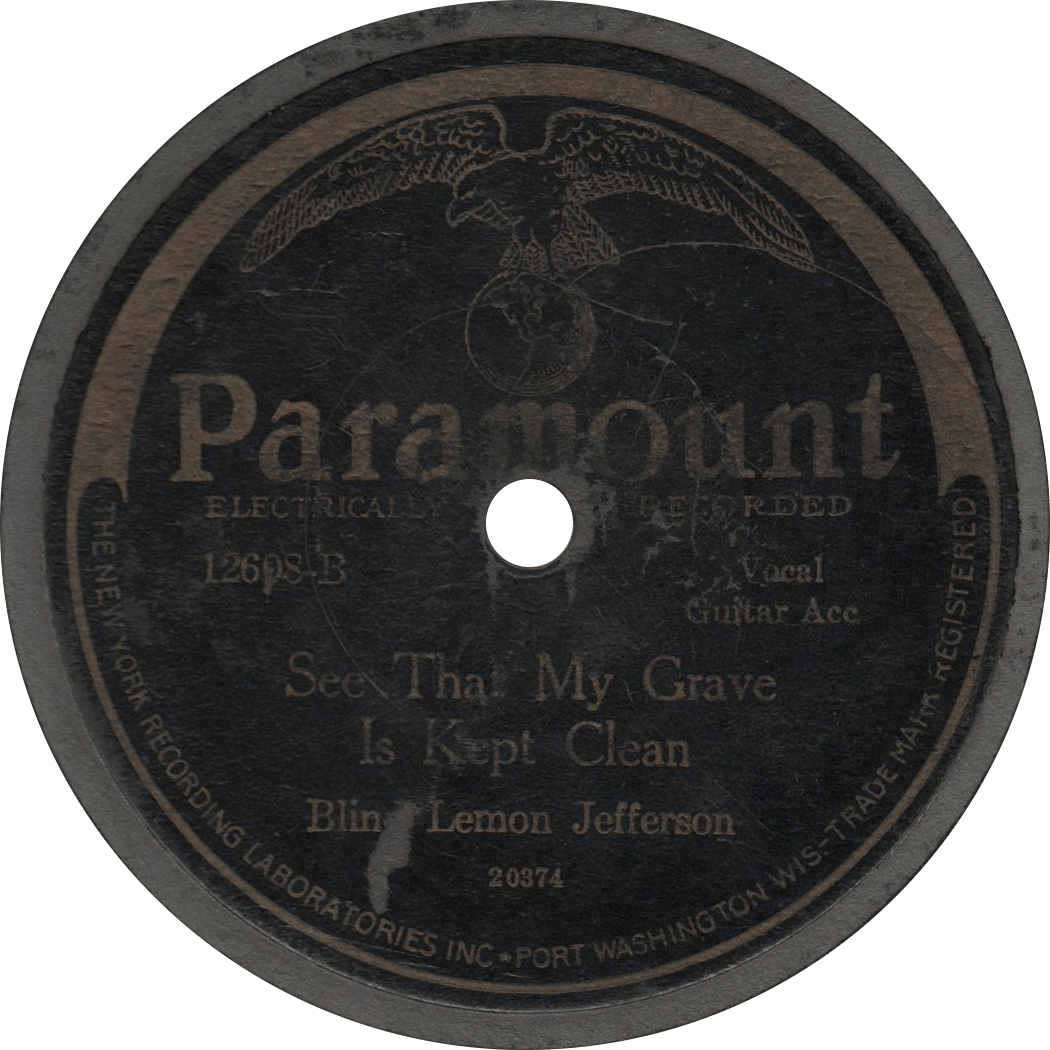
Paramount 12608 – Blind Lemon Jefferson – 1928

The incomparable Blind Lemon Jefferson truly was an artist without parallel.  Having cut his first disc in 1925 or ’26, he was one of the earliest male country blues musicians to record, and the success of his records paved the way for more blues artists to have their music immortalized in wax.  His peculiar yet virtuosic style of singing and guitar playing set him apart from all his contemporaries, and caused him to be seldom imitated (and interestingly, many of his early imitators were white; see Larry Hensley, “Slim Jim” Debs Mays, Roy Shaffer).  Considering both the quality and originality of his work, as well as the volume of his output, it would seem fair to consider Blind Lemon Jefferson one of the greatest heroes of the Texas blues.

Blind Lemon Jefferson, as pictured in the Paramount Book of Blues, 1927.

Like so many early blues people, much of Blind Lemon Jefferson’s life is shrouded in mystery.  He is usually said to have been born in September 24, 1893, though he claimed a date of October 26, 1894, himself.  July of 1897 has also been proffered by some sources, and his obituary suggested he was born about a decade earlier.  He learned to play guitar in his childhood or teens.  As an adult, he weighed about two-hundred-fifty pounds, and has been described as a snappy dresser, always wearing a John B. Stetson hat and a box-back suit from the Model Tailors in Dallas, and conversely as “fat, and a slovenly dresser.”  Lemon reported his profession to census takers in 1920 as a musician, his employer the “general public,” and outside of music he was said to have worked as a wrestler in Dallas.  He played and sang at functions around Freestone County and on street corners, honky tonks, and bordellos in Dallas, most notably on the east end of Elm Street called Deep Ellum, and even on the interurban railway that ran from from Waco north to Denison.  He was known to have worked with Lead Belly, and may have also associated with Washington Phillips and the Dallas String Band.  Like fellow Paramount artists Charley Patton and Blind Blake, only one published photograph of Lemon is known to exist (though at least one phony has been reputed as a second one, and there may well be another authentic but unpublished one in private hands).

As with his life, there is much legend surrounding the demise of Blind Lemon Jefferson.  It’s known that he died on a cold winter day in Chicago—around ten o’clock in the morning on December 19, 1929.  Some claim that he was poisoned by a jilted lover (much like the fate that befell Robert Johnson some nine years later).  Others have supposed that he was robbed of a royalty payment and murdered by a guide hired to help him find his way to the train station.  More reliable accounts suggest that he either died of a heart attack in his car and was abandoned by his driver, or became disoriented trying to find his way through a snowstorm and died from hypothermia.  His death certificate stated “probably chronic myocarditis” (not “acute” as many sources state), supporting the heart attack hypothesis.  In any event, Paramount Records paid for his body’s return to Texas by train, accompanied by Texas piano man Will Ezell, to be buried in the Wortham Negro Cemetery (now called the Blind Lemon Memorial Cemetery).  His funeral was reportedly attended by two or three hundred people, both black and white.  Lemon’s passing inspired a small wave of tributes, and Paramount released a memorial record in his honor, featuring Walter and Byrd singing “Wasn’t it Sad About Lemon” and Rev. Emmett Dickinson’s sermon on the “Death of Blind Lemon”, comparing Jefferson to Jesus Christ.  Had Lemon survived into the folk and blues revival of the 1960s, his impact would likely have been enormous.  Today, Lemon’s grave marker (placed in 1997) bears the epitaph “Lord, it’s one kind favor I’ll ask of you; see that my grave is kept clean.”

The tombstone of Blind Lemon Jefferson in Wortham, Texas, as it appeared eighty-eight years and one day after his death.  Kept clean at the time, as it were.

Paramount 12608 was recorded around February of 1928 in Chicago, Illinois, by Blind Lemon Jefferson.  It also appeared on Broadway 5059, though I’m not certain whether or not anyone has ever seen one of those—I know I haven’t.  It was released that March or early April, and first advertised in the Chicago Defender on April 7, 1928.  Prior to its acquisition by the Old Time Blues Collection, this particular battered copy belonged to the collection of the late folklorist Mack McCormick.

Now, I ordinarily prefer not to make posts honoring artists on the anniversaries of their deaths, but rather to celebrate their lives; under the circumstances however, this record seems an appropriate case to make an exception, for it contains Lemon’s legendary “See That My Grave is Kept Clean”.  A folk song apparently of Lemon’s own composition, and sometimes known as “Two White Horses in a Line” (by Joe Evans and Arthur McClain—the “Two Poor Boys”—and John Lee Hooker) or “One Kind Favor” (by Lightnin; Hopkins and others), Lemon first recorded the song in October of 1927, issued on Paramount 12585, backed with “He Arose from the Dead” under his sanctified pseudonym “Deacon L.J. Bates”.  That version was pulled soon after release and replaced with “Where Shall I Be”, while Lemon recorded a new version of “See That My Grave is Kept Clean” several months later, which saw release under his own name on the record you see and hear here.  Son House used the melody for his “Mississippi County Farm Blues”, which he recorded for Paramount in 1930, and many others have since performed and recorded Jefferson’s original.  In 1934, John A. Lomax recorded a bottleneck guitarist named Pete Harris singing the song in Richmond, Texas, under the title “Blind Lemon’s Song”, a testament to the impact of Jefferson’s recording, and in 1952, Harry Smith included the song in his influential Anthology of American Folk Music.  This song, together with “Match Box Blues” and “That Black Snake Moan” could be viewed as a sort of triumvirate of Lemon’s most famous and perhaps most influential songs.

See That My Grave is Kept Clean, recorded February 1928 by Blind Lemon Jefferson.

On the reverse, technically the “A” side, keeping with the rather morbid theme, Lemon sings “‘Lectric Chair Blues”, another excellent blues, even if it lacks the same grandeur as the previous one.  The original Chicago Defender advertisement said of the song: “Salty tears—wet tears—big, round tears—all kinds of tears and heart throbs, and you should put yourself in his place to feel just as blue.  ‘Lectric chair is the next place he’s gonna sit down in, and he ain’t tired either, so he don’t wanta sit down.”

‘Lectric Chair Blues, recorded February 1928 by Blind Lemon Jefferson.

Updated on May 23, 2018, and with improved audio on May 7, 2023.