Musicraft 31 – Negro Sinful Songs Sung by Lead Belly – 1939

In 1942, Woody Guthrie purchased a copy of Negro Sinful Songs, the Musicraft record album by his friend and colleague Lead Belly, as a gift for his wife.  A true poet, he inscribed at follows:

The gift I’d buy, had to be better than perfume and stronger than metal.  It had to be the simplicity of a whole people and the dignity of a race, the honesty of a saloon and the frenzy of a church.  So when I heard Lead Belly’s voice on these records, I thought here is the surprise I’ve been looking for.  Surprise!

Now, as Guthrie honored his wife with the album, we pay tribute to the man himself: Huddie Ledbetter—the legendary Lead Belly.  I’d pursued this set for quite a long while.  It didn’t come cheap, but I have to say, hokey as it might sound, I really am profoundly moved by these records.  I hope that you will be, too.

Negro Sinful Songs Sung by Lead Belly.  Later pressings switched to a (less evocative) design featuring a portrait of Lead Belly, rather than this one of black sharecroppers.

The exact date and year of Huddie William Ledbetter’s birth are uncertain—the date is most often given as January 20, believed to have been in 1888 or ’89 (the latter is officially offered by the Lead Belly Foundation), January 29, 1885 has also been suggested—but it is known that he was born on the Jeter Plantation in northwestern Louisiana, close to Mooringsport, the son of sharecroppers Wesley and Sallie Ledbetter.  When Huddie was five years old, the Ledbetters bought a piece of land in East Texas and moved across the state border, starting a farm of their own.  His first instrument was the accordion (or “windjammer” as he called it), and his uncle Terrell introduced him to the guitar not long after.  By the turn of the century, Huddie was an accomplished musicianer.  When his father would travel into Shreveport to sell their crops, Huddie would “put on long pants” and go down on Fannin Street to play his music.  He set out on his own in his early twenties, making his living as an itinerant songster.  In the early part of the 1910s, Ledbetter was in Dallas, playing the blues with Blind Lemon Jefferson in Deep Ellum.  He reportedly became enamored with the twelve-string guitar after seeing a Mexican musician performing with one.

In 1918, Ledbetter killed a man in a fight over a woman in Dallas (he was later quoted as saying, “a man tried to cut my head off.”), and was sentenced to thirty years imprisonment in Huntsville, Texas.  With no possibility for parole, he wrote a song to Governor Pat Neff, appealing for a pardon—”[If I] had you, Governor Neff, like you got me, I’d wake up in the morning and I’d set your free.”  In his final days in office, Neff granted his pardon on January 15, 1925, Ledbetter having served six years, seven months and eight days of his sentence.  In 1930 however, Ledbetter was back behind bars after a fight with three white men in Mooringsport, Louisiana.  The sheriff saved him from a lynch mob, but he was sentenced to five-to-ten years at Angola Prison Farm   At some point during one of Ledbetter’s prison stays, he acquired the nickname “Lead Belly”.  Exactly how it came to be is uncertain, but the name stuck, and he used throughout all of his professional musical career.  Three years into his sentence at Angola—in July of 1933—the prison was visited by John Avery Lomax and his son Alan, who were traveling the South with a trunkload of recording equipment to capture the folk music of America for the Library of Congress.  There, they captured Lead Belly’s voice on record for the first time.  Lomax returned the following year, eager to record Lead Belly’s extensive repertoire of folk songs; Lead Belly was eager to find someone to deliver his petition for a pardon to Governor O.K. Allen.  Following his release, Lead Belly returned to John A. Lomax, asking that he allow him to assist in his travels, lest his release be rescinded.  Lomax obliged, and Lead Belly accompanied him in his travels from September until the end of 1934.

Lomax, with Lead Belly along, arrived back in New York City around the New Year of 1935, and Lead Belly achieved notoriety, appearing in a March of Time newsreel and radio program made in celebration Lomax’s greatest discovery.  Ledbetter married his sweetheart, Martha Promise, that January, and she became his manager.  Days later, he made his first commercial recordings for American Record Corporation; he was introduced to their A&R man Art Satherly by recording artist Tex Ritter.  From the twenty-third to the twenty-fifth of January, the fifth of February, and twenty-fifth of March of 1935, Lead Belly cut more than forty sides for the ARC, of which only three records (six sides, that is) were released.  Those issued were all blues sides, rather than his folk songs.  These “race records” didn’t prove too popular with black listeners, who by that time were more interested in modern artists like Big Bill Broonzy than Lead Belly’s country blues, and they sold rather poorly.  That March, Lead Belly accompanied Lomax on a lecture in colleges across New England.

A full color spread of Lead Belly, as published in Life magazine on April 19, 1937.

The day after his final ARC session, Lead Belly left for Louisiana—moving to Dallas soon after—and his partnership with Lomax ended rather acrimoniously, with a paycheck for three-hundred dollars—Lead Belly’s cut of the 1,500 dollars they earned during their time together, subtracting “expenses for purchasing a new Stella guitar, clothing, dentist’s fees, etc.”  When he arrived in Shreveport, Lead Belly hired a lawyer and filed suit against John A. Lomax for full payment of his earnings while working for Lomax.  The suit was settled that September for two-hundred-fifty dollars, with Lead Belly asking for a reconciliation between the two.  By the early part of 1936, the Ledbetters had returned to New York, living in an apartment on West 52nd Street.  That November, John and Alan Lomax published Negro Folk Songs as Sung by Lead Belly, and the following April, Lead Belly was publicized in a Life magazine spread.  By the latter half of the 1930s, there was a surge in popularity for folk music burgeoning in New York, championed largely by leftists and union agitators, and Lead Belly was soon to become endeared to their movement.  As early as 1937, he was already being touted as a “people’s artist.”  While those folk singers like Woody Guthrie and Pete Seeger dressed in workingman’s garb—flannel shirts and denim workwear—Lead Belly, no doubt fed up on those styles from his time working on the field and in prison, always wore fine clothes—double breasted suits and bow ties.

On March 5, 1939, Lead Belly was jailed for assault at Riker’s Island, and once bailed, Alan Lomax arranged for a recording session with the “high end” record label Musicraft on the first of April.  These were to be his first commercial recordings since his ARC sessions in 1935, the proceeds of which would help with Lead Belly’s legal expenses.  Ten sides were released by Musicraft in an album titled Negro Sinful Songs Sung by Lead Belly.  As the folk music movement grew, so did Lead Belly’s popularity.  He began to perform on the radio, and achieve greater success.  In June of 1940, Alan Lomax convinced Victor to record Lead Belly, and he produced another album, this time paired with the Golden Gate Quartet to produce the three disc set The Midnight Special and Other Southern Prison Songs.  The next year, he attended the third inauguration of President Roosevelt, and began recording for Moe Asch’s Asch Records.  All the while, he continued to record prolifically for the Library of Congress.  In the middle of the 1940s, Lead Belly traveled to Los Angeles, California while Paramount Pictures optioned John A. Lomax’s autobiography Adventures of a Ballad Hunter as a picture, starring Bing Crosby as Lomax and Josh White as Ledbetter (oh how I wish that had come to fruition).  While there, Lead Belly had a short-lived radio program, and—again thanks to Tex Ritter—recorded twelve sides for Capitol Records.

Throughout the entire decade of the 1940s, Lead Belly’s popularity and success skyrocketed.  From humble beginnings, he was being touted as “quite probably the greatest living American folk singer.”  He toured, appearing in countless concerts, mostly in New York by the ’40s.  But by the end of the decade, Lead Belly started to wind down.  His success was soaring in 1949, and he embarked for a tour of Europe, but he soon fell ill, and was diagnosed with Lou Gehrig’s disease in Paris.  On his return to the states, Lead Belly played his last concert on June 15, 1949 at the University of Texas in Austin, remembering the life of John A. Lomax, who had died from a stroke the previous year.  On December 6, 1949, Huddie Ledbetter succumbed to his illness and died at the Bellevue Hospital in New York City, leaving behind a legacy of well over five hundred recorded songs and a profound impact on all the world’s music for generations to come.

Continue reading

Decca 7815 – Peetie Wheatstraw (The Devil’s Son-in-Law) – 1940

Though he wasn’t the most talented instrumentalist, nor the most able vocalist, the popular blues musician Peetie Wheatstraw—the Devil’s Son-in-Law, the High Sheriff from Hell—achieved great success in his time, and made a considerable impact on fellow musicians for years to come.

Contrary to the events presented in the 1977 film Petey Wheatstraw, Peetie Wheatstraw was not born as a walking, talking child.  Rather, he was born as William Bunch on December 21, 1902, likely in Ripley, Tennessee or Cotton Plant, Arkansas.  He learned to play the piano and guitar and in 1929 took up residence in East St. Louis, assuming the moniker “Peetie Wheatstraw, the Devil’s Son-in-Law”.  Some have suggested the “Peetie Wheatstraw” name traces its roots back to early Afro-American folklore, yet others suggest that Bunch himself was the originator.  Brought to the studio by bluesman and talent scout Charley Jordan, Wheatstraw made his first record for Vocalion in 1930—”Tennessee Peaches Blues”, assisted by an unidentified fellow by the name of “Neckbones” (possibly J.D. “Jelly Jaw” Short)—and he continued to record for them until 1936, with a handful of recordings made for Victor in 1931 on the side.  While still featured on Vocalion, Wheatstraw began recording for Decca in 1934, soon switching to that label exclusively.  Peetie Wheatstraw died in a car accident on his thirty-ninth birthday—he was sitting in the back seat of a Buick driven by a friend, when it struck a standing freight train, killing all passengers—less than one full month after recorded the prophetic seeming “Bring Me Flowers While I’m Living”.

With an idiosyncratic and formulaic style of singing and playing piano, Peetie Wheatstraw maintained a position as one of the top-selling and most prolific blues artists throughout the decade of the 1930s, alongside Blind Boy Fuller, Big Bill, and Bumble Bee Slim.  Influences of Wheatstraw’s signature piano style, mumbled vocals, and “hoo-well-well” holler could be heard in the music of many less successful blues artists across the land, such as Alabama’s Peanut, the Kidnapper (whose stage name is one of the few to rival “Peetie Wheatstraw”).  A testament to his success, fellow blues musician Robert Nighthawk was billed by Decca for a time as “Peetie’s Boy”.  Even noted Texas bluesman Andrew “Smokey” Hogg started out veritably copying Wheatstraw’s vocals and guitar playing, and was known as “Little Peetie Wheatstraw”.

Decca 7815 was recorded on April 4, 1940 and August 28, 1940 in New York City.  Peetie Wheatstraw is accompanied by Jonah Jones on trumpet, possibly Lil Armstrong on piano, and Big Sid Catlett on drums.

First up, Peetie Wheatstraw sings one of his more famous recordings, the swing infused “Gangster’s Blues”.  The noted accompanists account for the reason why these two songs don’t sound just like most every other song Wheatstraw recorded.

Gangster’s Blues, recorded April 4, 1940 by Peetie Wheatstraw (The Devil’s Son-in-Law).

Next, Wheatstraw sings “Look Out for Yourself”, one of countless blues songs echoing the melody of “Sitting On Top of the World”.

Look Out for Yourself, recorded August 28, 1940 by Peetie Wheatstraw (The Devil’s Son-in-Law).

Columbia 2586-D – Fletcher Henderson and his Orchestra – 1931

So the time again come again to pay tribute to one of the forefathers of swing music and leader of one of the finest jazz orchestras of the 1920s and ’30s, the incomparable Fletcher Henderson.

Fletcher Hamilton Henderson, Jr., was born on December 18, 1897 into a middle class family in Cuthbert, Georgia in a home built by his father.  Like so many, Fletcher learned to play piano as a boy, along with his brother Horace, who also went on to become a noted jazz musician and bandleader.  Henderson graduated from Atlanta University in 1920 with a bachelor’s in chemistry and mathematics, and thereafter moved to New York City with intention to attend Columbia University.  He got sidetracked soon after arriving however, and instead made his entry into the world of Harlem’s jazz music; while lodging with a riverboat musician, Fletcher filled in for him from time to time.  He soon began working as a song plugger for W.C. Handy, which led his getting his big break in 1921.  When publisher Harry Pace broke with Handy to form Black Swan Records, he made Henderson the musical director for the fledgling “race” label.  At Black Swan, Henderson led his first orchestra, and he continued to lead after the company folded in 1923.  Henderson began to record prolifically on most every record label in existence, both as a bandleader and as an accompanist to early blues singers.  In its heyday, his band often included jazz luminaries such as Don Redman, Coleman Hawkins, and, for a stretch in 1924 and ’25, Louis Armstrong.  A car accident in August of 1928 left Henderson with a few broken bones, and by some accounts a depression that caused his work to decline in quality.  Nonetheless, his orchestra continued to perform and record for another decade.  In 1931, his became the house band of Connie’s Inn, a prominent Harlem nightclub comparable to the famed Cotton Club.  As the swing era began to swing later in that decade, rising star Benny Goodman began purchasing arrangements from Henderson for his own orchestra to play; Goodman’s legendary rendition of Jelly Roll Morton’s “King Porter” is practically a recreation of Henderson’s recordings of the same from 1928, ’32, and ’33.  He continued to lead his own band as well until 1939, at which point he disbanded his group to join Goodman’s as a staff arranger, but re-formed an orchestra and recorded sporadically throughout the 1940s.  A stroke in 1950 left Henderson partially paralyzed, and he retired from music.  Fletcher Henderson died two years later on December 29, 1950.

Columbia 2586-D was recorded on December 2, 1931 in New York City.  The orchestra consists of Russell Smith, Rex Stewart, and Bobby Stark on trumpets, Jimmy Harrison and Claude Jones on trombone, Benny Carter on clarinet and alto sax, Harvey Boone on alto sax, Coleman Hawkins on tenor sax, Fletcher Henderson on piano, Clarence Holiday (that’s Billie’s father) on banjo and guitar, John Kirby on string bass and tuba, and Walter Johnson on drums.

First up, Henderson’s orchestra plays what is in a constant struggle with “Copenhagen” for the title of my favorite of their tunes, Smack’s jazzed up fox trot arrangement of the old Paul Dresser waltz “My Gal Sal”.

My Gal Sal

My Gal Sal, recorded December 2, 1931 by Fletcher Henderson and his Orchestra.

On the reverse, they play “My Pretty Girl” in a similar manner as Jean Goldkette’s rendition of four years prior, with a vocal by Lois Deppe.

My Pretty Girl

My Pretty Girl, recorded December 2, 1931 by Fletcher Henderson and his Orchestra.

Brunswick 6162 – Connie Boswell – 1931

We’ve celebrated the anniversary of the incomparable Miss Connie Boswell’s birth several times before here on Old Time Blues, but this time around it’s particularly significant, for it’s her 110th birthday.  Likewise, this is a particularly significant record for the occasion: Connie’s first solo record (excepting her early 1925 straggler).

Connie Boswell around 1932.

Connie was born Constance Foore Boswell—taking her middle name from her mother’s maiden name—in Kansas City, Missouri on December 3, 1907, the third of the Boswell children, and the middle Boswell sister.  They relocated to Birmingham when Connie was about three years old, and it was there where she suffered the incident that would leave her crippled, most likely by a bout of infantile paralysis, though her mother claimed it was the result of an accident involving a toy wagon.  In any event, she was left completely incapacitated, yet in spite of adversity, Connie recovered, even being able to stand up and walk after a fashion for a time, though she would later rely on a wheelchair.  Soon after the accident, the Boswells packed up and moved to New Orleans, where the children were exposed to—and became a part of—the genesis of jazz.

The three Boswell Sisters became a popular musical act around town, singing harmony and playing instruments; when the Victor Talking Machine Company made their first field trip to Houston and New Orleans, the Boswells made their first record.  Several years later, after some setbacks, the trio left for Chicago to embark on a vaudeville tour.  Eventually, they wound up in California, where they settled for a time in Los Angeles and became popular radio personalities.  Then a young hotel clerk they’d met and befriended in a seedy joint in San Francisco—Harry Leedy—came to visit and convinced them to take him on as their manager, and later Connie’s husband.  He succeeded in getting them a contract with Brunswick, and they traveled to New York to make records.  But in spite of his successful management of the trio, Leedy believed that Connie was the only sister with a lick of talent, and that the other two were essentially superfluous.  He pushed for Connie to do more solo work, which she did, and he positioned her to take more leading vocals on the Sisters’ records.  Ultimately, it’s likely that Leedy contributed considerably to the tensions that resulted in the Boswell Sisters 1936 breakup.

After the disintegration of the trio, Connie’s career fell into a bit of a slump, but her runaway swing hit of von Flotow’s “Martha” brought fast to the spotlight.  Throughout the remainder of the 1930s, and into the ’40s, she remained one of the most popular singers in the nation, duetting frequently with Bing Crosby.  She made a number of noteworthy film appearances in It’s All Yours and Artists and Models in 1937, the latter which saw her sing the Academy award nominated “Whispers in the Dark”, Kiss the Boys Goodbye in 1941, Syncopation in 1942, and Swing Parade of 1946.  Around 1942, she altered the spelling of her name to “Connee”, stating that it was easier to sign, but also possibly due to numerological reasons recommended by her sister Martha.  In the years following the Second World War, Connee Boswell’s career began to slow down, and she took a hiatus from her long time association with Decca Records in 1946.  The following year, she made two records for Apollo, and then quieted down for a five year stretch.  In 1952, Connee made a triumphant return to Decca, accompanied by Artie Shaw’s Gramercy Five, but her voice was beginning to sound noticeably hoarse in her mid-forties.  Nonetheless, she continued making records and television appearances on programs such as The Ed Sullivan Show through the decade, concluding with her final album in 1958.  Also in ’58, she made an appearance in the movie Senior Prom, and took a recurring role as “Savannah Brown” in the television adaptation of Pete Kelly’s Blues.  Slowing down in the 1960s, Connee made two rock ‘n’ roll-esque 45s for the Charles label in 1962, her last commercial records.  After a fairly quiet decade, Connee Boswell died of stomach cancer on October 12, 1976.

Brunswick 6162 was recorded around July 27, 1931 in New York City.  Connie Boswell is accompanied more-or-less by the Dorsey Brothers’ Orchestra, consisting of Manny Klein on trumpet, on trombone, Jimmy Dorsey on clarinet, Harry Hoffman on violin, sister Martha Boswell on piano, Dick McDonough on guitar, Joe Tarto on string bass, and Chauncey Morehouse on drums and vibraphone.

First, Connie sings an upbeat composition by the Harries Tobias and Barris, “What is It?”, with a little swinging going on in the background.

What is It?, recorded July 27, 1931 by Connie Boswell.

Next, Connie sings the lovely “I’m All Dressed Up With a Broken Heart”, a torch song which, much like Russ Columbo’s “You Call it Madness”, is truly evocative of its era.

I’m All Dressed Up With a Broken Heart, recorded July 27, 1931 by Connie Boswell.

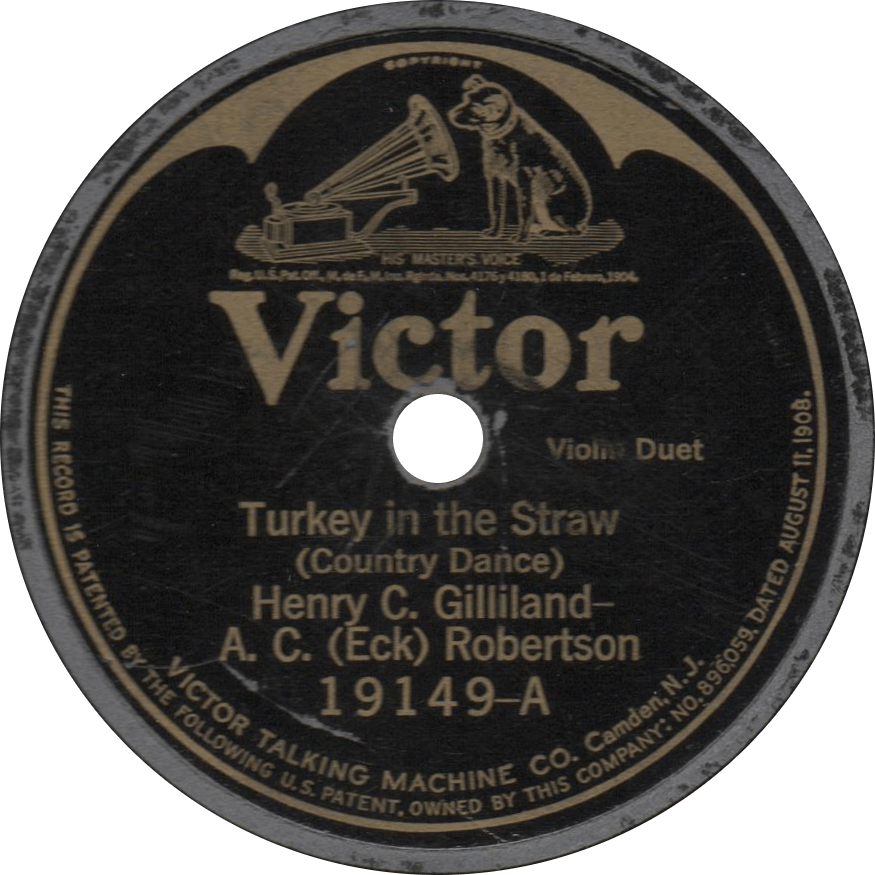
Victor 19149 – Henry C. Gilliland–A. C. (Eck) Robertson – 1922

This disc bears the distinction of being one of the first records (though not the first) whose contents could be considered “country” music.  However, the pair of musicians responsible for producing these tunes—Henry C. Gilliland and A.C. “Eck” Robertson—almost certainly were the first old time musicians from Texas to make a record.  What you’ll hear here is some of the finest rustic fiddling what am.

Henry Clay Gilliland was born on March 25, 1845 in Jasper County, Missouri.   His family relocated to Texas when he was eight years old, settling in Parker County (home of peaches).  He learned to play the fiddle at a young age from his older brother Joseph, and the two rose to prominence around Weatherford.  When the South seceded, Gilliland enlisted and served in the Arizona Brigade of the Second Texas Cavalry.  After the war was done, he returned home and became known as an Indian fighter and small-time politician.  Alongside talents such as Moses J. Bonner, Gilliland became one of the most prominent Texas fiddlers of his day.

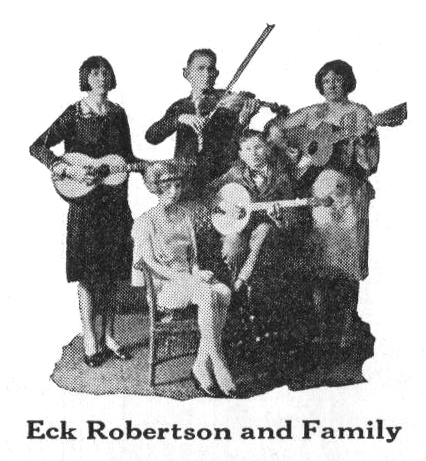
Eck Robertson (back row center, with fiddle) and family. As pictured in 1930 Victor catalog.

Alexander Campbell Robertson was born in Delaney, Arkansas on November 20, 1887 (though his tombstone says 1886).  Like Gilliland forty-some years his senior, Robertson’s family moved to Texas in his early childhood, making their home near Amarillo in the panhandle of the state.  His father was a fiddler-turned-preacher, and many of the other men in his family were also skilled on the instrument.  Unsurprisingly given such a heritage, the young “Eck” soon took up the fiddle himself.  At sixteen, he took off to join a medicine show, hoping to win fame as a musician.  After marrying and settling briefly in Amarillo as a piano tuner, he went on the road once again to play in fiddle contests and vaudeville shows throughout the Southwest.

The two men crossed paths at a Confederate reunion in 1922 in Richmond, Virginia; Robertson was the son of a veteran, Gilliland was a veteran himself.  Together, they played before a crowd of some four-thousand at the convention.  The two fiddlers evidently hit it off, and, with aid from a friend of Gilliland’s in a high place, very soon after traveled to New York to make a record for the Victor Talking Machine Company.  On June 30, 1922, the duo cut four sides, starting with “Arkansaw Traveler”, which, coupled with “Sallie Gooden” (Victor 18956) is often credited as the first “country” music record (though it is debatably not).  The following day, Robertson returned to the studio alone to make six more solo recordings.  Six of those ten sides saw release, only two of which featured Gilliland.  Henry C. Gilliland died on April 21, 1924 in Altus, Oklahoma at the age of seventy-nine, and was thereafter memorialized as the “greatest fiddler in the world.”  Eck Robertson on the other hand continued to perform and record.

In 1929, the Victor company twice ventured into Dallas to record the local talent, and Eck returned to the studio, this time bringing his family along: wife Nettie, son Dueron, and daughter Daphne.  In four sessions that year—one in August and three in October, the last of which was only nine days before the stock market crash that would all but kill off such recording field trips —Robertson recorded a further fourteen sides, five solo, nine with his family, and two with fellow fiddler Dr. J.B. Cranfill (seemingly the same man as the noted Dallas prohibitionist James Britton Buchanan Boone Cranfill, though I can’t find definitive confirmation), which altogether yielded a total of ten issued sides.  From then on out, he maintained that Victor had given him the short end of the stick.  Robertson also performed on Fort Worth’s WBAP from time to time, and he made a reported hundred non-commercial recordings for the Sellers transcription company of Dallas in September of 1940, which appear to be lost today.  Eck Roberton died on February 15, 1975 at age of eighty-eight, in Borger, Texas.

Victor 19149 was recorded on June 30 and July 1, 1922 in New York City, the former being their first session.  It was released on November 30, 1923, and remained in the catalog until 1936.  I found this record in Mineral Wells, Texas, not far from Gilliland’s home town of Weatherford; perhaps it was his own personal copy.  Unlikely a prospect as that is, it is conceivable that it could have been owned by someone personally acquainted with him.

First, both Robertson and Gilliland play a fiddle duet on the classic “Turkey in the Straw”.  Listen closely to the end for a little artifact from the recording studio: a small “bump”.  Could be one of the men setting down his instrument, could be something else entirely.

Turkey in the Straw, recorded June 30, 1922 by Henry C. Gilliland–A. C. (Eck) Robertson.

Next, Eck plays solo on another old time classic, the traditional Texas fiddle tune “Ragtime Annie”.  Ladies and gentlemen, this is truly old time fiddling.

Ragtime Annie, recorded July 1, 1922 by A. C. (Eck) Robertson.

Updated with improved audio on June 9, 2025.