Paramount 12608 – Blind Lemon Jefferson – 1928

The incomparable Blind Lemon Jefferson truly was an artist without parallel.  Having cut his first disc in 1925 or ’26, he was one of the earliest male country blues musicians to record, and the success of his records paved the way for more blues artists to have their music immortalized in wax.  His peculiar yet virtuosic style of singing and guitar playing set him apart from all his contemporaries, and caused him to be seldom imitated (and interestingly, many of his early imitators were white; see Larry Hensley, “Slim Jim” Debs Mays, Roy Shaffer).  Considering both the quality and originality of his work, as well as the volume of his output, it would seem fair to consider Blind Lemon Jefferson one of the greatest heroes of the Texas blues.

Blind Lemon Jefferson, as pictured in the Paramount Book of Blues, 1927.

Like so many early blues people, much of Blind Lemon Jefferson’s life is shrouded in mystery.  He is usually said to have been born in September 24, 1893, though he claimed a date of October 26, 1894, himself.  July of 1897 has also been proffered by some sources, and his obituary suggested he was born about a decade earlier.  He learned to play guitar in his childhood or teens.  As an adult, he weighed about two-hundred-fifty pounds, and has been described as a snappy dresser, always wearing a John B. Stetson hat and a box-back suit from the Model Tailors in Dallas, and conversely as “fat, and a slovenly dresser.”  Lemon reported his profession to census takers in 1920 as a musician, his employer the “general public,” and outside of music he was said to have worked as a wrestler in Dallas.  He played and sang at functions around Freestone County and on street corners, honky tonks, and bordellos in Dallas, most notably on the east end of Elm Street called Deep Ellum, and even on the interurban railway that ran from from Waco north to Denison.  He was known to have worked with Lead Belly, and may have also associated with Washington Phillips and the Dallas String Band.  Like fellow Paramount artists Charley Patton and Blind Blake, only one published photograph of Lemon is known to exist (though at least one phony has been reputed as a second one, and there may well be another authentic but unpublished one in private hands).

As with his life, there is much legend surrounding the demise of Blind Lemon Jefferson.  It’s known that he died on a cold winter day in Chicago—around ten o’clock in the morning on December 19, 1929.  Some claim that he was poisoned by a jilted lover (much like the fate that befell Robert Johnson some nine years later).  Others have supposed that he was robbed of a royalty payment and murdered by a guide hired to help him find his way to the train station.  More reliable accounts suggest that he either died of a heart attack in his car and was abandoned by his driver, or became disoriented trying to find his way through a snowstorm and died from hypothermia.  His death certificate stated “probably chronic myocarditis” (not “acute” as many sources state), supporting the heart attack hypothesis.  In any event, Paramount Records paid for his body’s return to Texas by train, accompanied by Texas piano man Will Ezell, to be buried in the Wortham Negro Cemetery (now called the Blind Lemon Memorial Cemetery).  His funeral was reportedly attended by two or three hundred people, both black and white.  Lemon’s passing inspired a small wave of tributes, and Paramount released a memorial record in his honor, featuring Walter and Byrd singing “Wasn’t it Sad About Lemon” and Rev. Emmett Dickinson’s sermon on the “Death of Blind Lemon”, comparing Jefferson to Jesus Christ.  Had Lemon survived into the folk and blues revival of the 1960s, his impact would likely have been enormous.  Today, Lemon’s grave marker (placed in 1997) bears the epitaph “Lord, it’s one kind favor I’ll ask of you; see that my grave is kept clean.”

The tombstone of Blind Lemon Jefferson in Wortham, Texas, as it appeared eighty-eight years and one day after his death.  Kept clean at the time, as it were.

Paramount 12608 was recorded around February of 1928 in Chicago, Illinois, by Blind Lemon Jefferson.  It also appeared on Broadway 5059, though I’m not certain whether or not anyone has ever seen one of those—I know I haven’t.  It was released that March or early April, and first advertised in the Chicago Defender on April 7, 1928.  Prior to its acquisition by the Old Time Blues Collection, this particular battered copy belonged to the collection of the late folklorist Mack McCormick.

Now, I ordinarily prefer not to make posts honoring artists on the anniversaries of their deaths, but rather to celebrate their lives; under the circumstances however, this record seems an appropriate case to make an exception, for it contains Lemon’s legendary “See That My Grave is Kept Clean”.  A folk song apparently of Lemon’s own composition, and sometimes known as “Two White Horses in a Line” (by Joe Evans and Arthur McClain—the “Two Poor Boys”—and John Lee Hooker) or “One Kind Favor” (by Lightnin; Hopkins and others), Lemon first recorded the song in October of 1927, issued on Paramount 12585, backed with “He Arose from the Dead” under his sanctified pseudonym “Deacon L.J. Bates”.  That version was pulled soon after release and replaced with “Where Shall I Be”, while Lemon recorded a new version of “See That My Grave is Kept Clean” several months later, which saw release under his own name on the record you see and hear here.  Son House used the melody for his “Mississippi County Farm Blues”, which he recorded for Paramount in 1930, and many others have since performed and recorded Jefferson’s original.  In 1934, John A. Lomax recorded a bottleneck guitarist named Pete Harris singing the song in Richmond, Texas, under the title “Blind Lemon’s Song”, a testament to the impact of Jefferson’s recording, and in 1952, Harry Smith included the song in his influential Anthology of American Folk Music.  This song, together with “Match Box Blues” and “That Black Snake Moan” could be viewed as a sort of triumvirate of Lemon’s most famous and perhaps most influential songs.
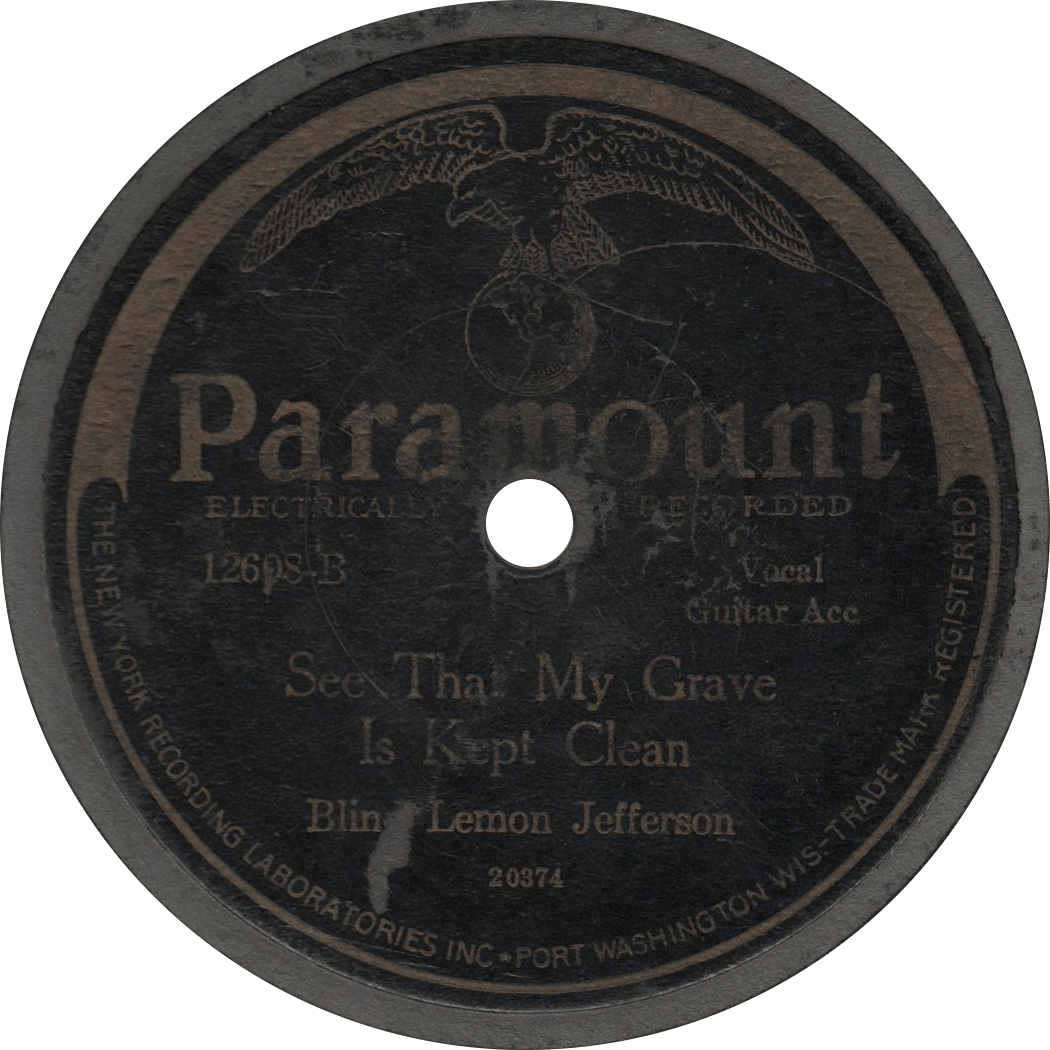
See That My Grave is Kept Clean, recorded February 1928 by Blind Lemon Jefferson.

On the reverse, technically the “A” side, keeping with the rather morbid theme, Lemon sings “‘Lectric Chair Blues”, another excellent blues, even if it lacks the same grandeur as the previous one.  The original Chicago Defender advertisement said of the song: “Salty tears—wet tears—big, round tears—all kinds of tears and heart throbs, and you should put yourself in his place to feel just as blue.  ‘Lectric chair is the next place he’s gonna sit down in, and he ain’t tired either, so he don’t wanta sit down.”

‘Lectric Chair Blues, recorded February 1928 by Blind Lemon Jefferson.

Updated on May 23, 2018, and with improved audio on May 7, 2023.

Melotone 7-02-61 – Bill Cox and Cliff Hobbs (The Dixie Songbirds) – 1936

By the time Franklin D. Roosevelt won his first reelection in 1936, he had already done a great deal for his country, including the rolling out his second wave of New Deal programs, including the WPA, the SSA, the NYA, and the RA.  But hailed by some as FDR’s crowning achievement was his fulfillment of one particular campaign promise: the repeal of the eighteenth amendment—prohibition.  Less than a year into his first term, on December 5, 1933, Roosevelt signed the twenty-first amendment into law, thus putting an end to the thirteen years dry years that had loomed over America’s head as it drank itself into a stupor like never seen before, and the whole nation celebrated with a round of beer.

The “Dixie Songbird” Bill Cox brought us the “N. R. A. Blues” in 1933, in celebration of the recently elected Franklin D. Roosevelt’s first New Deal.  Come FDR’s reelection three years later, Cox—ever the loyal Democrat—wasn’t about to let the occasion pass without a song.  This time around, he was joined by Cliff Hobbs, a young man whom Cox had earlier hired to accompany him on guitar after being temporarily incapacitated by a hand injury, and later joined him permanently as a singing partner at the suggestion of record producer Art Satherley.  Ultimately, the tribute that the two created turned out to be one of the most charming and enduring of the Depression-era topical songs.

Melotone 7-02-61 was recorded in New York, New York on November 28, 1936, less than a month after the election of ’36 that saw FDR’s reelection, and represents the entirety of Cox and Hobbs’ session that day.  Both Cox and Hobbs sing and play guitars; Cox doubles on harmonica on a rack.  It was also issued on Conqueror 8771 and later on Okeh 05896.

First up, the Dixie Songbirds celebrate Roosevelt’s 1936 reelection with their lively performance of “Franklin Roosevelt’s Back Again”, perhaps among the most memorable Great Depression-era topical songs.  “Since Roosevelt’s been elected, moonshine liquor’s been corrected; we’ve got legal wine, whiskey, beer, and gin!”  (“Hallelujah!”)

Franklin Roosevelt’s Back Again, recorded November 28, 1936 by Bill Cox and Cliff Hobbs (The Dixie Songbirds).

Next, Cox and Hobbs commemorate the first Democrat in the White House since Woodrow Wilson left office in 1921.  “Hee-haw hallelujah!  hee-haw hallelujah!  I’m back in old ‘Columby’ in the same old stall again!”

The Democratic Donkey (Is in His Stall Again), recorded November 28, 1936 by Bill Cox and Cliff Hobbs (The Dixie Songbirds).

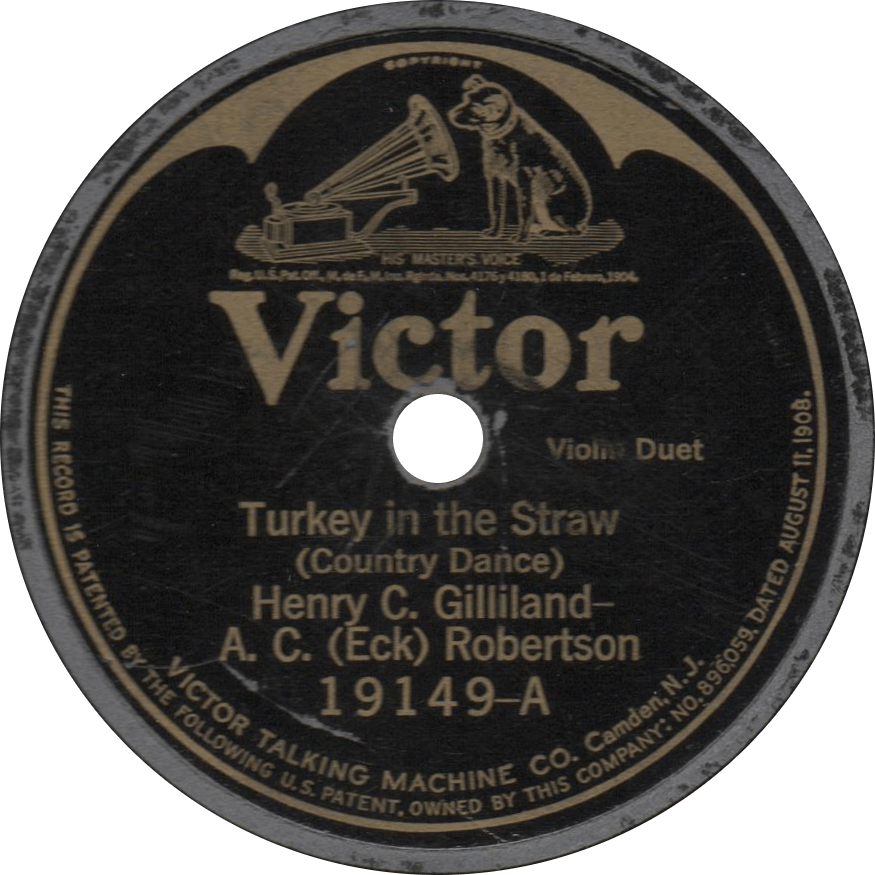
Victor 19149 – Henry C. Gilliland–A. C. (Eck) Robertson – 1922

This disc bears the distinction of being one of the first records (though not the first) whose contents could be considered “country” music.  However, the pair of musicians responsible for producing these tunes—Henry C. Gilliland and A.C. “Eck” Robertson—almost certainly were the first old time musicians from Texas to make a record.  What you’ll hear here is some of the finest rustic fiddling what am.

Henry Clay Gilliland was born on March 25, 1845 in Jasper County, Missouri.   His family relocated to Texas when he was eight years old, settling in Parker County (home of peaches).  He learned to play the fiddle at a young age from his older brother Joseph, and the two rose to prominence around Weatherford.  When the South seceded, Gilliland enlisted and served in the Arizona Brigade of the Second Texas Cavalry.  After the war was done, he returned home and became known as an Indian fighter and small-time politician.  Alongside talents such as Moses J. Bonner, Gilliland became one of the most prominent Texas fiddlers of his day.

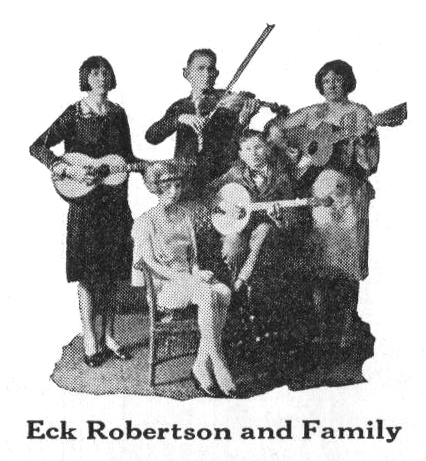
Eck Robertson (back row center, with fiddle) and family. As pictured in 1930 Victor catalog.

Alexander Campbell Robertson was born in Delaney, Arkansas on November 20, 1887 (though his tombstone says 1886).  Like Gilliland forty-some years his senior, Robertson’s family moved to Texas in his early childhood, making their home near Amarillo in the panhandle of the state.  His father was a fiddler-turned-preacher, and many of the other men in his family were also skilled on the instrument.  Unsurprisingly given such a heritage, the young “Eck” soon took up the fiddle himself.  At sixteen, he took off to join a medicine show, hoping to win fame as a musician.  After marrying and settling briefly in Amarillo as a piano tuner, he went on the road once again to play in fiddle contests and vaudeville shows throughout the Southwest.

The two men crossed paths at a Confederate reunion in 1922 in Richmond, Virginia; Robertson was the son of a veteran, Gilliland was a veteran himself.  Together, they played before a crowd of some four-thousand at the convention.  The two fiddlers evidently hit it off, and, with aid from a friend of Gilliland’s in a high place, very soon after traveled to New York to make a record for the Victor Talking Machine Company.  On June 30, 1922, the duo cut four sides, starting with “Arkansaw Traveler”, which, coupled with “Sallie Gooden” (Victor 18956) is often credited as the first “country” music record (though it is debatably not).  The following day, Robertson returned to the studio alone to make six more solo recordings.  Six of those ten sides saw release, only two of which featured Gilliland.  Henry C. Gilliland died on April 21, 1924 in Altus, Oklahoma at the age of seventy-nine, and was thereafter memorialized as the “greatest fiddler in the world.”  Eck Robertson on the other hand continued to perform and record.

In 1929, the Victor company twice ventured into Dallas to record the local talent, and Eck returned to the studio, this time bringing his family along: wife Nettie, son Dueron, and daughter Daphne.  In four sessions that year—one in August and three in October, the last of which was only nine days before the stock market crash that would all but kill off such recording field trips —Robertson recorded a further fourteen sides, five solo, nine with his family, and two with fellow fiddler Dr. J.B. Cranfill (seemingly the same man as the noted Dallas prohibitionist James Britton Buchanan Boone Cranfill, though I can’t find definitive confirmation), which altogether yielded a total of ten issued sides.  From then on out, he maintained that Victor had given him the short end of the stick.  Robertson also performed on Fort Worth’s WBAP from time to time, and he made a reported hundred non-commercial recordings for the Sellers transcription company of Dallas in September of 1940, which appear to be lost today.  Eck Roberton died on February 15, 1975 at age of eighty-eight, in Borger, Texas.

Victor 19149 was recorded on June 30 and July 1, 1922 in New York City, the former being their first session.  It was released on November 30, 1923, and remained in the catalog until 1936.  I found this record in Mineral Wells, Texas, not far from Gilliland’s home town of Weatherford; perhaps it was his own personal copy.  Unlikely a prospect as that is, it is conceivable that it could have been owned by someone personally acquainted with him.

First, both Robertson and Gilliland play a fiddle duet on the classic “Turkey in the Straw”.  Listen closely to the end for a little artifact from the recording studio: a small “bump”.  Could be one of the men setting down his instrument, could be something else entirely.

Turkey in the Straw, recorded June 30, 1922 by Henry C. Gilliland–A. C. (Eck) Robertson.

Next, Eck plays solo on another old time classic, the traditional Texas fiddle tune “Ragtime Annie”.  Ladies and gentlemen, this is truly old time fiddling.

Ragtime Annie, recorded July 1, 1922 by A. C. (Eck) Robertson.

Updated with improved audio on June 9, 2025.

Victor 20502 – Ernest Rogers/Vernon Dalhart – 1927/1925

Ernest Rogers, as pictured in a 1930 Victor catalog.

It’s no secret that I have sort of a thing for obscure—but excellent—musical artists of the 1920s and ’30s (also em dashes, if you haven’t noticed).  One of my most enduring favorites within that category is Mr. Ernest Rogers.  (Funny how so many of my favorite people are named “Rogers”, or some variation on that!)

William Ernest Rogers was born on October 27, 1897 in Atlanta, Georgia.  He was crippled by infantile paralysis at the age of two, but that evidently didn’t slow him down.  He attended Emory University—where he was the champion debater, a member of the glee club, mandolin club, and literary society, and founder of the campus newspaper, the Emory Wheel—and graduated with a Bachelor of Science in 1920.  After college, Rogers found work as an editor, reporter, arts critic, and features writer for the Atlanta Journal, with whom he remained until 1962.  He married Bertha Turnipseed and they had one child, Wallace.  On the side, Ernest sang and played the guitar, and served as a performer and announcer on the Atlanta radio station WSB.  His repertoire consisted primarily of vaudevillian material, including such songs as “Steamboat Bill”, “Waitin’ for the ‘Robert E. Lee'”, and “Willie the Weeper”, as well as a few compositions of his own, like “My Red-Haired Lady” and “Let Me Be Your Man in the Moon”.  He made his first record for the Columbia Phonograph Company in January of 1925, during their second field trip to Atlanta, cutting two sides which were both issued.  Two years later, the Victor Talking Machine company brought their recording equipment to Atlanta, and Rogers cut another two sides.  Victor must’ve liked him, because he had two more sessions with them in May of ’27 and February of ’28, producing a further eight sides.  Of the twelve sides he recorded, all but two were released.  Following the culmination of his recording career, Ernest Rogers continued to have success in the literary world, publishing relatively successful books: The Old Hokum Bucket in 1949, and Peachtree Parade in 1956, both compilations of his newspaper columns.  Ernest Rogers died on October 9, 1967 in Atlanta.

An entirely different and unrelated Ernest Rogers recorded “Baby, Low Down, Oh, Low Down Dirty Dog” for John A. Lomax in Angola Prison Farm in July of 1934.

Victor 20502 was recorded in two quite separate sessions: the first side was at the Elyea Talking Machine Co. in Atlanta, Georgia on February 17, 1927, while the second was recorded almost two years earlier in New York City on June 25, 1925.  It was released in May of 1927, and remained Victor’s catalog all the way into 1944.

First, Ernest Rogers sings a classic vaudeville song by the name of “Willie the Weeper”, or in this case “Willie the Chimney Sweeper”.  You may notice more than a passing similarity to Cab Calloway’s famous “Minnie the Moocher”, which drew heavily on the song.  Rogers recorded “Willie the Weeper” at his first session for Columbia, as well—I’ve never heard that version, but I’d assume it’s much the same as this one.

Willie, the Chimney Sweeper, recorded February 17, 1927 by Ernest Rogers.

On the reverse, our ol’ pal Vernon Dalhart sings a perfectly solid rendition of another old vaudeville standby, “Casey Jones”, with Carson Robison on guitar, and harmonica and Jew’s harp played by Dalhart himself.  Say what you will about Dalhart, but this record—both sides—truly is a great piece of Americana.

Casey Jones, recorded June 25, 1925 by Vernon Dalhart.

Broadway 8089 – Georgia Melody Boys – 1927

There were some artists of yesteryear who created a truly unique sound, and made music that was without parallel (for better or for worse).  Names like Washington Phillips—who played what he called a “manzarene”, possibly two modified zithers played simultaneously, to accompany his sanctified singing—come to mind.  In this case (partly because I don’t have any of Mr. Phillips’ records), we’ll look at the Golden Melody Boys, a truly obscure duo whose sound was aptly characterized by Tony Russell as “a bubbling sixteen-string polyphony.”  While I count eighteen (the American tiple has ten strings), they certainly made music like no other that I am aware of.

The Golden Melody Boys—Dempsy “Demps” Jones and Philip Featherstonhaugh (or “Featherstonehaugh”, or “Featherstone”)—were a musical duo hailing from Cedar Rapids, Iowa.  Demps was born on November 9, 1890 in Fountain Run, Kentucky; Phil on November 4, 1892 in Illinois.  Phil could play a mean mandolin, and Demps was skilled on guitar, banjo, and the rather out-of-the-ordinary tiple.  Aside from their musical proclivities, Dempsy was the Linn County Recorder, and worked variously on the side as a baseball player, a newspaperman, in construction, and for Quaker Oats.  Phil, apparently, was more or less of a bootlegger.  They were playing together as early as 1925, and played on Earl May’s KMA in Shenandoah, Iowa, as well as a number of other stations.  They made their recording debut in October of 1927 for the New York Recording Laboratories (makers of Paramount, Broadway) in Chicago, and cut a total of eighteen sides for them over the following year, all of which but one were released.  Dempsy followed up with six solo re-recordings of earlier titles for the Starr Piano Company (for their Champion and Superior labels) on November 19, 1931 in Richmond, Indiana.  Jones stayed in Iowa, starting a family band in the 1930s which apparently continued all the way into the days of television, while Featherstonhaugh moved west.  Jones died on April 10, 1963 in Cedar Rapids, Iowa, and Featherstonhaugh on March 1, 1969 in Beaumont, California.  As of late, their “Gonna Have ‘Lasses in de Mornin'” made its way into PBS’s grand project American Epic.

Broadway 8089 was recorded circa October of 1927 in Chicago, Illinois.  The Golden Melody Boys (here under the rather thin pseudonym “Georgia Melody Boys”) consist of Demps on tiple and Phil on mandolin.  Demps provides the vocals.  It was their first released record, and was also issued on Paramount 3068.  Jones recorded both these songs again in their 1931 Gennett session.

“My grandfather’s hat was too big for his head, it was caused by drinking Milwaukee beer,” is the first line in “The Old Tobacco Mill” (a parody of the old “My Grandfather’s Clock”), and is just the sort of whimsical, often nonsensical lyrics that characterize the bulk of the Golden Melody Boys’ recorded output.

The Old Tobacco Mill, recorded October, 1927 by the Georgia Melody Boys.

On “The Cross Eyed Butcher”, we’re treated to two stories for the price of one, first that ot the titular butcher, then of a fellow’s dental follies, with a nice little instrumental break in-between.  Demps’s vocals rather remind me of Frank Crumit, who—incidentally—was also a tiple player.

The Cross Eyed Butcher, recorded October, 1927 by the Georgia Melody Boys.