Paramount 12386 – Deacon L. J. Bates – c. 1925

As the years continue to fly by and 2025 gives way to 2026, we come upon a historic milestone which we cannot afford to miss: the centenary of Blind Lemon Jefferson’s first recordings.

The only known photograph of Blind Lemon Jefferson, as pictured on the cover of King of the Country Blues (Yazoo 1069).

By the time of the First World War, Lemon Jefferson had moved from his pastoral home place in Freestone County, Texas, to the big city of Dallas.  There, he set about a reputation for himself in the local music scene, particularly around the neighborhood known as Central Track, or Deep Ellum.  Eventually, Lemon’s powerful singing and virtuosic guitar picking earned him an opportunity rare at the time for a “country” blues singer such as himself—a chance to make a phonograph record.  At the time, “on-location” recording in the southern states was quite new, and hadn’t yet commenced in earnest, so it was still essentially necessary for southern artists to travel to the big cities up north if they wished to pursue a fruitful recording career.  Prior to Jefferson’s recording debut, a small few Texas blues musicians had made records—such as Sippie Wallace—but the state’s blues tradition had been hitherto largely unexplored.  The precise circumstances that precipitated Lemon’s first recordings are likely lost to time.  It is widely understood that he was “discovered” by fellow musician Sammy Price (later a widely known and respected blues and jazz musician in his own right), who was then-employed by R.T. Ashford’s Music Store at 409 North Central Avenue in Dallas.  Price had been familiar with Lemon prior to arriving in Dallas, having seen him perform in Waco when the former was a youth there.  Ashford—the store’s proprietor—was a local dealer and “agent” for Black Swan and subsequently Paramount Records, and served as a talent scout for the latter; he was later responsible for bringing several other Dallas singers to the attention of record companies, including Willard “Ramblin'” Thomas and Lillian Glinn.  In any event, it is evident that Jefferson made the journey north to Chicago around the end of 1925 to make his debut recordings for the New York Recording Laboratories of Port Washington, Wisconsin, manufacturers of Paramount Records.  On one fateful day in December of 1925 or January of ’26—the exact date being unknown—Lemon Jefferson stepped before the recording horn (as acoustical recordings were still in use at the time) for the first time and waxed two religious numbers: “All I Want is That Pure Religion” and “I Want to Be Like Jesus in My Heart”.  Those two sides were held back from release for the better part of a year, with his first disc being released in early April of 1926 and consisting of the blues songs “Booster Blues” and “Dry Southern Blues” (Paramount 12347), which he had recorded at his second session the preceding March.  When the products of his first session were finally released in October of that year, the name that appeared on the record was not “Blind Lemon Jefferson”, but “Deacon L. J. Bates”.  Presumably, Paramount’s executives thought that “sanctified” record buyers might be put off if they knew that their church music was being made by a singer of the devil’s music; they released one other sacred record by Jefferson under the same pseudonym, and used the same tactic a few years later when marketing Charley Patton’s sacred music under the name “Elder J.J.’ Hadley”.  (In spite of false information published by the Smithsonian Institution—or rather whoever is in charge of their social media—”Deacon L.J. Bates” was not Lemon Jefferson’s real name.)

Paramount 12386 was recorded at Rodeheaver Recording Laboratories in Chicago, Illinois, in late December of 1925 or early January of the following year, and was released around October 2, 1926.  Its two sides (Paramount matrices 11040 and 11041) comprise the first recordings ever made by Blind Lemon Jefferson, though it was his fifth to be issued.  It is also the first of two discs to be released under Jefferson’s “sanctified” pseudonym “Deacon L. J. Bates”.  It was later issued on Herwin 93031, credited to “Deacon Jackson”.

In a performance somewhat evocative of his later and more famous “See That My Grave is Kept Clean”, Lemon’s rendition of the gospel song “All I Want is That Pure Religion” is haunting to say the least, showing us that the blues singer could preach fire and brimstone nearly as effectively as his contemporary Blind Willie Johnson.
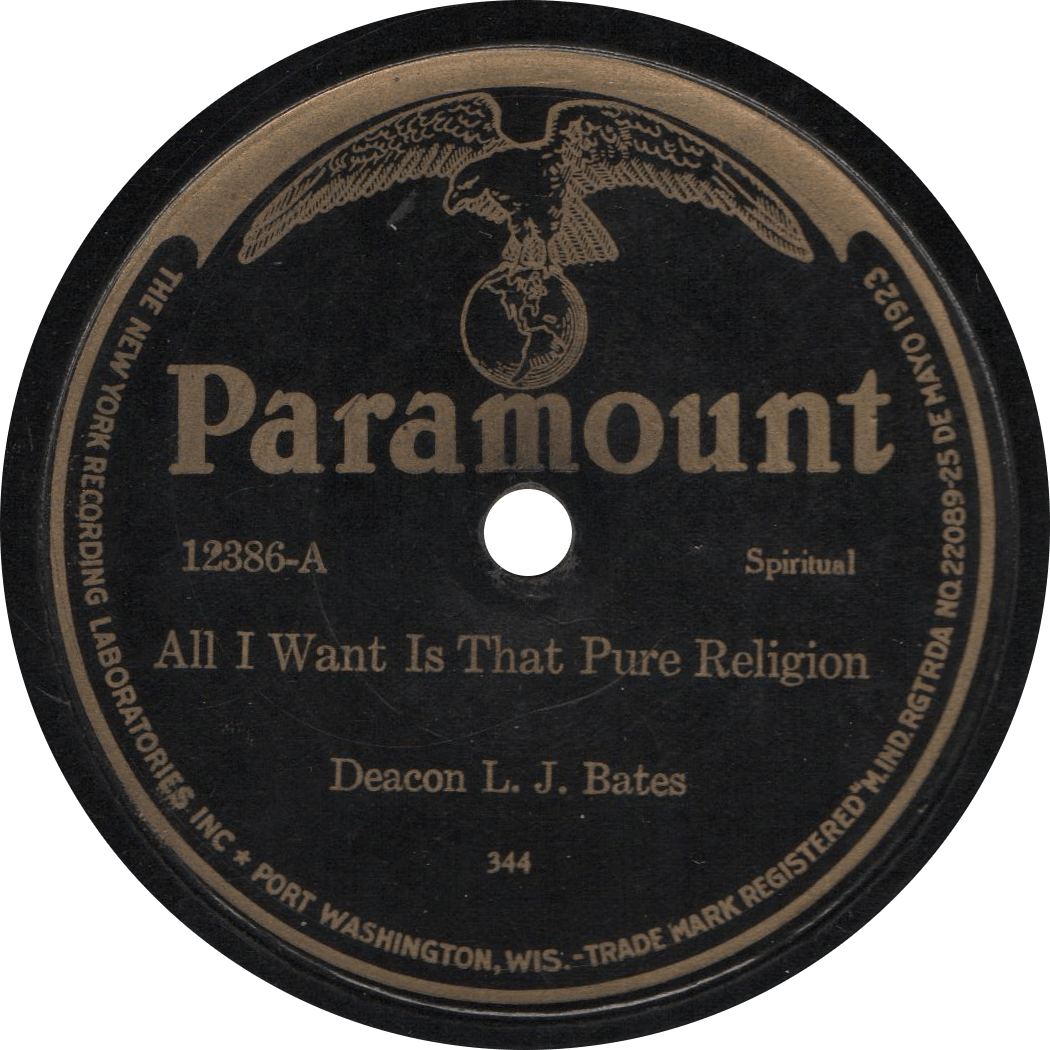
All I Want is That Pure Religion, recorded c. 1925/1926 by Deacon L. J. Bates.

Jefferson delivers a lighter, but no less effective performance of the traditional Negro spiritual “I Want to Be Like Jesus in My Heart” on the flip.  The popular sacred song was also recorded by slide guitarist Crying Sam Collins in 1927.
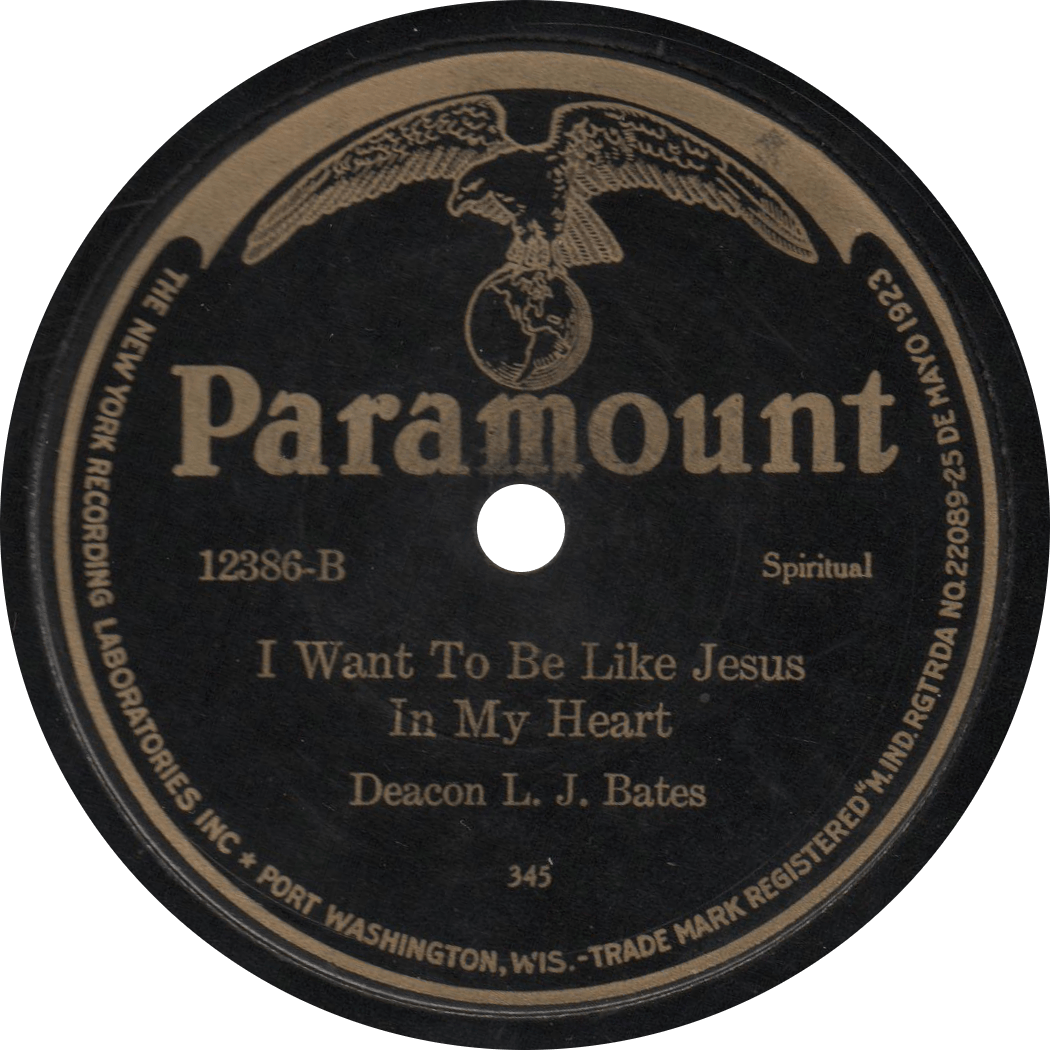
I Want to Be Like Jesus in My Heart, recorded c. 1925/1926 by Deacon. L. J. Bates.

Paramount 12650 – Blind Lemon Jefferson – 1928

Back in the days of 78 RPM, it was not an altogether uncommon sight to find records bearing elaborate and often colorful “picture labels” (not to be confused with picture discs), individuating special releases or records by big-time hit-makers from the hoi polloi.  The Columbia company was perhaps the chief exploiter of this gimmick, issuing special label designs on many discs by their stars Paul Whiteman and Ted Lewis in the 1920s, and one more on their subsidiary Okeh for Seger Ellis.  On the other hand, the New York Recording Laboratory of Port Washington, Wisconsin, manufacturer of Paramount records produced only three such picture labels, which were used for only three different records; the first was in 1924 for their top star “Ma” Rainey, the next for white preacher Rev. J.O. Hanes in 1927, and finally, in 1928, one for their new big moneymaker, Blind Lemon Jefferson.

On a striking bright label of white and (appropriately) lemon yellow—in stark contrast to Paramount’s standard black and gold design—were emblazoned the words “Blind Lemon Jeffersons’ [sic] Birthday Record”.  As to exactly what day it was celebrating, that is not concretely known.  The most commonly agreed upon date attributed to Lemon Jefferson’s birth is September 24, 1893, supported by both the 1900 and 1910 United States censuses, but others have been suggested.  Lemon himself gave a date of October 26, 1894, to one Edward Seaman, registrar of his 1917 draft card, which also seems to be supported by his reported age of twenty-five in the 1920 census.  His 1930 obituary in the Wortham Journal gave his age as forty-five, suggesting he was born as early as 1884.  Others still have proposed a birth date of July 11, 1897.  Some oddities exist surrounding Lemon’s census records, which further complicates matters.  In his entry in the 1900 census, the enumerator, one Leonard Carrier, appears to have reported his birth date as “Sept 24”, with the number written in small print above the month, despite the fact that dates of birth were not recorded in that census, only months, and no other birth dates were recorded for other individuals in the same or adjacent pages.  Why then, did Mr. Carrier seemingly write down the full date of birth for Lemon and only Lemon?  Did he somehow foresee that this six-year-old blind boy would one day be a star, and this information would be valuable one-hundred years from then?  Did Lemon’s mother or father give the full date (which incidentally is the only date or month recorded for the entire Jefferson family) and he decided to write it down for the heck of it, despite no space for it being given?  Or could this errant “24” have some other obscure meaning, perhaps lost to time?  Those are questions which I, at this time, cannot answer.  Perhaps some census expert may have better insight.  The same census also reported Lemon’s name as “Jefferson, Lemmon\Bl”, which has been misinterpreted to mean that Lemon’s real, full name was “Lemmon B. Jefferson”.  That is not the case—in fact, the “Bl” next to his name was to denote his blindness (some censuses contained a separate column to indicate whether the subject was blind, but 1900 did not); so it seems that, at least by the United States federal government, he was already dubbed “Blind Lemon Jefferson” by the age of six.  The anomalous spelling of “Lemmon” can be easily discounted as well, for the census was taken orally and filled out be the enumerator, thus numerous spelling errors are present.  In any event, Lemon’s “Birthday Record” was released to the public in August of 1928, which could be interpreted as belatedly celebrating his July birthday, or preemptively celebrating his September birthday—that is assuming it was not simply a marketing gimmick irrespective of the actual date of his birth, a prospect that may well be the most probable.

Paramount 12650 was recorded circa March and June of 1928, respectively, and was released in August of the same year, with the first advertisement for it appearing in the Chicago Defender on August 4, 1928.

“Piney Woods Money Mama” is one of Lemon;s lyrical masterworks, one of many songs he recorded which appear to be mostly original, rather than drawn from the “floating verse” tradition, as so many blues songs of his day were.  “She got ways like the devil and hair like a Injun squaw; she’s been tryin’ two years to get me to be her son-in-law.”

Piney Woods Money Mama, recorded c. March 1928 by Blind Lemon Jefferson.

On the “B” side, the hoodoo-tinged “Low Down Mojo Blues” is perhaps not as memorable a song as the former, but still a testament to Lemon’s songwriting genius and expressive guitar playing.

Low Down Mojo Blues, recorded c. June 1928 by Blind Lemon Jefferson

Okeh 8455 – Blind Lemon Jefferson – 1927

Blind Lemon Jefferson, circa 1926; as pictured in the Paramount Book of Blues.

In his all-too-brief four year recording career, Blind Lemon Jefferson produced nearly one-hundred songs that helped to define the country blues and open the door for future guitar-slinging blues singers to record their art.  All but one of those records appeared on the Paramount label—a few of which have been examined previously on Old Time Blues—this time around, we turn our attention to the odd one out.

As 1926 turned to ’27. Blind Lemon Jefferson’s recording career entered its second year.  The previous one had seen a bountiful debut, producing a total of twenty recorded songs to his credit (roughly one-fifth of his total recorded output), all for Paramount Records of Port Washington, Wisconsin.  The Texas bluesman was becoming a sensation, and other record companies soon took notice.  It wasn’t long before the Okeh record company—then a subsidiary of Columbia Records and top competitor to Paramount with their extensive catalog of popular “race” records featuring the music of black artists—was the first to act  Early in 1927, Jefferson was contacted by Atlanta-based Okeh representatives Polk C. Brockman (best remembered for orchestrating Fiddlin’ John Carson’s recording debut) and T.J. Rockwell.  They extended an invitation to Jefferson for a recording session in Atlanta, to which he obliged.  The singer arrived at his destination in mid-March, a little later than expected, for Jefferson had made an unplanned stop in Shreveport, Louisiana, as he had never “seen” the city before.  Thus, on March 14, 1927, Lemon Jefferson recorded seven songs for Okeh, and one more the next day.  The first two of those titles were released the following month, comprising Okeh 8455.  When the record began to gain steam on the market, Paramount evidently threatened legal action against Okeh for “poaching” one of their top stars, and as a result, the remaining six sides were never issued.  While the recordings are now presumed lost, what is known of those six songs reveals a rather different character than most of the material he recorded for Paramount.  Of those six titles, “Elder Green’s in Town” was a version of “Alabama Bound”, and “Laboring Man Away from Home” was a rendition of the English ballad “Our Goodman” (also recorded by others as “Cabbage Head Blues” and “Drunkard’s Special”).  “English Stop Time” was an instrumental piece similar to “Buck Dance” pieces recorded by many blues and ragtime guitarists.  “Woman’s Labor Man” (or “Laboring Man Blues”) and “‘Stillery Blues” were evidently original songs never otherwise recorded or published.  When Lemon returned to the Paramount recording laboratory in Chicago the next month, he remade “My Easy Rider” as “Easy Rider Blues”, coupled with a re-recording of “Match Box Blues”.  The company saw to it that Lemon didn’t get away again, and all of Jefferson’s further recordings were for Paramount.

Okeh 8455 was recorded on March 14, 1927, in Atlanta, Georgia, featuring the voice and guitar of Blind Lemon Jefferson.  It was first advertised for sale on April 23 of the same year.

On the “A” side of Okeh 8455, Lemon sings a re-telling of his famous “Black Snake Moan”, one of his more popular Paramount recordings, which he had recorded about five months prior to his Okeh session.

Black Snake Moan, recorded March 14, 1927 by Blind Lemon Jefferson.

The “B” side contains Jefferson’s first recording of another of his most memorable—and most widely covered—hit songs: “Match Box Blues”.  Jefferson subsequently re-recorded two more takes of the soon-to-be blues standard upon his return to Paramount, each one noticeably different than the others.

Match Box Blues, recorded March 14, 1927 by Blind Lemon Jefferson.

Updated on May 12, 2025.

Paramount 12354 – Blind Lemon Jefferson – 1926

A crop of the only known photograph of Lemon Jefferson, circa 1926, as was pictured in the Paramount Book of Blues.

The legendary Blind Lemon Jefferson was renowned for traveling far and wide all across the United States, ranging territories far exceeding that traversed by many of his contemporaries.  His journeys broadened his musical horizons considerably wider than most home-bound musicians and brought him into contact with numerous other blues people, whom he seldom failed to impress.  While many of his contemporaries were confined to their region or state, Lemon achieved national fame through his successful recording contract, and toured all around the country.  As such, he impressed his music on a broad variety of different audiences, and conversely incorporated a broad variety of different musical influences into his own style of playing.

While he may not have “walked from Dallas to Wichita Falls,” Lemon was an institution in his native Texas around his local haunts like Central Track (a.k.a. Deep Ellum) in Dallas, and was said to have taken the interurban train from Denison down to Waco, entertaining passengers along the way, sometimes joined by his friend Huddie Ledbetter.  Lemon was well known around such small towns as Mart, Texas—eighteen miles east of Waco—where he would sit on Main Street for hours on end playing his music for passers-by.  He was a staple at country barbecues and picnics, one of which brought him into contact with the eight-year-old Sam Hopkins, who helped guide him around, and it’s said that he became one of the only people Lemon would allow to play with him.  A similar privilege was afforded to young Dallas-native Aaron “Oak Cliff T-Bone” Walker—purportedly the stepson of Dallas String Band bassist Marco Washington, an associate of Jefferson’s—who was indelibly impressed with the elder bluesman’s style of playing.  Josh White, too, claimed to have spent some time as Jefferson’s lead boy for a brief period in his youth.  In Johnson City, Tennessee, Lemon’s playing attracted the interest of white musician Clarence Greene, who was inspired by Jefferson’s virtuoso blues guitar-picking, showing it particularly in his song “Johnson City Blues”.  Probably through his records, Lemon also impressed his style on white musicians Larry Hensley and Debs Mays, who recorded versions of his “Match Box Blues” and “Rabbit Foot Blues”, respectively, in the middle of the 1930s, following Jefferson’s own demise; both imitated Lemon’s style of playing closely.  Travels in Virginia brought Lemon in contact with ragtime guitarists Stephen Tarter and Harry Gay, who introduced young musician Lesley Riddle to him.  Riddle soon after befriended A.P. Carter, and impressed his blues knowledge on the Carter Family in the next decade.  In 1928, while passing through Minden, Louisiana, Jefferson picked up fellow musician Joe Holmes, traveling with him in Texas for a short period.  Holmes eventually traveled to Wisconsin to record for Paramount as King Solomon Hill, and posthumously eulogized his friendship with Jefferson in the song “My Buddy Blind Papa Lemon”.  He was also eulogized by his old friend Lead Belly in at least four different songs, including his 1935 ARC recording of “My Friend Blind Lemon”, and the eponymous “Blind Lemon”, memorably recounted in the 1976 movie about Ledbetter’s life: “Blind Lemon—oh baby—he’s a blind man!  He doin’ all he can—oh baby—’till he’s travelin’ through the land.”

Paramount 12354 was released with two different sets of masters; original pressings use 2472 and 2471, respectively, recorded at Paramount’s studio in March of 1926, this one uses the later takes—1054 and 1053, though the labels were not altered to reflect it—which were electrically recorded at Marsh Laboratories in Chicago, Illinois around May of the same year.  You may note that both labels erroneously give composer’s credit to “Lemons” Jefferson.

Firstly Lemon delivers one of his most successful numbers: “Long Lonesome Blues”, with that hot bit in the middle in which he busts out the lyrics: “hey, mama mama, papa papa ’deed double do love you doggone it, somebody’s talking to you mama papa ’deed double do love you” (or something to that effect) in double time.  Beginning with the lyrics, “I walked from Dallas, I walked to Wichita Falls” (which were later copped by Bob Wills), this song stood alongside “Match Box Blues”—with which it shares many melodic similarities—as one of Lemon’s best known numbers to his audiences back home in Texas.

Long Lonesome Blues, recorded c. May 1926 by Blind Lemon Jefferson.

“The blues come to Texas, lopin’ like a mule,” Lemon opens his “Got the Blues”, which in later years lent the verse to title Mack McCormick and Paul Oliver’s magnum opus book on the Texas blues.  Echoes of the song can be heard in subsequent Texas blues songs from Texas Alexander’s “Texas Special” to Lightnin’ Hopkins’ “Mojo Hand”.

Got the Blues, recorded c. May 1926 by Blind Lemon Jefferson.

Updated with improved audio on June 30, 2024.

Paramount 12608 – Blind Lemon Jefferson – 1928

The incomparable Blind Lemon Jefferson truly was an artist without parallel.  Having cut his first disc in 1925 or ’26, he was one of the earliest male country blues musicians to record, and the success of his records paved the way for more blues artists to have their music immortalized in wax.  His peculiar yet virtuosic style of singing and guitar playing set him apart from all his contemporaries, and caused him to be seldom imitated (and interestingly, many of his early imitators were white; see Larry Hensley, “Slim Jim” Debs Mays, Roy Shaffer).  Considering both the quality and originality of his work, as well as the volume of his output, it would seem fair to consider Blind Lemon Jefferson one of the greatest heroes of the Texas blues.

Blind Lemon Jefferson, as pictured in the Paramount Book of Blues, 1927.

Like so many early blues people, much of Blind Lemon Jefferson’s life is shrouded in mystery.  He is usually said to have been born in September 24, 1893, though he claimed a date of October 26, 1894, himself.  July of 1897 has also been proffered by some sources, and his obituary suggested he was born about a decade earlier.  He learned to play guitar in his childhood or teens.  As an adult, he weighed about two-hundred-fifty pounds, and has been described as a snappy dresser, always wearing a John B. Stetson hat and a box-back suit from the Model Tailors in Dallas, and conversely as “fat, and a slovenly dresser.”  Lemon reported his profession to census takers in 1920 as a musician, his employer the “general public,” and outside of music he was said to have worked as a wrestler in Dallas.  He played and sang at functions around Freestone County and on street corners, honky tonks, and bordellos in Dallas, most notably on the east end of Elm Street called Deep Ellum, and even on the interurban railway that ran from from Waco north to Denison.  He was known to have worked with Lead Belly, and may have also associated with Washington Phillips and the Dallas String Band.  Like fellow Paramount artists Charley Patton and Blind Blake, only one published photograph of Lemon is known to exist (though at least one phony has been reputed as a second one, and there may well be another authentic but unpublished one in private hands).

As with his life, there is much legend surrounding the demise of Blind Lemon Jefferson.  It’s known that he died on a cold winter day in Chicago—around ten o’clock in the morning on December 19, 1929.  Some claim that he was poisoned by a jilted lover (much like the fate that befell Robert Johnson some nine years later).  Others have supposed that he was robbed of a royalty payment and murdered by a guide hired to help him find his way to the train station.  More reliable accounts suggest that he either died of a heart attack in his car and was abandoned by his driver, or became disoriented trying to find his way through a snowstorm and died from hypothermia.  His death certificate stated “probably chronic myocarditis” (not “acute” as many sources state), supporting the heart attack hypothesis.  In any event, Paramount Records paid for his body’s return to Texas by train, accompanied by Texas piano man Will Ezell, to be buried in the Wortham Negro Cemetery (now called the Blind Lemon Memorial Cemetery).  His funeral was reportedly attended by two or three hundred people, both black and white.  Lemon’s passing inspired a small wave of tributes, and Paramount released a memorial record in his honor, featuring Walter and Byrd singing “Wasn’t it Sad About Lemon” and Rev. Emmett Dickinson’s sermon on the “Death of Blind Lemon”, comparing Jefferson to Jesus Christ.  Had Lemon survived into the folk and blues revival of the 1960s, his impact would likely have been enormous.  Today, Lemon’s grave marker (placed in 1997) bears the epitaph “Lord, it’s one kind favor I’ll ask of you; see that my grave is kept clean.”

The tombstone of Blind Lemon Jefferson in Wortham, Texas, as it appeared eighty-eight years and one day after his death.  Kept clean at the time, as it were.

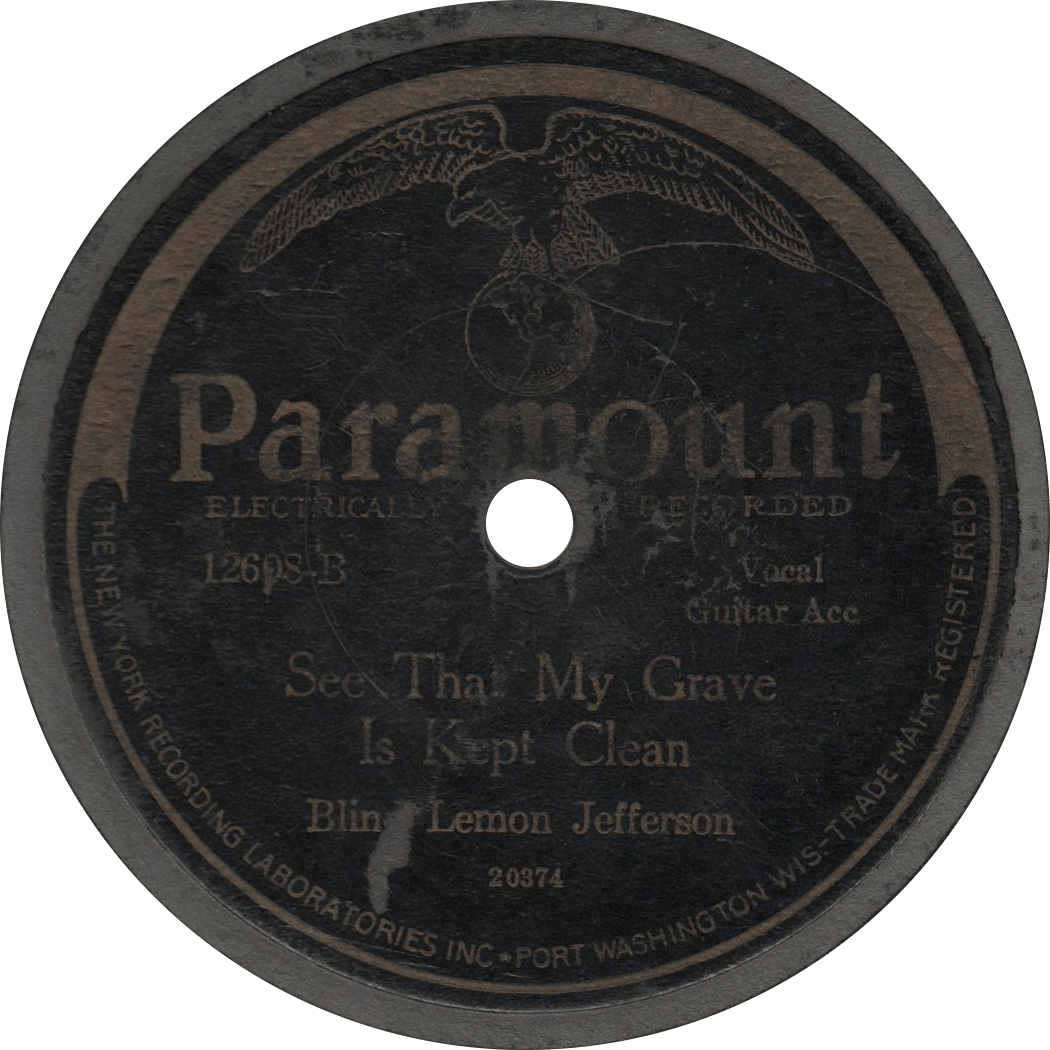
Paramount 12608 was recorded around February of 1928 in Chicago, Illinois, by Blind Lemon Jefferson.  It also appeared on Broadway 5059, though I’m not certain whether or not anyone has ever seen one of those—I know I haven’t.  It was released that March or early April, and first advertised in the Chicago Defender on April 7, 1928.  Prior to its acquisition by the Old Time Blues Collection, this particular battered copy belonged to the collection of the late folklorist Mack McCormick.

Now, I ordinarily prefer not to make posts honoring artists on the anniversaries of their deaths, but rather to celebrate their lives; under the circumstances however, this record seems an appropriate case to make an exception, for it contains Lemon’s legendary “See That My Grave is Kept Clean”.  A folk song apparently of Lemon’s own composition, and sometimes known as “Two White Horses in a Line” (by Joe Evans and Arthur McClain—the “Two Poor Boys”—and John Lee Hooker) or “One Kind Favor” (by Lightnin; Hopkins and others), Lemon first recorded the song in October of 1927, issued on Paramount 12585, backed with “He Arose from the Dead” under his sanctified pseudonym “Deacon L.J. Bates”.  That version was pulled soon after release and replaced with “Where Shall I Be”, while Lemon recorded a new version of “See That My Grave is Kept Clean” several months later, which saw release under his own name on the record you see and hear here.  Son House used the melody for his “Mississippi County Farm Blues”, which he recorded for Paramount in 1930, and many others have since performed and recorded Jefferson’s original.  In 1934, John A. Lomax recorded a bottleneck guitarist named Pete Harris singing the song in Richmond, Texas, under the title “Blind Lemon’s Song”, a testament to the impact of Jefferson’s recording, and in 1952, Harry Smith included the song in his influential Anthology of American Folk Music.  This song, together with “Match Box Blues” and “That Black Snake Moan” could be viewed as a sort of triumvirate of Lemon’s most famous and perhaps most influential songs.

See That My Grave is Kept Clean, recorded February 1928 by Blind Lemon Jefferson.

On the reverse, technically the “A” side, keeping with the rather morbid theme, Lemon sings “‘Lectric Chair Blues”, another excellent blues, even if it lacks the same grandeur as the previous one.  The original Chicago Defender advertisement said of the song: “Salty tears—wet tears—big, round tears—all kinds of tears and heart throbs, and you should put yourself in his place to feel just as blue.  ‘Lectric chair is the next place he’s gonna sit down in, and he ain’t tired either, so he don’t wanta sit down.”

‘Lectric Chair Blues, recorded February 1928 by Blind Lemon Jefferson.

Updated on May 23, 2018, and with improved audio on May 7, 2023.