This occasion’s serenade is provided by the obscure but outstanding string duo of Nap Hayes and Matthew Prater, who play here a couple of snappy rag numbers on mandolin and guitar.
Napoleon “Nap” Hayes and Matthew Prater were a pair of black musicians hailing from Vicksburg, in the heart of the Mississippi Delta. Hayes was likely born in 1885 in West Corinth, Mississippi, and Prater in New Albany in either 1886 or on June 30, 1889. With Hayes on guitar and Prater on mandolin, the two played raggy music in a style not too disparate from that of the Dallas String Band. In February of 1928, they traveled to Memphis, Tennessee to record a total of eight sides for Okeh Records, out of which all but two were issued. Half of those eight featured vocals and violin by Lonnie Johnson (though some sources, including Discography of Okeh Records, cite a different Johnson—T.C. Johnson—who recorded at the same field trip as part of the minstrel-esque trio Johnson-Nelson-Porkchop). Out of those three discs, only one was released in the 8000 “race” series, while the other two were in the 45000 “hillbilly” series. Each record was credited differently, one under their own names as Nap Hayes and Matthew Prater, another as “The Blue Boys”, and one with Johnson as “The Johnson Boys”. Of note, those sides included a piece titled “Easy Winner”, which, despite taking the name of another of his rags, was in fact a take on Scott Joplin’s “The Entertainer”. That session accounted for the entirety of Hayes and Prater’s recorded legacy, and their later lives are as yet undocumented.
Okeh 45231 was recorded February 15, 1928 in Memphis, Tennessee by Nap Hayes and Matthew Prater. Hayes plays guitar, while Prater takes the raggy mandolin. I picked this record up in a junk shop, and it’s not in the most wonderful condition, but it plays quite well in spite of it. Not bad for a record that made the 78 Quarterly’s list of “The Rarest 78s”!
The duo first play a peppy rendition of Scott Joplin’s 1903 rag “Something Doing”, here styled as “Somethin’ Doin'”.
Somethin’ Doin’, recorded February 15, 1928 by Nap Hayes and Matthew Prater.
As an answer to the first tune, on the flip they play the folk rag “Nothin’ Doin'”, a little bluer—and a little cleaner playing—than the previous side. I’m hearing a bit of Lemon Jefferson’s “Black Snake Moan” interpolated in this tune (“oh-oh, honey what’s the matter now”).
Nothin’ Doin, recorded February 28, 1928 by Nap Hayes and Matthew Prater.
Recognized as one of the great luminaries of old time folk music—thanks in no small part to Harry Smith’s Anthology of American Folk Music—is “Dock” Boggs, whose blend of hillbilly style and Afro-American blues and penchant for “lonesome songs” distinguished him as a unique figure in American music, and lent a window into the melancholic soul of a rural artist.
Moran Lee Boggs was born in West Norton, Virginia on February 7, 1898, named after the town doctor who (presumably) delivered him. His father gave him the nickname “Dock” while he was a toddler, and the name stuck, Boggs preferring it over his given name. His music-loving father taught him how to sing, and he soon took up the banjo, which he learned to pick in a clawhammer style he called “knockdown.” The young Boggs also learned folk songs such as “John Henry” from a local black songster called “Go Lightning” who played by the railroad tracks. Other influences included his brother Roscoe, an itinerant musician by the name of Homer Crawford, and his brother-in-law, the Holiness preacher Lee Hansucker, as well as many phonograph records. Like Frank Hutchison and so many of his contemporaries, Boggs was a coal miner by trade, and musician by passion.
In 1927, with a borrowed banjo, Boggs auditioned for the Brunswick-Balke-Collender company at the Hotel Norton. Out of however many auditioned, only Boggs and John Dykes’ Magic City Trio made the cut, and thereafter he traveled to the Brunswick studios in New York City and cut eight sides, which were all issued. After returning to Norton in 1928, Boggs organized a band, calling themselves “Dock Boggs and his Cumberland Mountain Entertainers” and playing at local functions. In spite of his musical success, he was met with opposition from his wife, who wished for her husband to walk the straight and narrow path away from bootlegging, gambling, and the Devil’s music. Two years after his first recordings, Boggs was contracted by music store owner W.A. Myers to record for his remarkably short-lived record label The Lonesome Ace—”Without a Yodel.” For Myers, Dock ventured to Chicago to cut four titles, accompanied by Emry Arthur on guitar, for Paramount Records, who was doing the recording and pressing work for The Lonesome Ace. Those four, including the haunting “Old Rub Alcohol Blues”, were to be the final recordings of his original musical career.
When the Great Depression came on, records sales dropped to near zero, putting the hurt on Boggs’ music career. He had an ill-fated attempt at a radio show in 1930, and in June of 1931, Boggs was offered the opportunity to record for Victor in Louisville, but was unable to raise funds for the journey. He spent the rest of that decade in the coal mines, eventually giving up on his life as in music. After living in obscurity for several decades, Dock Boggs was rediscovered in 1963 by Mike Seeger. Seeger brought Boggs back into music as part of the burgeoning folk revival of the day. He made appearances at such to-dos the American Folk Festival in Asheville, North Carolina and the Newport Folk Festival, and also recorded fairly extensively for Folkways Records. Dock Boggs’ health was in decline by the 1970s, and he died on his seventy-third birthday on February 7, 1971.
Brunswick 118 was recorded on March 10, 1927 in New York City by “Dock” Boggs, accompanied on guitar by G.H. “Hub” Mahaffey, a player in John Dykes’ Magic City Trio. It is Boggs’ first issued record, though his third and fourth recorded sides. Though the condition of this copy is rather lacking, I’ve tried to get the most out of it, as always. These things do tend to be quite scarce nowadays.
First up is “Down South Blues”. Boggs once professed, “lonesome songs always appealed to me.”
Down South Blues, recorded March 10, 1927 by “Dock” Boggs.
On the designated “B” side, Boggs sings what is perhaps his most famous song, “Sugar Baby”, made legendary by its inclusion in Harry Smith’s Anthology of American Folk Music. “What more can a poor boy do?”
Sugar Baby, recorded March 10, 1927 by “Dock” Boggs.
The incomparable Blind Lemon Jefferson truly was an artist without parallel. Having cut his first disc in 1925 or ’26, he was one of the earliest male country blues musicians to record, and the success of his records paved the way for more blues artists to have their music immortalized in wax. His peculiar yet virtuosic style of singing and guitar playing set him apart from all his contemporaries, and caused him to be seldom imitated (and interestingly, many of his early imitators were white; see Larry Hensley, “Slim Jim” Debs Mays, Roy Shaffer). Considering both the quality and originality of his work, as well as the volume of his output, it would seem fair to consider Blind Lemon Jefferson one of the greatest heroes of the Texas blues.
Blind Lemon Jefferson, as pictured in the Paramount Book of Blues, 1927.
Like so many early blues people, much of Blind Lemon Jefferson’s life is shrouded in mystery. He is usually said to have been born in September 24, 1893, though he claimed a date of October 26, 1894, himself. July of 1897 has also been proffered by some sources, and his obituary suggested he was born about a decade earlier. He learned to play guitar in his childhood or teens. As an adult, he weighed about two-hundred-fifty pounds, and has been described as a snappy dresser, always wearing a John B. Stetson hat and a box-back suit from the Model Tailors in Dallas, and conversely as “fat, and a slovenly dresser.” Lemon reported his profession to census takers in 1920 as a musician, his employer the “general public,” and outside of music he was said to have worked as a wrestler in Dallas. He played and sang at functions around Freestone County and on street corners, honky tonks, and bordellos in Dallas, most notably on the east end of Elm Street called Deep Ellum, and even on the interurban railway that ran from from Waco north to Denison. He was known to have worked with Lead Belly, and may have also associated with Washington Phillips and the Dallas String Band. Like fellow Paramount artists Charley Patton and Blind Blake, only one published photograph of Lemon is known to exist (though at least one phony has been reputed as a second one, and there may well be another authentic but unpublished one in private hands).
As with his life, there is much legend surrounding the demise of Blind Lemon Jefferson. It’s known that he died on a cold winter day in Chicago—around ten o’clock in the morning on December 19, 1929. Some claim that he was poisoned by a jilted lover (much like the fate that befell Robert Johnson some nine years later). Others have supposed that he was robbed of a royalty payment and murdered by a guide hired to help him find his way to the train station. More reliable accounts suggest that he either died of a heart attack in his car and was abandoned by his driver, or became disoriented trying to find his way through a snowstorm and died from hypothermia. His death certificate stated “probably chronic myocarditis” (not “acute” as many sources state), supporting the heart attack hypothesis. In any event, Paramount Records paid for his body’s return to Texas by train, accompanied by Texas piano man Will Ezell, to be buried in the Wortham Negro Cemetery (now called the Blind Lemon Memorial Cemetery). His funeral was reportedly attended by two or three hundred people, both black and white. Lemon’s passing inspired a small wave of tributes, and Paramount released a memorial record in his honor, featuring Walter and Byrd singing “Wasn’t it Sad About Lemon” and Rev. Emmett Dickinson’s sermon on the “Death of Blind Lemon”, comparing Jefferson to Jesus Christ. Had Lemon survived into the folk and blues revival of the 1960s, his impact would likely have been enormous. Today, Lemon’s grave marker (placed in 1997) bears the epitaph “Lord, it’s one kind favor I’ll ask of you; see that my grave is kept clean.”
The tombstone of Blind Lemon Jefferson in Wortham, Texas, as it appeared eighty-eight years and one day after his death. Kept clean at the time, as it were.
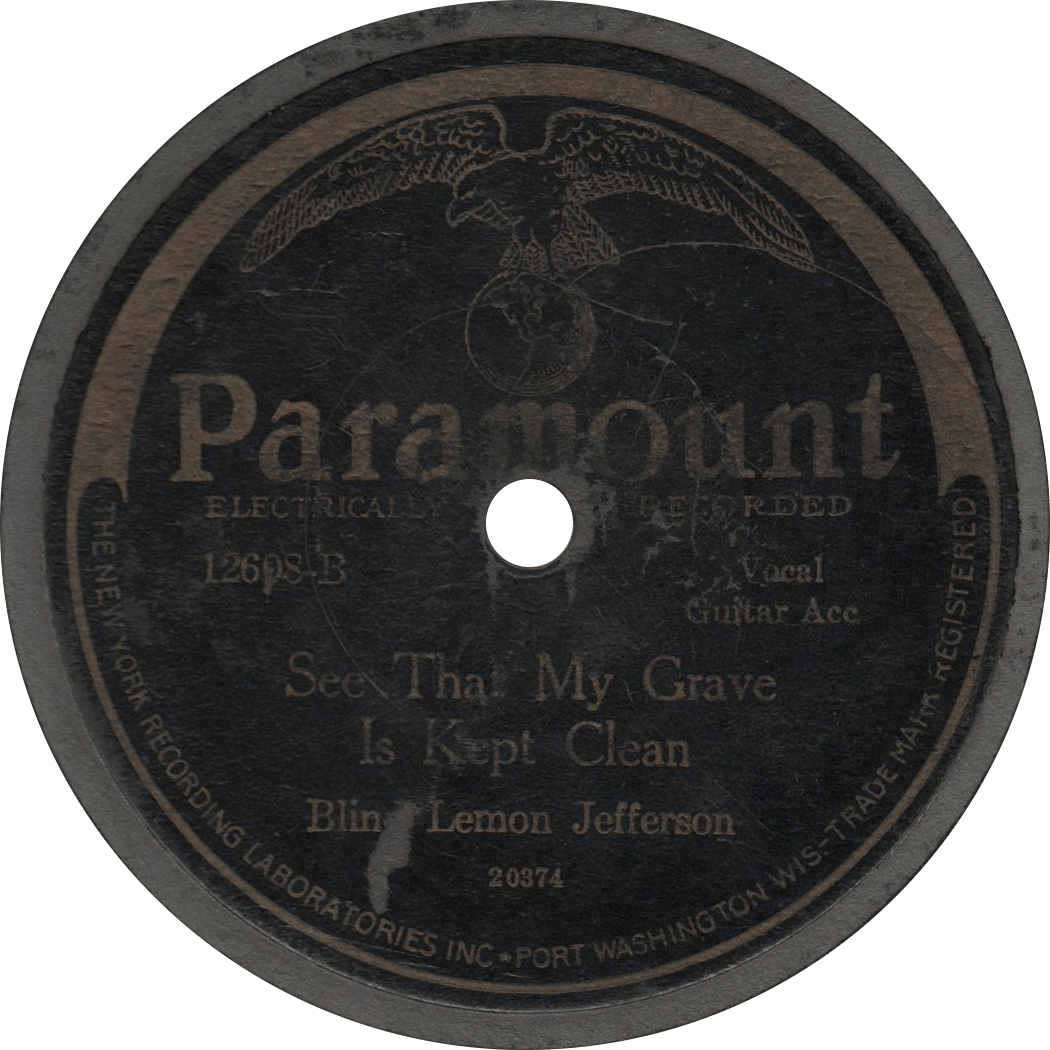
Paramount 12608 was recorded around February of 1928 in Chicago, Illinois, by Blind Lemon Jefferson. It also appeared on Broadway 5059, though I’m not certain whether or not anyone has ever seen one of those—I know I haven’t. It was released that March or early April, and first advertised in the Chicago Defender on April 7, 1928. Prior to its acquisition by the Old Time Blues Collection, this particular battered copy belonged to the collection of the late folklorist Mack McCormick.
Now, I ordinarily prefer not to make posts honoring artists on the anniversaries of their deaths, but rather to celebrate their lives; under the circumstances however, this record seems an appropriate case to make an exception, for it contains Lemon’s legendary “See That My Grave is Kept Clean”. A folk song apparently of Lemon’s own composition, and sometimes known as “Two White Horses in a Line” (by Joe Evans and Arthur McClain—the “Two Poor Boys”—and John Lee Hooker) or “One Kind Favor” (by Lightnin; Hopkins and others), Lemon first recorded the song in October of 1927, issued on Paramount 12585, backed with “He Arose from the Dead” under his sanctified pseudonym “Deacon L.J. Bates”. That version was pulled soon after release and replaced with “Where Shall I Be”, while Lemon recorded a new version of “See That My Grave is Kept Clean” several months later, which saw release under his own name on the record you see and hear here. Son House used the melody for his “Mississippi County Farm Blues”, which he recorded for Paramount in 1930, and many others have since performed and recorded Jefferson’s original. In 1934, John A. Lomax recorded a bottleneck guitarist named Pete Harris singing the song in Richmond, Texas, under the title “Blind Lemon’s Song”, a testament to the impact of Jefferson’s recording, and in 1952, Harry Smith included the song in his influential Anthology of American Folk Music. This song, together with “Match Box Blues” and “That Black Snake Moan” could be viewed as a sort of triumvirate of Lemon’s most famous and perhaps most influential songs.
See That My Grave is Kept Clean, recorded February 1928 by Blind Lemon Jefferson.
On the reverse, technically the “A” side, keeping with the rather morbid theme, Lemon sings “‘Lectric Chair Blues”, another excellent blues, even if it lacks the same grandeur as the previous one. The original Chicago Defender advertisement said of the song: “Salty tears—wet tears—big, round tears—all kinds of tears and heart throbs, and you should put yourself in his place to feel just as blue. ‘Lectric chair is the next place he’s gonna sit down in, and he ain’t tired either, so he don’t wanta sit down.”
‘Lectric Chair Blues, recorded February 1928 by Blind Lemon Jefferson.
Updated on May 23, 2018, and with improved audio on May 7, 2023.
The lovely Miss Lee Morse, pictured in a 1932 publication.
Long before Bill Monroe ever had his Blue Grass Boys, Lee Morse had him beat to the punch, though with music not remotely similar. She sang, she yodeled, she played guitar—what’s not to love?
Lee Morse was born Lena Corinne Taylor on November 30, 1897 to to Pleasant John—a Texas Ranger-turned-traveling preacher—and Olive Taylor, the only girl of twelve children. Her younger brother Glen would go on to be a U.S. Senator of Idaho and run for Vice President in 1948 on the Progressive ticket. She was touted professionally for her Southern upbringing, but she was born Cove, Oregon, though her family did have roots south of the Mason-Dixon Line. She made her professional debut in an Idaho movie house in 1918, and later sang at the 1920 Democratic National Convention in San Francisco. Thereafter, Morse was discovered by vaudeville big shot Will King, and left her domestic life behind for a career in show business, adopting “Lee Morse” as her professional name. Though only five feet and under a hundred pounds, Morse possessed a deep singing voice—much like her younger contemporary Connie Boswell—which recorded well using the acoustical technology that preceded the advent of electric recording, and on her earliest records was credited as “Miss Lee Morse” to ensure that listeners would not confuse her for a male singer. In 1923, Morse signed with Pathé and began making records, staying with them until switching to Columbia four years later. On stage, she appeared in the musicals Hitchy-Koo of 1922, and Artists and Models in 1923. She was slated to appear in 1930’s Simple Simon, but her alcoholism—a problem she may have developed in an effort to combat crippling stage fright—caused her to lose the part to Ruth Etting. On the silver screen, Morse starred in three shorts, two Paramount: A Million Me’s [sic] and Song Service, and one Warner Bros.: The Music Racket, all in 1930. Her career slowed down as the Great Depression killed off record sales, and she switched from Columbia to Bluebird in 1933, making two discs for the fledgling dimestore label, then to Decca in 1938, producing another two. The rest of that decade was largely spent singing in nightclubs to make ends meet. In the 1940s, Lee hosted a local radio program in Rochester, New York, and she made her final phonograph records for Decca in 1950. Lee Morse died suddenly and unexpectedly on December 16, 1954.
Perfect 11580 was recorded on May 7, 1925 in New York City. It was also issued on Pathé 25146. These mid-1920s acoustic Pathé pressings are afflicted with a background rumble as a result of their recording process, which entailed mastering it first on a large cylinder, then dubbing it to a disc. I’ve tried to equalize out most of the rumble without detriment to the quality of the music, I hope the transfers will be pleasing to your ears.
First, Lee sings a jubilant rendition of a “roaring twenties” classic, Gus Kahn and Walter Donaldson’s timeless “Yes, Sir, That’s My Baby”. This is perhaps my personal favorite Lee Morse side, and certainly my favorite version of this song.
Yes, Sir, That’s My Baby, recorded May 7, 1925 by Miss Lee Morse and her Blue Grass Boys.
On the “B” side, Morse sings one of her own compositions, “An Old-Fashioned Romance”, and it’s a darn good one at that! On top of that, what a fine orchestration, topped off with a nice little Chicago-style ride out at the end. Morse recorded this tune again in 1927, after moving to Columbia Records. In my opinion, this one is the better of the two.
An Old-Fashioned Romance, recorded May 7, 1925 by Miss Lee Morse and her Blue Grass Boys.
This disc bears the distinction of being one of the first records (though not the first) whose contents could be considered “country” music. However, the pair of musicians responsible for producing these tunes—Henry C. Gilliland and A.C. “Eck” Robertson—almost certainly were the first old time musicians from Texas to make a record. What you’ll hear here is some of the finest rustic fiddling what am.
Henry Clay Gilliland was born on March 25, 1845 in Jasper County, Missouri. His family relocated to Texas when he was eight years old, settling in Parker County (home of peaches). He learned to play the fiddle at a young age from his older brother Joseph, and the two rose to prominence around Weatherford. When the South seceded, Gilliland enlisted and served in the Arizona Brigade of the Second Texas Cavalry. After the war was done, he returned home and became known as an Indian fighter and small-time politician. Alongside talents such as Moses J. Bonner, Gilliland became one of the most prominent Texas fiddlers of his day.
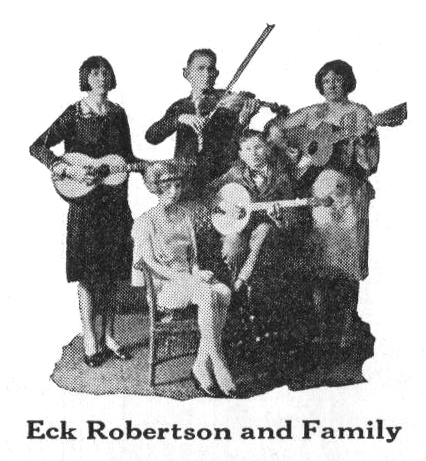
Eck Robertson (back row center, with fiddle) and family. As pictured in 1930 Victor catalog.
Alexander Campbell Robertson was born in Delaney, Arkansas on November 20, 1887 (though his tombstone says 1886). Like Gilliland forty-some years his senior, Robertson’s family moved to Texas in his early childhood, making their home near Amarillo in the panhandle of the state. His father was a fiddler-turned-preacher, and many of the other men in his family were also skilled on the instrument. Unsurprisingly given such a heritage, the young “Eck” soon took up the fiddle himself. At sixteen, he took off to join a medicine show, hoping to win fame as a musician. After marrying and settling briefly in Amarillo as a piano tuner, he went on the road once again to play in fiddle contests and vaudeville shows throughout the Southwest.
The two men crossed paths at a Confederate reunion in 1922 in Richmond, Virginia; Robertson was the son of a veteran, Gilliland was a veteran himself. Together, they played before a crowd of some four-thousand at the convention. The two fiddlers evidently hit it off, and, with aid from a friend of Gilliland’s in a high place, very soon after traveled to New York to make a record for the Victor Talking Machine Company. On June 30, 1922, the duo cut four sides, starting with “Arkansaw Traveler”, which, coupled with “Sallie Gooden” (Victor 18956) is often credited as the first “country” music record (though it is debatably not). The following day, Robertson returned to the studio alone to make six more solo recordings. Six of those ten sides saw release, only two of which featured Gilliland. Henry C. Gilliland died on April 21, 1924 in Altus, Oklahoma at the age of seventy-nine, and was thereafter memorialized as the “greatest fiddler in the world.” Eck Robertson on the other hand continued to perform and record.
In 1929, the Victor company twice ventured into Dallas to record the local talent, and Eck returned to the studio, this time bringing his family along: wife Nettie, son Dueron, and daughter Daphne. In four sessions that year—one in August and three in October, the last of which was only nine days before the stock market crash that would all but kill off such recording field trips —Robertson recorded a further fourteen sides, five solo, nine with his family, and two with fellow fiddler Dr. J.B. Cranfill (seemingly the same man as the noted Dallas prohibitionist James Britton Buchanan Boone Cranfill, though I can’t find definitive confirmation), which altogether yielded a total of ten issued sides. From then on out, he maintained that Victor had given him the short end of the stick. Robertson also performed on Fort Worth’s WBAP from time to time, and he made a reported hundred non-commercial recordings for the Sellers transcription company of Dallas in September of 1940, which appear to be lost today. Eck Roberton died on February 15, 1975 at age of eighty-eight, in Borger, Texas.
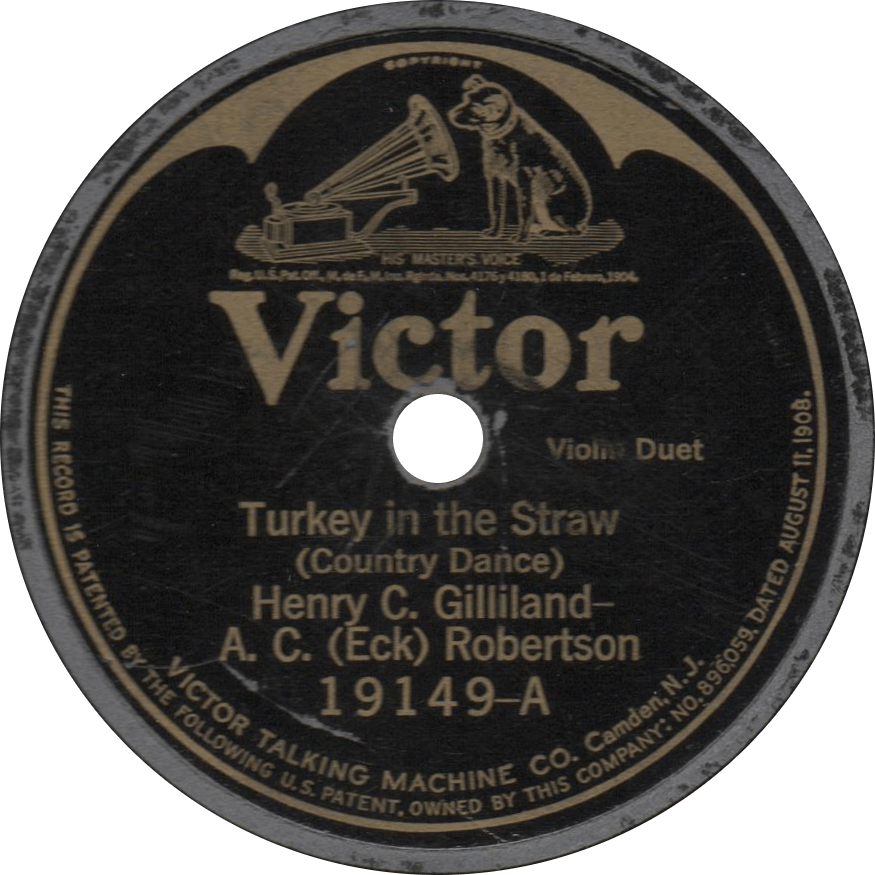
Victor 19149 was recorded on June 30 and July 1, 1922 in New York City, the former being their first session. It was released on November 30, 1923, and remained in the catalog until 1936. I found this record in Mineral Wells, Texas, not far from Gilliland’s home town of Weatherford; perhaps it was his own personal copy. Unlikely a prospect as that is, it is conceivable that it could have been owned by someone personally acquainted with him.
First, both Robertson and Gilliland play a fiddle duet on the classic “Turkey in the Straw”. Listen closely to the end for a little artifact from the recording studio: a small “bump”. Could be one of the men setting down his instrument, could be something else entirely.
Turkey in the Straw, recorded June 30, 1922 by Henry C. Gilliland–A. C. (Eck) Robertson.
Next, Eck plays solo on another old time classic, the traditional Texas fiddle tune “Ragtime Annie”. Ladies and gentlemen, this is truly old time fiddling.
Ragtime Annie, recorded July 1, 1922 by A. C. (Eck) Robertson.