Okeh 40188 – Jack Linx and his Society Serenaders – 1924

In another installment in Old Time Blues continuing series on territory jazz bands, let us turn our attentions to a hot little group from deep down south: Jack Linx’s Society Serenaders.

Scarcely any information seems to be available regarding Jack Linx and his Society Serenaders.  Based in Birmingham, Alabama, they formed in the first half of the 1920s and played gigs around town.  In 1924, they traveled to Atlanta for the first of several sessions for the Okeh record company.  They returned to Atlanta every subsequent year until 1927—twice in 1925.  In that three year recording career, they cut a total of twenty-three sides for Okeh—including jazz standards like “Tiger Rag” and “Sweet Georgia Brown”, and original compositions like “Don’t You Try To High-Hat Me“—of which all but four were released.  When the Starr Piano Company brought their Gennett mobile recording laboratory down to Birmingham, Linx’s band cut three more sides, though all were rejected, this time calling themselves the “West Lake Ramblers”.  In 1929, the band secured a position as the house band of Birmingham’s stately new Thomas Jefferson Hotel and adopted the name “Jeffersonians” accordingly, and they played on local radio station WAPI the same year.

Okeh 40188 was recorded in Atlanta, Georgia on August 28, 1924 by Jack Linx and his Society Serenaders, their first released record from their first session, consisting of their second and third recorded sides.  It was also released in the United Kingdom on Parlophone E 5263.  The Society Serenaders consist of Coleman Sachs on cornet, Jack Linx on clarinet, soprano sax, and alto sax, Sidney Patterson on clarinet and alto sax, Seibert Traxler on clarinet, tenor sax, and baritone sax, Eph Tunkle on piano, Maurice Sigler on banjo, Frank Manning on tuba, and Carroll Gardner on drums.

First up, they play hotter than you might expect from a band called the “Society Serenaders” on an out-of-this-world rendition of Wendell Hall’s hit “It Ain’t Gonna Rain No Mo'”, with a low-down and slightly raunchy vocal by banjoist Maurice Sigler.  Interestingly, it seems to be the only side they recorded to have a vocal.

It Ain’t Gonna Rain No Mo’, recorded August 28, 1924 by Jack Linx and his Society Serenaders.

On the “B” side, they play the Art Kassel and Mel Stitzel novelty composition “Doodle Doo Doo”—which served as the theme song for the former’s Chicago-area band—featuring a dandy rag-style piano solo by Tunkle.

Doodle Doo Doo, recorded August 28, 1924 by Jack Linx and his Society Serenaders.

Updated with improved audio on July 1, 2023.

Okeh 40339 – Jack Gardner’s Orchestra – 1924

In Old Time Blues’ continuing series honoring the musical heritage of Texas, we pay due tribute to the bandleader whose orchestra bears the distinction of producing the earliest commercial recordings made within the borders of the Lone Star State: the Dallas-based pianist and songwriter Jack Gardner.

Jack Gardner and his Orchestra, pictured on 1925 sheet music for “Dallas, I Love You”.

Jack was born Francis Henry Gardner on August 14, 1903, in Joliet, Illinois.  He took up playing piano while a young boy, and began playing professionally after the family relocated to Denver, Colorado, reportedly appearing with Boyd Senter’s band.  He was also a competent and relatively prolific songwriter best remembered for the 1927 hit “Bye-Bye, Pretty Baby”.  Many sources state that Gardner moved to Chicago in 1923 and remained there until 1937, but, unless there were two different pianists named Jack Gardner, that cannot be accurate as at least in the middle years of that decade, he was director of the house band at the stately Adolphus Hotel in Dallas, Texas. (Editor’s note: as it turns out, there were two Jack Gardners, so this article is inaccurate.  Please take it with a grain of salt, it will be rewritten in due time!)  When Ralph S. Peer of the Okeh record company brought mobile recording equipment to a dealer’s warehouse in Dallas in 1924, Gardner and his orchestra had the special privilege of being the first to make commercial recordings in the state of Texas.  Upon Okeh’s return to Dallas the following year, his orchestra had another session, this time introducing the talent of local singer Irene Taylor, who would later go on to be featured by the most popular orchestra in the United States: Paul Whiteman’s.  Gardner may have been in Chicago as early as the end of 1925, at which time he is suggested as a possible instrumentalist with Fred Hamm’s orchestra, one of a number of groups managed by Chicago impresario Edgar A. Benson.  He had definitely made it to the toddling town by 1928, at which time he began sitting in with jazz bands such as those of Wingy Manone and Jimmy McPartland.  In 1939, Gardner went to New York City to assume the role of pianist first with Sandy Williams, then in Texas-raised trumpeter Harry James’s orchestra, a position which he held for around a year before returning to Chicago.  After an active period there, Jack Gardner returned to Dallas, where he remained until his death on November 26, 1957.

Okeh 40339 was recorded around the middle of October of 1924 (though Brian Rust’s Jazz and Ragtime Records suggests September), in Dallas, Texas, the Gardner band’s first session.  Though the orchestra’s personnel is only tentatively identified, it probably includes at least some of the following members: Johnnie Mills and Charlie Willison cornets, Stanton Crocker on trombone, Robert B. Dean, Robert K. Harris, and Bernie Dillon on reeds, Jack Gardner on piano, Earl D. McMahan on banjo, Ralph W. “Cricket” Brown on tuba, and Bob Blassingame on drums.  Dillon White sings the vocal on side “A”, and may also be an instrumentalist.

First, Dillon White sings the vocal on “Who? You?”, one of Jack Gardner’s own compositions.  I must admit that White’s vocal gives me a little chuckle every time I listen to it (“Who? Yoouu!“), but that band sure could play!

Who? You?, recorded c. October 1924 by Jack Gardner’s Orchestra.

They follow with a wild, eccentric jazz tune, another Gardner original: “Who’d a Thunk It”.  One thing you can say for certain: the folks in Texas did like their jazz played hot!

Who’d a Thunk It, recorded c. October 1924 by Jack Gardner’s Orchestra.

Okeh 8300 – Louis Armstrong and his Hot Five – 1926

Louis Armstrong around the age of nineteen, circa 1920. Pictured in Jazzmen, 1939.

As the anniversary of the day the great Louis Armstrong was born rolls around once again, it’s come time to commemorate the occasion with another page from musical history.  Previously, we’ve examined his theme song, his original Hot Five’s last recordings, and his 1933 European tour.  Now let us turn our attention to an earlier point in old Satchel Mouth’s illustrious career, toward one of the most memorable records from his first endeavor as the leader of a band.

After Louis Armstrong parted ways with his mentor King Oliver’s Creole Jazz Band in 1924, he was invited to New York City for a seat in Fletcher Henderson’s orchestra, the top black dance band in operation, making his first records with them on October 7, 1924.  He remained with Henderson for only a year, but in that time helped produce some of the band’s greatest musical successes.  Thereafter, he returned to Chicago and started up a band of his own: the Hot Five, featuring the extraordinary talents of Johnny Dodds, Kid Ory, Johnny St. Cyr, and his wife Lil, sometimes joined by guests like Lonnie Johnson.  He secured a contract with Okeh Records, for whom he had recorded as a member of Oliver’s Jazz Band, and the Hot Five made their first three recordings on November 12, 1925.  In addition to his bandleading, Armstrong also worked as something of a staff trumpeter at Okeh, often backing blues singers like Bertha “Chippie” Hill.  Though his contract forbade him from making records under his own name on other labels, he occasionally made clandestine ventures to other companies; the Hot Five cut one record for Vocalion as “Lill’s Hot Shots”, and Armstrong sat in for a session with Erskine Tate’s Vendome Orchestra.  Nonetheless, his contract proved to be quite fruitful, for Armstrong remained on Okeh’s roster—sometimes expanding the Hot Five to the Hot Seven, and later fronting full-fledged orchestras—until the middle of 1932, at which point he left the faltering label in favor of recording for Victor, which had managed to stay afloat as the Great Depression took its heavy toll on the record companies.

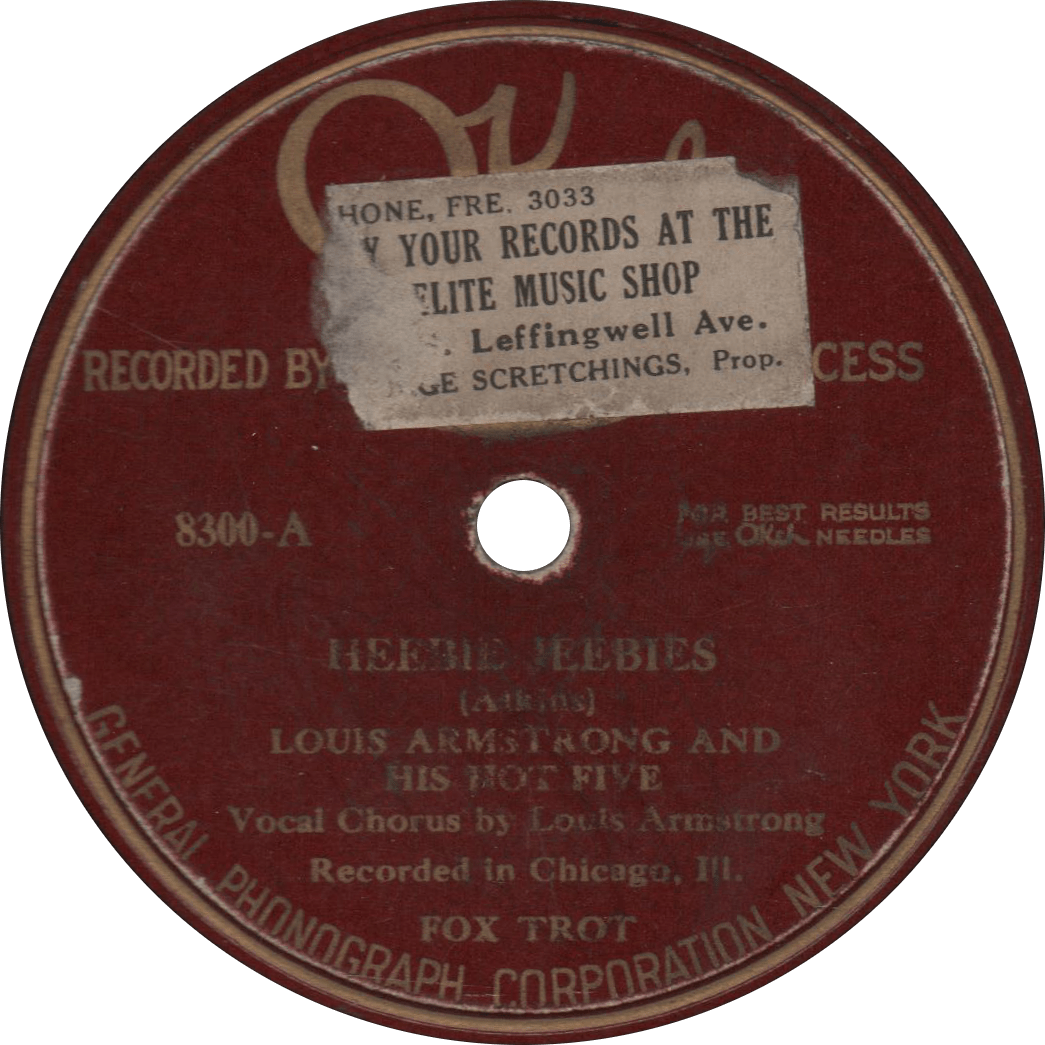
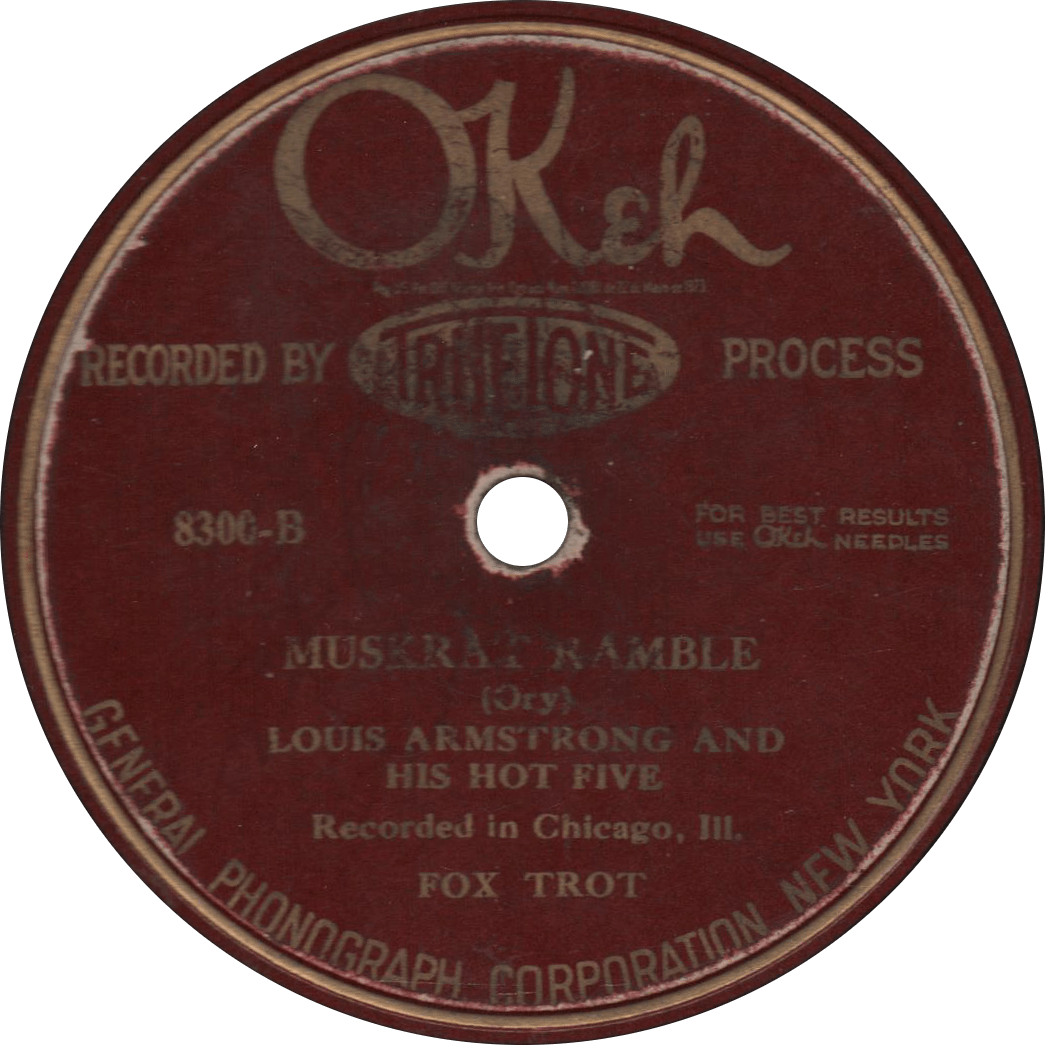
Okeh 8300 was recorded on February 26, 1926 in Chicago, Illinois, at the Armstrong’s Hot Five’s third session.  The Hot Five is its original lineup of Louis Armstrong on cornet, Kid Ory on trombone, Johnny Dodds on clarinet, Lil Armstrong on piano, and Johnny St. Cyr on six-string banjo.

First up is “Heebie Jeebies”, most certainly the definitive version of this tune, which we last heard played by Fess Williams’ Royal Flush Orchestra.  Armstrong’s recording of this popular jazz tune is frequently cited as one of the most influential early examples of scat singing.  According to Richard M. Jones, Armstrong’s famous scat chorus began because his lyric sheet fell off his music stand and he couldn’t remember the words.  That story is likely pure fiction, though Armstrong did blurt out “I done forgot the words” in his scat chorus on his 1930 recording of “(I’m a) Ding Dong Daddy from Dumas”.

Heebie Jeebies, recorded February 26, 1926 by Louis Armstrong and his Hot Five.

Next up is the the first ever recording of Kid Ory’s hot jazz standard, “Muskrat Ramble” (sometimes titled “Muskat Ramble”, and occasionally “Muskrat Scramble”, which I imagine as quite a terrible egg dish).

Muskrat Ramble, recorded February 26, 1926 by Louis Armstrong and his Hot Five.

Updated with improved audio on June 23, 2024.

Victor 19813 – Carl T. Sprague – 1925

It’s come time we heard again from one of my favorite cowboy singers: Carl T. Sprague.  This is a record that I’ve had since my earliest days of collecting, one of about a hundred that I inherited from my great-great-grandfather.  As such, it’s been in my family since its original purchase in 1925.  Like many of that bunch however, the condition leaves something to be desired.  I’ve been searching fruitlessly for a replacement copy for some time, but as of yet no cigar.  (If you happen to have a copy you’re looking to get rid of, let’s talk.)  It escaped my interest for a long while after it arrived in my possession; before I’d listened to it, I assumed it was just a run of the early vocal record like all the Henry Burr and John Steel and whatnot that the old folks seemed so fond of.  Once it finally made its way onto my turntable, I realized I had been missing out.  It piqued my interest in old folk music and introduced me to Carl T. Sprague.  I later delved deeper to uncover more about the history of both songs, and became even more enthralled.  Suffice to say, it’s since become one of my favorite folk music records.  Both songs were popular comical songs in the second half of the nineteenth century, and both were scarcely recorded in the next century.  Though Sprague is credited on the labels as composer of both sides, the songs actually predate his birth by quite a few years.  Both were originally published on broadside song sheets, as was common practice in the several centuries preceding 1900.

Since original publication, I was finally able to procure a near mint copy of this record upgrading from my previously rather lacking one, so I have updated the audio and label scans accordingly.

Victor 19813 was recorded in Camden, New Jersey on August 3 and 5, 1925.  It was released in December of that year, and cut from the catalog in 1928.  They are among the earliest electrical recordings made, only a few months after Victor introduced their new process.  The Discography of American Historical Recordings notes Victor’s “Special Booklet 1925” as a source.  I’m not entirely sure what that means, but it’s possible that this record never saw widespread release.  Obviously staples of his repertoire, Sprague re-recorded both these sides in 1972 for his eponymous LP.

First, is Sprague’s first recorded side, “Kisses”, a song which dates back to the days of broadside song sheets.  It was originally published in 1882 as “Sock Her on Her Kisser”.  Another version was recorded in 1941 by Lewis Winfield Moody for the Library of Congress by Robert F. Draves, under the title “Everybody Has a Finger in the Pie”.  Chubby Parker of WLS recorded a version of the song as “The Kissing Song” in 1931.  Canadian folklorist MacEdward Leach collected a version of the song as “Turtle Dove” in Newfoundland in 1951.  The DAHR makes note that a re-make (take “5”) of “Kisses” was recorded on June 22, 1926; this take appears to be the originally issued one (“3”).  Sprague’s 1972 re-recording of the song was titled “Kissing”.

Kisses, recorded August 3, 1925 by Carl T. Sprague.

On “B”, Sprague sings another popular humorous ditty titled “The Club Meeting”, also known as “I’ve Only Been Down to the Club”, seemingly the first of only a very few recordings of the song.  Like the previous, this song was originally published on a broadside; it appears to have been originally published by E.H. Harding of New York in 1876, words and music by Joseph P. Skelly, also known for the memorable 1884 song “A Boy’s Best Friend is his Mother”, recorded by Vernon Dalhart and others.  Al Hopkins’ Buckle Busters (a.k.a. Hill Billies) recorded the song as “Down to the Club” in 1927 for Brunswick, the lyrics to which were transcribed and printed in the songbook “The Roaming Cowboy”, Book No. 2, published by the “border blaster” radio station XEPN of Piedras Negras, Coahuila, Mexico in the mid-to-late 1930s.  Another version was sung by Sam Bell of Tuolumne County, California for the Library of Congress in 1939, recorded by Sidney Cowell Robertson.  Additional recordings were made by Walter Coon for Gennett in 1930 as “The Club Had a Meeting” and Billy Vest for Columbia in 1931 as “The Club Held a Meeting”, but neither were released.

The Club Meeting, recorded August 5, 1925 by Carl T. Sprague.

Columbia 15038-D – Charlie Poole Accomp. by The North Carolina Ramblers – 1925

Unquestionably one of the foremost names in “old-time” music during the 1920s, as well as one of the leading figures in the development of what would eventually come to be known as “country music” is the original North Carolina Rambler: Charlie Poole.

Charlie Poole (left) with the North Carolina Ramblers, pictured in 1928 Columbia “Familiar Tunes” catalog.

Charlie Clay Poole hailed from Randolph County, North Carolina, in the town of Franklinville, where he was born on March 22, 1892, the son of an Irish immigrant.   As did his parents before him, Charlie went to work in a textile mill, but his real interest was in making music.  Unable to afford a proper instrument, he fashioned his first banjo out of a gourd.  As the result of a childhood incident in which he bet friends that he could catch a baseball without wearing a mitt, he learned to play the instrument in a unique three-fingered style of picking.  In addition to his musical proclivities, Poole also had a reputation as a rounder and hell raiser supreme.  After years toiling away his youth in the mill, Poole saved up enough money to purchase a Gibson banjo, then quit his job to pursue a career as a musician.  Joined by his brother-in-law Posey Rorer, who played fiddle, and a host of other local musicians, he entertained at local functions.  With the addition of guitarist Norman Woodlieff, the trio traveled to New York City in July of 1925 to make their first records for Columbia as the “North Carolina Ramblers”, producing four sides for which they received seventy-five dollars pay.  Their first record turned out to be a hit, and Poole, along with Gid Tanner’s Skillet Lickers, helped to make Columbia into a powerhouse of old-time music in the genre’s earliest years on record, and he was one of the best-selling artists in their “Old Familiar Tunes” series.  Thereafter, the North Carolina Ramblers returned to New York once a year—twice in 1930—to make further records, with two excursions to Paramount and Brunswick on the side, ultimately resulting in a total of eighty sides cut, of which all but ten were released.  Membership within the band changed as years passed; Woodlieff was replaced with former railroad engineer Roy Harvey, and Lonnie Austin and Odell Smith came to take Rorer’s place, but Charlie Poole always remained constant as the North Carolina Ramblers’ nucleus and main attraction (though members of the group did make several records without him).  Aside from recording, the North Carolina Ramblers also toured Vaudeville and appeared on radio around the Appalachian region.  After his last recording session, Poole and band were invited to Hollywood to provide music for a Western movie in 1931.  Unfortunately, before leaving for the west, Poole suffered a heart attack and died at the age of thirty-nine on May 21, 1931.

Columbia 15038-D was recorded on July 27, 1925 in New York, New York.  Sales figures have been reported as an astounding 102,451 copies.  It is Charlie Poole’s first released record, consisting of his third and fourth recorded sides.  The North Carolina Ramblers are Posey Rorer on fiddle, Norman Woodlieff on guitar, and of course Poole on the banjo.

First, Poole sings what could probably be considered the definitive recording of the old folk song “Can I Sleep In Your Barn Tonight Mister”.

Can I Sleep in Your Barn Tonight Mister, recorded July 27, 1925 by Charlie Poole Accomp. by The North Carolina Ramblers.

On the reverse, they play another definitive rendition, this one of the classic “Don’t Let Your Deal Go Down Blues”—one of my personal favorites of the North Carolina Ramblers’ recordings—referring to the card game called “Georgia skin”, a game of chance popular in the South in those days, both for playing and singing about.

Don’t Let Your Deal Go Down Blues, recorded July 27, 1925 by Charlie Poole Accomp. by The North Carolina Ramblers.

Updated with improved audio on June 9, 2025.