It has come time once again to pay tribute to a legend lost, to the greatest of them all, America’s Blue Yodeler, and the Father of Country Music: Jimmie Rodgers. At the time of this posting, it has been eighty-five years to the day that Jimmie walked through those pearly gates, a victim of the white plague at only thirty-five years old.
In the wake of Jimmie Rodgers’ tragic demise, numerous songwriters published melodies eulogizing him. Among the most successful of these were Bob Miller’s “The Life of Jimmie Rodgers” and “The Death of Jimmie Rodgers”, recorded by Gene Autry and Bradley Kincaid, the latter of whom also sang “Mrs. Jimmie Rodgers’ Lament”, composed by Rich Kuster. But those were far from the only ones. Songwriters Dwight Butcher and Lou Herscher, who had collaborated with Rodgers in composing “Old Love Letters”, which Jimmie cut at his last session, penned the popular “When Jimmie Rodgers Said Goodbye”, recorded by a fair number of artists, including Autry and radio yodeler Kenneth Houchins, and by Grand Ole Opry performers Asher Sizemore and his son Little Jimmie under the title “Little Jimmie’s Goodbye to Jimmie Rodgers”. Three years after Rodgers’ passing, Ernest Tubb made his recording debut backing Mrs. Jimmie Rodgers (the former Carrie Williamson) on a weepy performance of “We Miss Him When the Evening Shadows Fall”, then he sang “The Last Thoughts of Jimmie Rodgers” and “The Passing of Jimmie Rodgers” himself. Even decades later, Rodgers was still being honored in song by devotees such as Tubb and Hank Snow, two of the countless many whose lives his music had touched.
Vocalion 02605 was recorded on October 11th and 10th, 1933, respectively, in Chicago, Illinois. The Light Crust Doughboys are Herman Arnspiger and Leon Huff on guitars, Sleepy Johnson on banjo, Leon McAuliffe on steel guitar, and Ramon DeArman on string bass. Leon Huff provides lead vocals. W. Lee O’Daniel was there, too, but he didn’t do anything on this record.
Opening out with a guitar run reminiscent of Rodgers’ signature style, Leon Huff sings and yodels W. Lee O’Daniel’s own tribute to the Blue Yodeler, “Memories of Jimmy [sic] Rodgers” (though either he or the record company misspelled Rodgers’ name).
Memories of Jimmy [sic] Rodgers, recorded October 11, 1933 by the Light Crust Doughboys.
Lightening up considerably from the more solemn tone of the previous song, the Doughboys sing a humorous number poking a little fun at the Depression on the flip, “I Want Somebody to Cry Over Me”, punctuated by Sleepy Johnson’s tenor banjo.
I Want Somebody to Cry Over Me, recorded October 10, 1933 by the Light Crust Doughboys.
The Boswell Sisters in 1930 or early 1931. Pictured on the sheet music cover for “Roll On, Misissippi, Roll On”.
It seems that it’s been far too long since we last heard from our good friends the Boswell Sisters. I try to give both the sisters’ works and Connie’s solos equal attention in accordance with the fairness doctrine, and it’s already been more than a year since I last posted one of the trio’s records, so here are those syncopating harmonists from New Orleans with one of their earliest records.
The years of 1929 and ’30 saw the Boswell Sisters on the West Coast. They had settled in Los Angeles following a vaudeville tour of the States, residing in an apartment at El Pueblo Court in Hollywood. They became popular local radio artists, even recording around fifty titles for a series of transcription discs made by the Continental Broadcasting Corporation to be shipped out for broadcast in Hawaii. They also “side-miked” for some motion pictures, to have their voices dubbed over those of movie actors that couldn’t sing, notably for the number “Harlem Hop” in the film Under Montana Skies. In 1930, they hadn’t made a commercial record in five years, not since their first one made in New Orleans in 1925, but that was soon to change. That July, the sisters teamed with Jackie Taylor’s Los Angeles-based dance band to record two sides, “We’re On the Highway to Heaven” from Oh Sailor Behave and “That’s What I Like About You”, though only the former was released. Later, that October, Okeh recorded them solo, singing four songs including the first commercial take of their signature song “Heebie Jeebies”. All four sides were released, essentially constituting the beginning of their solo recording career. Not long after, with Harry Leedy hired as their manager, they moved to New York and began their fruitful engagement with Brunswick, often accompanied by the Dorsey Brothers’ Orchestra, that resulted in their vibrant and prolific legacy.
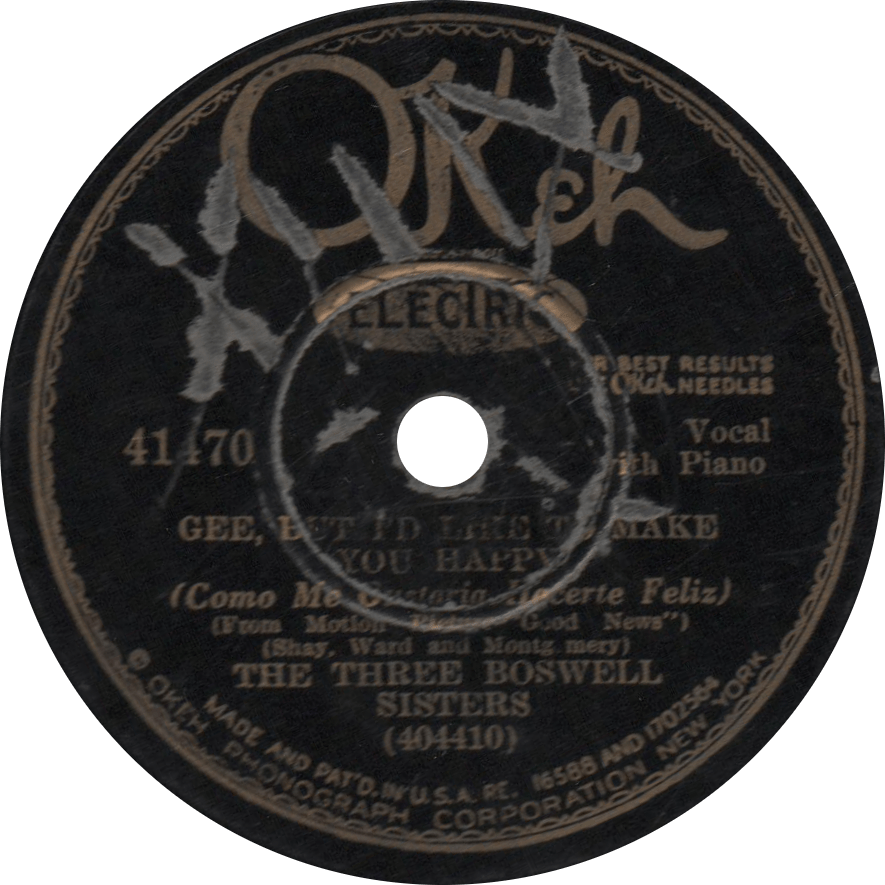
Okeh 41470 was recorded on October 3 and 31, 1930 in Los Angeles, California, the second of their two Okeh records. The instrumentation consists solely of Martha Boswell’s piano and the trio’s vocal effects. This is the pure, unadulterated Boswell Sisters sound of their early days, before the influence of manager Harry Leedy, record bigwig Jack Kapp, and their ilk.
On the first side, the Bozzies sing “Gee, But I’d Like to Make You Happy” from the musical picture Good News (it was written for the movie and did not appear in the 1927 stage production).
Gee, But I’d Like to Make You Happy, recorded October 3, 1930 by The Three Boswell Sisters.
On the flip, recorded at the later date, they sing one of my favorite Boswell performances, “Don’t Tell Her What’s Happened to Me”, rendered as “Don’t Tell Him“.
Don’t Tell Her What’s Happened to Me, recorded October 31, 1930 by The Three Boswell Sisters.
Today’s platter dates to the postwar 1940s, a little past Old Time Blues’ typical era but nonetheless deserving of attention. It is of the western swing variety, played by a fairly obscure group on a small West Coast label. I’ve had this disc since I first started out collecting records; it belonged to a bunch that originally belonged to my great grandmother and her father.
Leodie Jackson was born May 20, 1926 in Blocker, Oklahoma, one of three children of Bennie and Zella Jackson. He learned to play steel guitar, and with his brother Leon started his first band in Oklahoma, playing local dances. Like so many of his fellow Okies in the Dust Bowl era, he had relocated to California by the middle of the 1940s, where he found success as a steel guitarist. Jackson formed his own band, the Swingsters, sometime in the mid-1940s and recorded for the Courtney label in Los Angeles. He was featured in advertising for Bigsby Electric Guitars in 1949. He seems to have returned to Oklahoma by the 1960s, and he married Catherine Housley there in 1968. Jackson died September 20, 1995 in McAlester, Oklahoma.
Courtney 137 was recorded at 1424 East 78th Street in Los Angeles, California in mid-1946—possibly around June or July. The exact recording date is unknown, at least to me. It was listed in the August 1946 issue of Billboard in the Advance Record Data column, listed as “generally approximately two weeks in advance of actual release date.” The band includes Terry Fell on guitar, Leodie Jackson on steel guitar, Kenny Williams on vocal, and an unknown bassist, fiddler, pianist, and drummer. Interestingly, two different versions of Courtney 137 were issued, with different takes, and labels. “That Naggin’ Wife of Mine” was also issued on Courtney 230 (incorrectly numbered as 130) with the artist listed as Lucky White and his Dude Ranch Boys.
First, the Swingsters swing “That Naggin’ Wife of Mine”. The copyright for this tune was registered by Leodie Jackson on August 8, 1946, perhaps giving some indication of when it was recorded. The song gained a certain degree of popularity, and another version was recorded by Fairley Holden for King Records in 1949 (with Holden claiming authorship of the tune), and a number of further times by others.
That Naggin’ Wife of Mine, recorded 1946 by Leodie Jackson and his Swingsters.
On the reverse, the Swingsters play another of Jackson’s compositions: “Double Crossing Mama”.
Double Crossing Mama, recorded 1946 by Leodie Jackson and his Swingsters.
Out of all the countless blues musicians whose lives are shrouded in obscurity, it would be rather difficult to pick one about whom less is known than Seth Richard. Indeed, historians like Bob Eagle and Eric LeBlanc have been able to piece together a small few biographical details, which is more than can be said about some of his contemporaries, but even that remains rather tentative.
Seth Richard was born around 1905, purportedly in North Carolina, whereabouts of Halifax County, though Bedford County, Virginia origins have also been proposed. Likely, he spent his early years in the vicinity of southern Virginia and northern Carolina. Given that all of his recordings were made in the New York and New Jersey and two of his titles reference streets in Newark, New Jersey, it would seem probably that Richard lived a considerable part of his life in that area, but that is purely speculation. As a musician, he was counted alongside Barbecue Bob, Blind Willie McTell, and Lead Belly as one of the handful of blues artists to adopt the twelve-string guitar. He was in New York City in 1928, when he went to Columbia Records to make but a single record, which became a rather decent seller in the “race” catalog. Thereafter, he went silent until late in 1943, when he (probably) resurfaced to cut four sides including the wartime “Gas Ration Blues” under the pseudonym “Skoodle-Dum-Doo”, after one of the songs he recorded for Columbia fifteen years prior, for Irving Berman’s Regis and Manor record labels with a harmonica player known only as “Sheffield” (possibly John Sheffield). Whatever became of Seth Richard after his brief and well spread-apart recording career is unknown.
Columbia 14325-D was recorded on May 15, 1928 in New York City. Seth Richard sings, accompanying himself on twelve-string guitar and kazoo. The DAHR notes takes “2” and “3” as issued for both sides; these are both take “2”.
First, Richard sings the plaintive and eponymous “Lonely Seth Blues”.
Lonely Seth Blues, recorded May 15, 1928 by Seth Richard.
Next, Seth gets wild on his signature song, “Skoodeldum Doo”, a jazzed up adaptation of Papa Charlie Jackson’s “Skoodle-Um-Skoo”.
Skooodeldum Doo, recorded May 15, 1928 by Seth Richard.
Long before the days of so-called “country and western” music, real working cattlemen sang and played their songs out on the range. Regrettably, being so far away from centers of civilization, only relatively little of that authentic cowboy music was fortunate enough to be recorded for posterity before commercial hillbilly music took off. However, a handful of real cowboy singers and musicians did make it into the studio, including the Oklahoma Cowboy Band, founded by former Rough Rider Billy McGinty, which, unlike many contemporaries, would later go on to achieve nationwide acclaim.
The Oklahoma Cowboy Band, directed by Otto Gray, broadcasting from the General Electric station WGY, Schenectady, N.Y. around 1930. Left-to-right: Otto Gray, Rex, Florence “Mommie” Gray, Owen “Zeb” Gray, “Chief” Sanders, Lee “Zeke” Allen, and Wade “Hy” Allen. Pictured in Songs: Otto Gray and his Oklahoma Cowboys, 1930.
Band founder and financier William M. “Billy” McGinty of the Indian Territory was a true cowboy of legendary stature. Born in Missouri on New Year’s Day of 1871, he started out punching cattle at the age of fourteen, on a ranch in Kansas. During those years, he got to know old west legends by the likes of outlaw Bill Doolin and built up a reputation for being able bust any bronc, no matter how tough it were. Following the loss of the Battleship Maine, he went south to join up with Teddy Roosevelt’s Rough Riders, going on to become a hero at the Battle of San Juan Hill—Roosevelt said of him, “we had no better or braver man in the fights”. When the war was through, he came back home to become a star of Buffalo Bill’s Wild West Show. Sometime in the early 1920s, McGinty founded the Oklahoma Cowboy Band of local musicians around Ripley, Oklahoma. The band made their first radio appearance in 1925 on Bristow, Oklahoma’s KFRU, and their first record for Okeh the following year. McGinty later retired as the band’s manager to focus on his ranch in Ingalls and his duties as postmaster of Ripley, leaving Otto Gray, who raised midget cattle in Stillwater and had previously served as the band’s director, to assume his position and lead the band to great national success. McGinty published an autobiography titled The Old West, as Written in the Words of Billy McGinty in 1937. In his later years, he served stints as president of the Roosevelt Rough Riders Association and the Cherokee Strip Cowpunchers Association. Billy McGinty died on May 21, 1961 at the age of ninety, and was buried in the Ingalls Cemetery.
Okeh 45057 was recorded in St. Louis, Missouri in May of 1926 by Dave Cutrell and McGinty’s Oklahoma Cowboy Band (Otto Gray, director). Both the DAHR and Rust and Laird’s Discography of OKeh Records, 1918-1934 place the recordings in Atlanta, Georgia in March of that year, but earlier pressings on the state “Recorded in St. Louis” on the label, and Victoria Spivey made her first recordings on the adjoining matrices in St. Louis on May 11, 1926, likely placing these around that date. The May date is further corroborated by Tony Russell’s Country Music Records: A Discography, 1921-1942. Although the label credits McGinty’s band as accompanying Cutrell’s vocal on the first side, he is backed only by a single guitar, likely his own. The personnel of McGinty’s Cowboy Band for this session is unknown, but it may include Cutrell. McGinty’s band cut two additional unissued sides that day, the titles and contents of which are lost to time.
Dave Cutrell’s recording of “Pistol Pete’s Midnight Special” holds the distinction of being the first recorded version of the traditional prison song “The Midnight Special”. It was subsequently recorded by Wilmer Watts and his Lonely Eagles for Paramount around April of 1927 as “Walk Right in Belmont”, blues man Sam Collins for Gennett that September, and again by Otto Gray’s Oklahoma Cowboy Band in March of 1929. In the next decade, the song came to be associated with Lead Belly, who made his first of at least five recordings of the song at his second Library of Congress session with John Avery Lomax while still incarcerated at Angola Prison Farm on July 1, 1934. Since then, it has been recorded countless times in a variety of styles and genres.
By many accounts, the song spins a story of a prisoner at Texas’ Sugar Land penitentiary longing to receive a pardon from the governor. The titular Midnight Special was a train that came in the middle of the night to take pardoned ex-convicts away, so as to avoid the threat of extrajudicial action by people in town, and legend had it that if the Midnight Special shone its light on you, you were soon to be pardoned. The titular “Pistol Pete” is presumably in reference to the famed Oklahoma cowboy, gunslinger, and mascot of Oklahoma State University, Frank “Pistol Pete” Eaton. Cutrell adds two humorous verses of his own mentioning band leaders Billy McGinty and Otto Gray: “Mr. McGinty’s a good man, but he’s run away now with a cowboy band.” and “Now Otto Gray, he’s a Stillwater man, but he’s manager now of a cowboy band.”
Pistol Pete’s Midnight Special, recorded c. May 1926 by Dave Cutrell.
On the “B” side, with fiddle, guitar, banjo, and ‘cello, McGinty’s Oklahoma Cowboy Band plays a rousing instrumental of “Cow Boy’s Dream” that puts you right there by the campfire. In my opinion, this side is one of only a few records that capture the mystique of the wide open space of the Old West. It also appears that whoever was typesetting the labels for Okeh that day wasn’t too fond of compound words.
Cow Boy’s Dream, recorded c. May 1926 by Mc Ginty’s Oklahoma Cow Boy Band (Otto Gray, Director).