Paramount 12252 – Ma Rainey Acc. by Her Georgia Jazz Band – 1924

Madam “Ma” Rainey, as pictured in The Paramount Book of Blues, 1927.  Perhaps the most flattering portrait of Rainey.

Earning the honorific “The Mother of the Blues”, Madam “Ma” Rainey is Indisputably a legend of the blues.  Her jazz-inflected vaudevillian blues served to define the genre as it was to be on records and helped to pave the way for future blues recordings by male and female artists alike.

“Ma” Rainey was born Gertrude Pridgett on April 26, 1886 (according to most sources, with September 1882 being another possibility).  By her own account, she was born in Columbus, Georgia, though latter-day research implicates Russell County, Alabama as the place of her birth, though the former was her hometown in any event.  She began her career in the show-business in her early teenage years, when she won a talent contest in Columbus.  By the turn of the century, she was performing in southern minstrel shows.  In 1904, Pridgett married William “Pa” Rainey and the two toured as part of the Rabbit’s Foot Minstrels troupe, later forming an act called Rainey and Rainey, Assassinators of the Blues.  In her travels across the southern states, Rainey encountered a young Bessie Smith in Chattanooga and took her under her wing, teaching her the blues.  Come December of 1923, traveled to Chicago and began recording for Paramount Records, an association which lasted through 1928 and produced nearly one hundred recordings.  On records, she was accompanied at first by Lovie Austin’s Blues Serenaders, Paramount’s “house” jazz band, before beginning to front her own “Georgia Jazz Band” which at times included the likes of Louis Armstrong, Kid Ory, Buster Bailey, and Fletcher Henderson, with occasional collaborations with Blind Blake, Papa Charlie Jackson, and Tampa Red and Georgia Tom on the side.  In the middle of the 1920s, she toured on the T.O.B.A. vaudeville circuit.  After the onset of the Great Depression in the 1930s, Rainey retired from performing and returned home to Georgia, managing two or three theaters in Columbus and Rome.  Gertrude “Ma” Rainey died in Rome, Georgia on December 22, 1939.

Paramount 12252 was recorded on October 15 and 16, 1924 in New York City.  Ma Rainey’s Georgia Jazz Band is made up of members of Fletcher Henderson’s orchestra, including Howard Scott on cornet, Charlie Green on trombone, Don Redman on clarinet, Fletcher Henderson on piano, and Charlie Dixon on banjo.  On the second date, Scott and Redman are replaced by Louis Armstrong and Buster Bailey on cornet and clarinet, respectively.

First up is “Jealous Hearted Blues”, a largely “floating verse” twelve-bar blues song containing lyrics like “it takes a rockin’ chair to rock, a rubber ball to roll,” later notably included in “Jim Jackson’s Kansas City Blues”.  It made enough of an impact to be covered by Barbecue Bob’s brother Charley Lincoln in 1927 and was later adapted by the Carter Family as “Jealous Hearted Me” in 1936.

Jealous Hearted Blues, recorded October 15, 1924 by Ma Rainey Acc. by Her Georgia Jazz Band.

On the reverse, Ma Rainey sings a legendary performance of her immortal “See See Rider Blues”—often in later years (incorrectly) called “C. C. Rider”, here erroneously titled “See See Blues” on the label.  Later pressings corrected this error.

See See [Rider] Blues, recorded October 16, 1924 by Ma Rainey Acc. by Her Georgia Jazz Band.

Updated with improved audio on July 5, 2024.

An Edison Needle Type Electric Dance Band Double Feature – 14003 & 14041 – 1929

B.A. Rolfe, as pictured in a 1932 publication.

Thomas A. Edison’s “Needle Type Electric” records—sometimes called “thin” Edisons for reasons self explanatory—were his last hurrah in the record business, before bidding the industry farewell forever.  Unlike his vertically cut, quarter-of-an-inch thick Diamond Discs, they were plain, ordinary shellac 78s, which could be played on any Victrola or like talking machine.  The completely redesigned labels—with an array of lightning bolts striking from the top, framing the name “Edison”, emblazoned in bold, block lettering—represent the pinnacle of late-1920s commercial art.  Thus, like any of the countless extremely short-lived record lines (e.g. Black Patti, Timely Tunes, Sunrise, etc.—all of which, incidentally, also had beautifully designed labels), they are quite uncommon today.

First up, the famed B. A. Rolfe and his Lucky Strike Dance Orchestra plays “Dance of the Paper Dolls” and “Fioretta”, both sides featuring vocals provided by an uncredited Jack Parker.  Born on October 24, 1879, Benjamin Albert Rolfe, known in earlier life as the “Boy Trumpet Wonder” was a trumpet prodigy who went on to become a popular radio bandleader and Edison recording artist.  During the 1910s and ’20s, Rolfe spent a stretch as a Hollywood movie producer, following which he established his distinguished career as a bandleader.  Notably. he directed his “Palais D’or Orchestra”—named for his own Broadway cabaret—from 1926 until 1928, at which point it became the “Lucky Strike Dance Orchestra” for the remainder of his time with Edison.  Rolfe remained a radio mainstay into the 1930s, appearing in a pair of Vitaphone short films, and leading the B.F. Goodrich Silvertown Orchestra in 1935 and ’36.  B.A. Rolfe died of cancer on April 23, 1956.

Edison 14003 was recorded on March 19, 1929 in New York City.  Both tunes also appeared on separate Diamond Discs, as the “R” side of their respective discs.  This Needle Type record provides a somewhat uncommon opportunity to hear Rolfe’s orchestra on a standard laterally cut phonograph record. First up is “Dance of the Paper Dolls”, which also appeared on Diamond Disc 52548, backed with “Hello Sweetie”.

Dance of the Paper Dolls, recorded on March 19, 1929 by B. A. Rolfe and his Lucky Strike Dance Orchestra.

On the “R” side, Rolfe’s orchestra plays “Fioretta”, from the 1929 Broadway musical of the same name.  This disc, unfortunately, is a little moisture damaged, causing some noticeable “swishing.”  This one was also issued on Diamond Disc 52531, backed with “If I Had You”.

Fioretta, recorded on March 19, 1929 by B. A. Rolfe and his Lucky Strike Dance Orchestra.

Next up is another Edison dance band on Edison 14041, recorded on July 18, 1929, also in New York City.  The Hotel Commodore Dance Orchestra (under the direction of violinist Bernhard Lewitow) first plays “Where the Sweet Forget-Me-Nots Remember” I’m not sure who the vocalist is on this one, so if anyone could tip me off, I’d be much obliged.

Where the Sweet Forget-Me-Nots Remember, recorded July 18, 1929 by Hotel Commodore Dance Orchestra Under the Direction of Bernhard Levitow.

On the reverse, they play “Smiling Irish Eyes”, from the 1929 Warner Bros. Vitaphone talkie of the same name, starring Colleen Moore, now a lost film.  This tune also appeared on Diamond Disc number 52637.  These two are in better shape than the previous, and if you ask me, the music is too; those last two are just too darned dainty.

Smiling Irish Eyes, recorded July 18, 1929 by Hotel Commodore Dance Orchestra Under the Direction of Bernhard Levitow.

Updated on April 28, 2018.

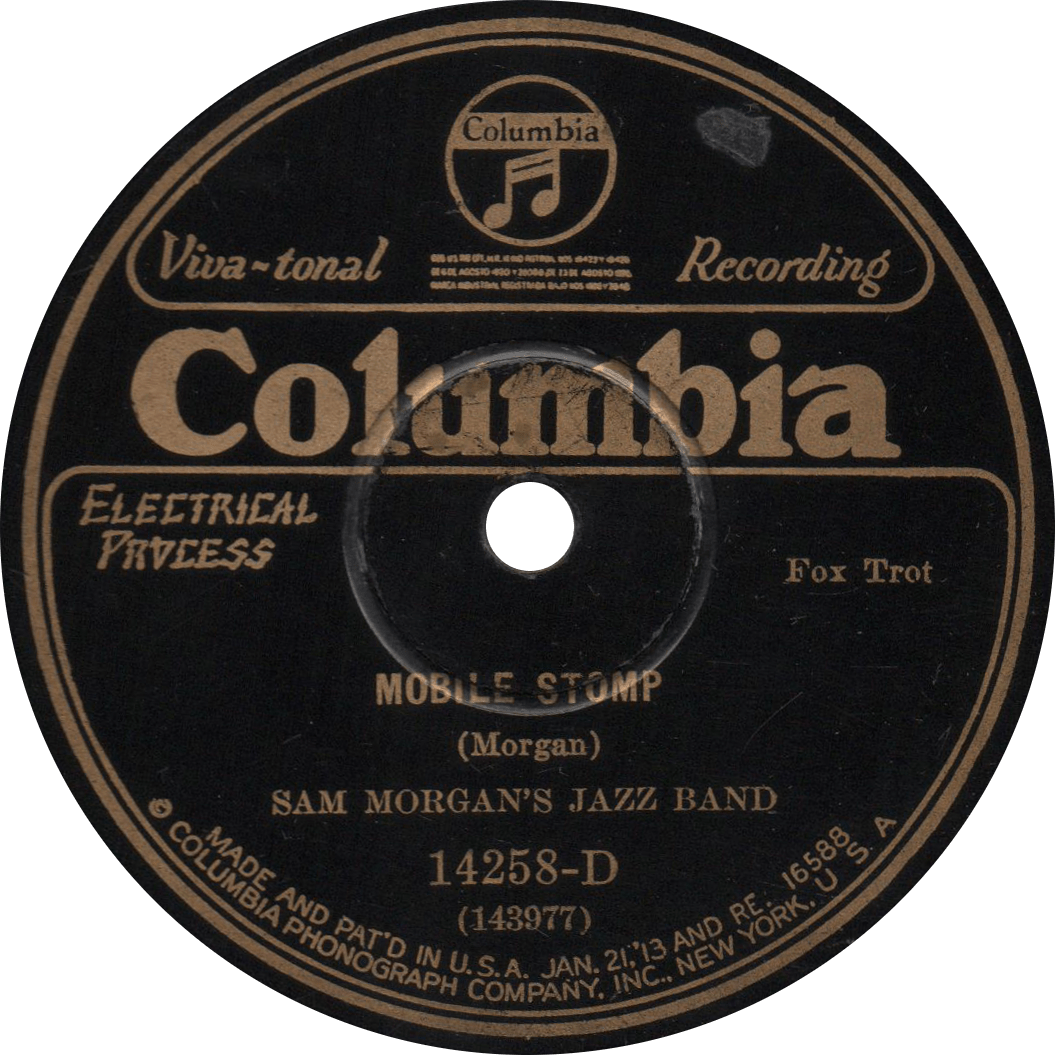
Columbia 14258-D – Sam Morgan’s Jazz Band – 1927

Of all the hundreds of bands to record jazz, there were only a relative handful that stayed home in New Orleans instead of traveling away to Chicago, Los Angeles, or New York, and were recorded playing what might be described as pure, unadulterated jazz, perhaps akin to what was played by the legendary Buddy Bolden’s band.  Among the New Orleans hometown bands were those of Armand J. Piron, “Papa” Oscar Celestin, and among the finest of them all, Sam Morgan.

In spite of Morgan’s excellence in music, not much is known about his life.  He was born in Bertrandville, Louisiana in the late part of the nineteenth century—most sources state 1895, others offer the date of December 18, 1887.  Part of a musical family, his younger brothers Isaiah “Ike”, Al, and Andrew also turned out to be musicians.  Sam, like his brother Ike and so many New Orleans greats, took up the cornet.  Morgan grew up playing in the brass bands in Plaquemines Parish, and took up residence in New Orleans in the mid-1910s, where he became the director of the Magnolia Brass Band.  A stroke around 1925 forced a year of convalescence, but he soon returned to music as a member of Ike’s band, the leadership of which soon became his own.  With a sound characterized by a strong reed section at the forefront and a walking bass plucked out on the bullfiddle, Morgan’s band became a popular group in the Crescent City, as Morgan touted in his verse of the eponymous song: “ev’rybody’s talkin’ ’bout Sammy, ’cause Morgan’s got the best go here” (or something to that effect, he’s rather hard to understand).  Their repertoire consisted of both hot jazz tunes like “Mobile Stomp” and “Bogalousa Strut” (both of which incidentally drew their names from nearby towns) and traditional hymns and negro spirituals like “Over in the Glory Land” and “Down By the Riverside”.  On the side, Morgan ran some kind of a treasure-hunting service.  When the Columbia Phonograph Company made a field trip to New Orleans in April of 1927, Sam Morgan’s Jazz Band cut four sides at Werlein’s Music Store, followed by another four that October.  Morgan continued to lead his band until 1932, when he suffered a second stroke that put him out of music permanently.  Following several years of ill health, Sam Morgan died on February 25, 1936.

Columbia 14258-D—in the “race” series—was recorded on April 14, 1927 at Werlein’s Music Store on Canal Street in New Orleans.  The band consists of Sam Morgan and Isaiah “Ike” Morgan on cornets, Big Jim Robinson on trombone, Earl Fouche on alto sax, Andrew Morgan on clarinet and tenor sax, Tink Baptiste on piano, Johnny Davis on banjo, Sidney Brown on string bass, and Nolan Williams on drums.

On the first side—also the first recorded at Morgan’s first session—is “Steppin’ On the Gas”, a different piece than the 1925 tune of the same name that Jimmie O’Bryant recorded for Paramount.

Steppin’ On the Gas, recorded April 14, 1927 by Sam Morgan’s Jazz Band.

On the reverse, they play another hot Sam Morgan composition: “Mobile Stomp”.

Mobile Stomp, recorded April 14, 1927 by Sam Morgan’s Jazz Band.

Updated with improved audio on June 9, 2025.