
Paramount 12386 – Deacon L. J. Bates – c. 1925

As the years continue to fly by and 2025 gives way to 2026, we come upon a historic milestone which we cannot afford to miss: the centenary of Blind Lemon Jefferson’s first recordings.

The only known photograph of Blind Lemon Jefferson, as pictured on the cover of King of the Country Blues (Yazoo 1069).

By the time of the First World War, Lemon Jefferson had moved from his pastoral home place in Freestone County, Texas, to the big city of Dallas.  There, he set about a reputation for himself in the local music scene, particularly around the neighborhood known as Central Track, or Deep Ellum.  Eventually, Lemon’s powerful singing and virtuosic guitar picking earned him an opportunity rare at the time for a “country” blues singer such as himself—a chance to make a phonograph record.  At the time, “on-location” recording in the southern states was quite new, and hadn’t yet commenced in earnest, so it was still essentially necessary for southern artists to travel to the big cities up north if they wished to pursue a fruitful recording career.  Prior to Jefferson’s recording debut, a small few Texas blues musicians had made records—such as Sippie Wallace—but the state’s blues tradition had been hitherto largely unexplored.  The precise circumstances that precipitated Lemon’s first recordings are likely lost to time.  It is widely understood that he was “discovered” by fellow musician Sammy Price (later a widely known and respected blues and jazz musician in his own right), who was then-employed by R.T. Ashford’s Music Store at 409 North Central Avenue in Dallas.  Price had been familiar with Lemon prior to arriving in Dallas, having seen him perform in Waco when the former was a youth there.  Ashford—the store’s proprietor—was a local dealer and “agent” for Black Swan and subsequently Paramount Records, and served as a talent scout for the latter; he was later responsible for bringing several other Dallas singers to the attention of record companies, including Willard “Ramblin'” Thomas and Lillian Glinn.  In any event, it is evident that Jefferson made the journey north to Chicago around the end of 1925 to make his debut recordings for the New York Recording Laboratories of Port Washington, Wisconsin, manufacturers of Paramount Records.  On one fateful day in December of 1925 or January of ’26—the exact date being unknown—Lemon Jefferson stepped before the recording horn (as acoustical recordings were still in use at the time) for the first time and waxed two religious numbers: “All I Want is That Pure Religion” and “I Want to Be Like Jesus in My Heart”.  Those two sides were held back from release for the better part of a year, with his first disc being released in early April of 1926 and consisting of the blues songs “Booster Blues” and “Dry Southern Blues” (Paramount 12347), which he had recorded at his second session the preceding March.  When the products of his first session were finally released in October of that year, the name that appeared on the record was not “Blind Lemon Jefferson”, but “Deacon L. J. Bates”.  Presumably, Paramount’s executives thought that “sanctified” record buyers might be put off if they knew that their church music was being made by a singer of the devil’s music; they released one other sacred record by Jefferson under the same pseudonym, and used the same tactic a few years later when marketing Charley Patton’s sacred music under the name “Elder J.J.’ Hadley”.  (In spite of false information published by the Smithsonian Institution—or rather whoever is in charge of their social media—”Deacon L.J. Bates” was not Lemon Jefferson’s real name.)

Paramount 12386 was recorded at Rodeheaver Recording Laboratories in Chicago, Illinois, in late December of 1925 or early January of the following year, and was released around October 2, 1926.  Its two sides (Paramount matrices 11040 and 11041) comprise the first recordings ever made by Blind Lemon Jefferson, though it was his fifth to be issued.  It is also the first of two discs to be released under Jefferson’s “sanctified” pseudonym “Deacon L. J. Bates”.  It was later issued on Herwin 93031, credited to “Deacon Jackson”.

In a performance somewhat evocative of his later and more famous “See That My Grave is Kept Clean”, Lemon’s rendition of the gospel song “All I Want is That Pure Religion” is haunting to say the least, showing us that the blues singer could preach fire and brimstone nearly as effectively as his contemporary Blind Willie Johnson.
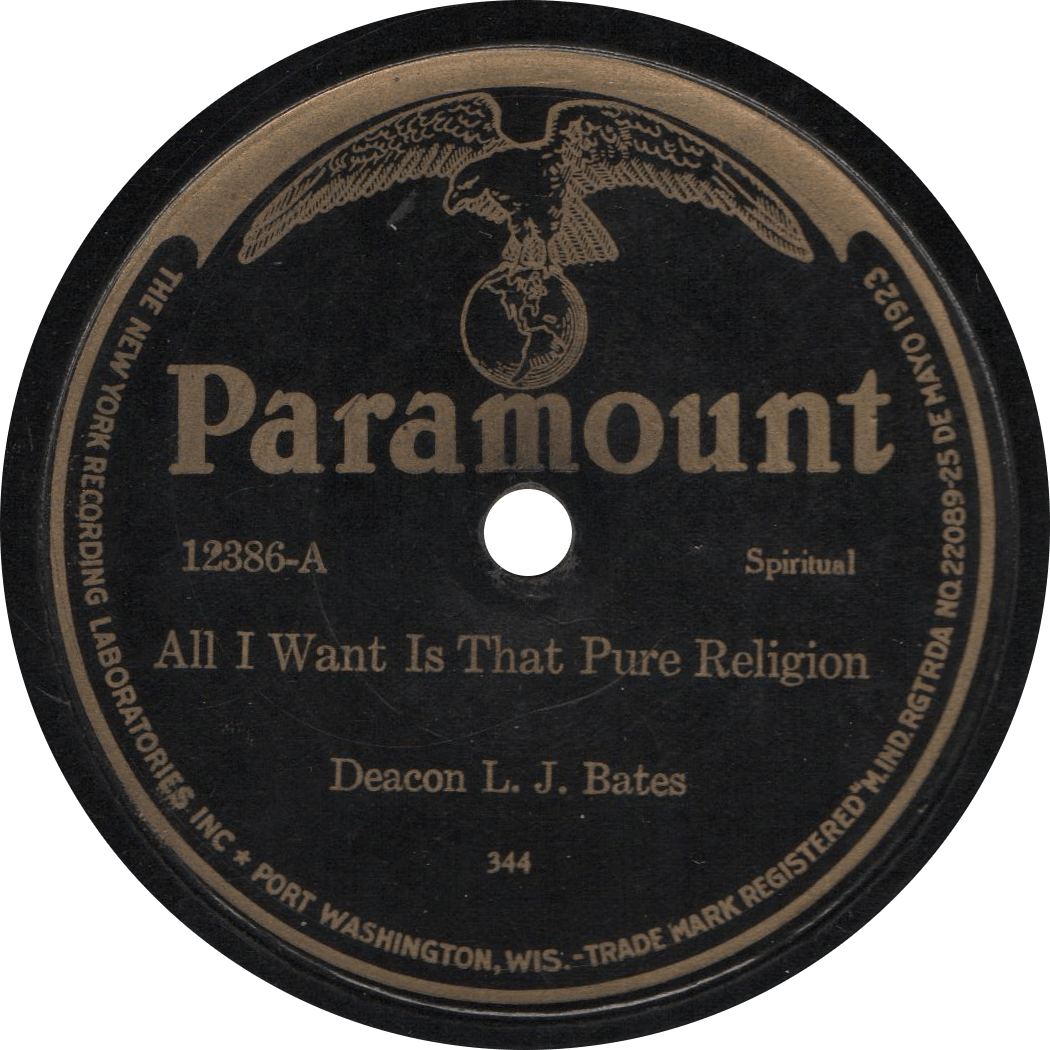
All I Want is That Pure Religion, recorded c. 1925/1926 by Deacon L. J. Bates.

Jefferson delivers a lighter, but no less effective performance of the traditional Negro spiritual “I Want to Be Like Jesus in My Heart” on the flip.  The popular sacred song was also recorded by slide guitarist Crying Sam Collins in 1927.
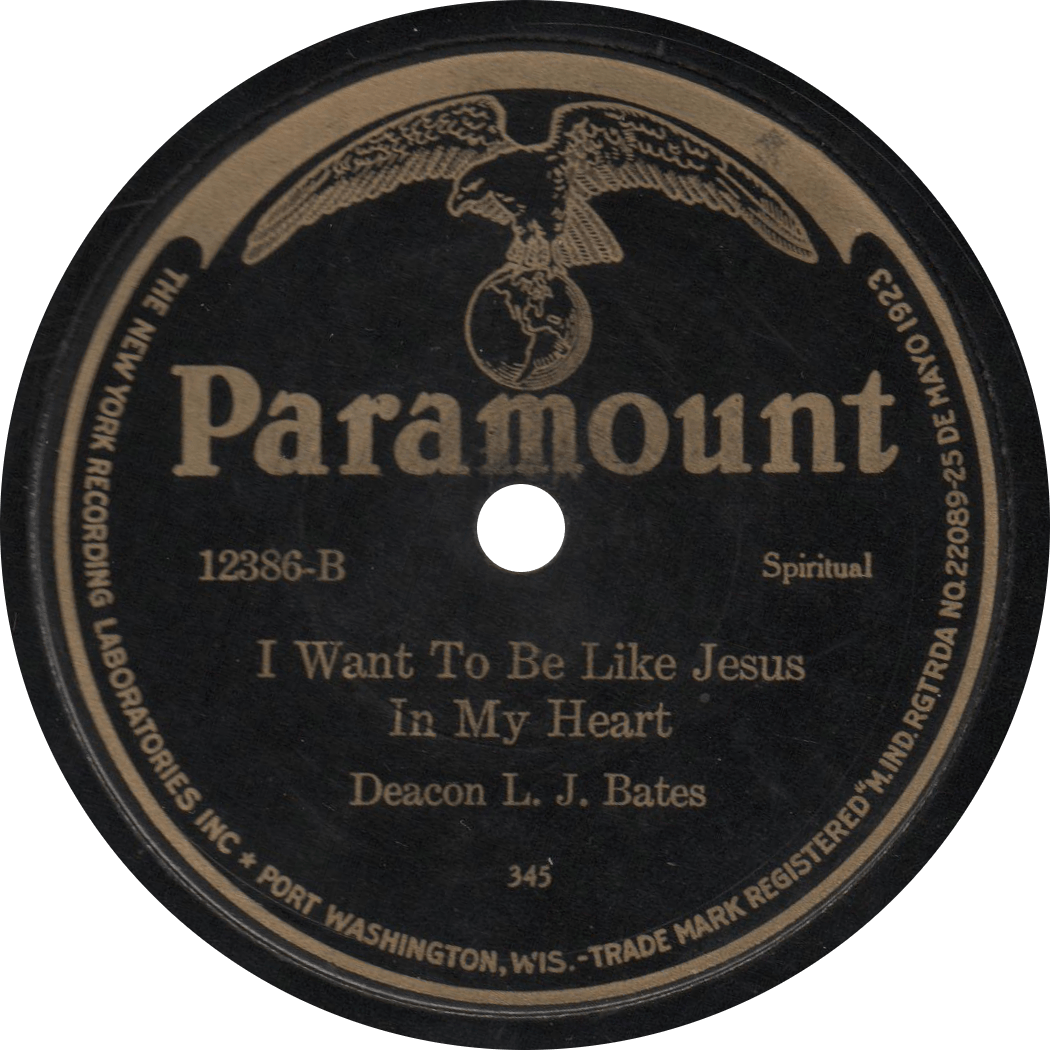
I Want to Be Like Jesus in My Heart, recorded c. 1925/1926 by Deacon. L. J. Bates.

Columbia 15510-D – Lubbock Texas Quartet – 1929

This record likely contains the earliest audio recordings of music from Lubbock, Texas, and quite possibly such from the Llano Estacado region in the Panhandle of west Texas (a number of southwest Texas “cowboy country” musicians had recorded previously, such as Jules Verne Allen).

Preceded by a number of earlier vocal groups in Lubbock town in the 1910s and beginning of the ’20s, the group known as the Lubbock Texas Quartet was formed in earnest around 1922 by Tony Q. Dyess a musical entrepreneur and promoter of the “shape note” tradition.  Dyess was born in Brazos County, Texas, on December 15, 1881, and lived in Vernon prior to taking up residence in Lubbock.  In its early years, the quartet was often known locally as the “Lubbock Peerless Quartet”, the “Home Brew Quartet”, or the ‘Lubbock Quartet”—or simply by the names of its members: Dyess, Holland, Wendell, and Wilson.  The group soon affiliated itself with the successful Stamps-Baxter music publishing company in Dallas, and were accordingly promoted variously as the “Lubbock Stamps Quartet” or sometimes simply “Stamps Quartet”, sharing the latter title with a number of other Stamps groups.  The quartet’s Personnel varied throughout its  years of existence, but from the late 1920s through the early 1940s members included Tony and Doc Dyess, Clyde Burleson, Cecil and Glenn Gunn, Wilson Carson, Minnis Meek, Louis Brooks, and Homer Garrison, with the occasional addition of pianist Marion Snider.  In December of 1929, the quartet traveled three-hundred miles to Dallas to record but a single phonograph record for Columbia, who were conducting a series of session in the city on one of their field trips south. The group never recorded again subsequently, but they continued to perform in the Texas Panhandle throughout the following decades, they sang on Lubbock’s KFYO and other stations, in addition to frequent live performances throughout Texas and the surrounding states, even venturing as far as West Virginia.  The group appears to have dissolved around 1943, as the war was escalating in Europe.

If you are interested in reading a more exhaustive examination of the Lubbock Texas Quartet and all of their history, I recommend a look at Curtis L. Peoples’s essay The Lubbock Texas Quartet and Odis “Pop” Echols: Promoting Southern Gospel Music on the High Plains of Texas, published in the Journal of Texas Music History in 2014, from which most of the information included in this article was sourced.

Columbia 15510-D was recorded on December 9, 1929, in Dallas, Texas; their only two recordings. The Lubbock Texas Quartet likely consists of tenors Clyde Rufus Burleson or possibly Cecil Lee Gunn, baritones Minnis Monroe Meek and Wilson Lloyd Carson, and possibly bass Louis M. Brooks, though all are unconfirmed; they are accompanied by an unknown guitarist, probably Carson.  It is reported to have sold a total of 12,776 copies, and remained in “print” until at least Columbia’s “Royal Blue” era around 1933-34; this pressing dates to around 1931.

Their first song, and without a doubt the better remembered of their two due to its appearance in several reissue compilations, is “Turn Away”, composed by prolific songwriter and Methodist Reverend B.B. Edmiaston and published by the Stamps-Baxter Music Company of Dallas, Texas.

Turn Away, recorded December 9, 1929 by Lubbock Texas Quartet.

The mournful “O Mother How We Miss You” is quite a lovely song in spite of its rather morose theme, and includes a brief solo guitar passage by the group’s accompanist.  It has been suggested that this song was the more popular of these two in its own day.

O Mother How We Miss You, recorded December 9, 1929 by Lubbock Texas Quartet.

Montgomery Ward M-7348 & M-7350 – Uncle Dave Macon – 1937

‘Uncle Dave Macon, the Dixie Dewdrop, King of the Hillbillies, and Star of WSM’s Grand Ole Opry!’ Photograph and original caption from Songs and Stories of Uncle Dave Macon, 1938.

The last time we heard from the famed “Dixie Dewdrop”, Uncle Dave Macon, it was with two of his earliest recordings.  This time around, let us turn our attention to thirteen years later, at the height of the Great Depression, and the height of his fame.

In 1938, Macon, a favorite performer in the Southern states who had appeared on WSM’s Grand Ole Opry since its start in 1925, published a book of his songs and stories, fittingly titled Songs and Stories of Uncle Dave Macon.  Selling the books for twenty-five cents each, within its pages Macon reminisced about his early days, writing, “at my advanced age I realize more keenly the great mental powers of youth, and could I command an audience of the youth of our land today, I would say to them: ‘Learn the beautiful things of life in your early years—from Holy Writ we learn.  Remember thy Creator in the days of thy youth.'”  Also included in the folio were twenty-four of Macon’s popular songs, and several pictures of him, some with his son Dorris.  Concurrently, Macon had turned over a new page in his prolific recording career, becoming an exclusive RCA Victor artist in 1935, with most of his recordings appearing on their Bluebird label and client label for Montgomery Ward.

Montgomery Ward M-7348 and M-7350 were recorded on August 3, 1937 in Charlotte, North Carolina, Uncle Dave’s second session for RCA Victor.  Macon is accompanied by his own banjo, an unknown guitar and second vocal (the two likely belonging to the same individual) on M-7348, and an unknown fiddler on M-7350-B.  I would assume the guitarist to be Uncle Dave’s son Dorris Macon, but since this was not suggested in Country Music Records: A Discography, 1921-1942, I assume Mr. Russell had good reason to nix the possibility.

Alongside a large volume of the secular, minstrel type material that he’s probably best remembered for, Macon also recorded numerous sacred songs in his almost fifteen year career as a recording artist.  Straight out of Songs and Stories, on the “A” side Macon recounts the Parable of the Prodigal Son in a jubilant rendition of “Honest Confession is Good for the Soul”.

Honest Confession is Good for the Soul, recorded August 3, 1937 by Uncle Dave Macon.

On “B”, and also in the book, he sings another sanctified song on “Fame Apart from God’s Approval”, but you don’t have to be a religious person to enjoy the gospel as it was preached by that songster from days of old.

Fame Apart From God’s Approval, recorded August 3, 1937 by Uncle Dave Macon.

On M-7350, Uncle Dave first sings “Two in One Chewing Gum”, also appearing in Songs and Stories.  He first recorded “(She Was Always) Chewing Gum” for Vocalion in 1924; the “two in one” part referring to Dave’s humorous rendering of the immensely popular “Nobody’s Darlin’ but Mine” that follows the titular song.

Two in One Chewing Gum, recorded August 3, 1937 by Uncle Dave Macon.

Finally, Dave and an unknown fiddle player get hot on the old-time number “Travelin’ Down the Road”, a melody that’s “just as loose, as loose as a goose!”  This tune is the only one out of these four songs that’s not included in Songs and Stories of Uncle Dave Macon, so I’ll have to offer you all one of his stories instead…

“When prohibition struck Tennessee, and the apple business became an unprofitable one, two Warren county farmers, disgusted with poor land and poorer prices, set out for Texas in a wagon drawn by mules.  In Texas, they were dazed by the enormous plains, rolling away in every direction as far as the eye could see.  Undaunted, they pressed on for West Texas, where reports held out promises of prosperity.

After a week of travel, deeper and deeper into the heart of the great plains, a sand and dust storm came upon them—in a short time they could not see even the tips of the mules’ ears.  One of the men turned to the other and said: ‘Bill, hold the mules, while I get down and pray.’

Bill climbed down, held the mules, and the other dropped to his knees: ‘Oh, Lord, here we are, out in the middle of this prairie; lost!  Lord, we don’t know where we are.  We don’t know.’

Bill was unusually anxious, and interrupted—’Hey, He knows where we are!  Tell Him something, brother, tell him something.'”

Travelin’ Down the Road, recorded August 3, 1937 by Uncle Dave Macon.

Columbia 14624-D – Blind Willie Johnson – 1929

Against odds stacked against him, the guitar evangelist and musical visionary Blind Willie Johnson rightly secured his place as a gospel music pioneer and veritable legend in the annals of American music.  While he found neither great fame nor fortune during his life, his rousing religious songs and inspired slide guitar have received much admiration from music lovers, and the convoluted details surrounding his life have inspired much interest from researchers (and as such, some of the facts presented herein are of rather tenuous accuracy) in the decades since.

Willie Johnson was born to “Dock” (variously reported in source documents as Willie, Sr., or George) and Mary Johnson in Pendleton, Texas (though other sources have suggested Independence, some one-hundred miles southeast), in January of 1897; his draft card gave a date of the twenty-fifth, while his death certificate proffered the twenty-second.  He spent most of his life from childhood to adulthood in Marlin, Texas.  His mother died when he was four years old, and his father later remarried.  It is widely believed that Johnson became blind around the age of seven, though the cause of his blindness is not definitively known; the most popular story—based upon an account by his alleged widow Angeline—asserts that he was blinded by lye water thrown by his stepmother during a marital dispute with his father (and accounts differ as to whether the lye was meant for Willie or his father).  A perhaps more plausible theory suggests that he became blind from viewing a solar eclipse which would have been visible from Texas on August 30, 1905, through a piece of broken glass.  No matter the unfortunate circumstance, Johnson found religion and thus aspired preach the gospel.  Inspired by fiddling evangelist Blind Madkin Butler, he learned to play guitar in a distinctive style using a steel ring for a slide to accompany his coarse, false bass singing (though he naturally possessed a pleasant singing voice).  He traveled from town-to-town, playing and singing his religious songs on street corners around the Brazos Valley, sometimes sharing the space with Blind Lemon Jefferson and his blues songs.  Around the middle of the 1920s, Johnson met Willie B. Harris, who would soon become his (possibly second) wife and singing partner, and with whom he would have one daughter in 1931.  He made his first recordings on December 3, 1927—one day after fellow Texas gospel blues man Washington Phillips made his own debut—for Columbia, who had set up a temporary recording laboratory in Dallas, Texas, possibly at the Jefferson Hotel.  His religious songs proved quite successful, some records rivaling the popular Bessie Smith’s blues songs in sales figures.  Ultimately, Johnson had three more sessions in Dallas, New Orleans, and Atlanta, producing a total of thirty issued sides for the Columbia Phonograph Company—plus an additional two unreleased masters credited in the company ledgers to “Blind Texas Marlin”, which are speculated to have been pseudonymous recordings of secular material, or which may have simply been a clerical error—before the crush of the Great Depression curtailed their field recording activity and thus ended his recording career.  Sometime in the 1930s, Johnson left his family in Marlin for the Gulf Coast, where he eventually settled in Beaumount, evidently with a woman named Angeline (with whom he may have had relations concurrent to his marriage to Harris), purportedly the sister of blues guitarist L.C. Robinson.  He continued to sing on street corners in the vicinity, and may have appeared on the radio on KTEM in Temple in the early 1940s, according to an anecdote related by Houston folklorist Mack McCormick, and operated a “house of prayer” in Beaumont.  A decade after his recording career had concluded, John A. Lomax expressed interest in Johnson’s music in an interview with another Blind Willie in 1940, but McTell perplexingly informed the ballad hunter that the gospel singer was dead, according to a letter he had received from Johnson’s wife.  His house in Beaumont reportedly burned in the middle 1940s, and Blind Willie Johnson died on September 18, 1945, from a cause reported as malarial fever.

As with so many of history’s truest luminaries, Blind Willie Johnson’s greatest fame was achieved posthumously.  Only seven years after his demise, Harry Smith included his 1930 recording of “John the Revelator” in his influential Anthology of American Folk Music, presenting Johnson’s music to a new generation of folkies.  In 1977, Johnson’s instrumental “Dark Was the Night, Cold Was the Ground” was selected among the twenty-seven musical recordings included on the Voyager Golden Record, sending the blind pilgrim’s celestial music to an appropriate venue amongst the stars.

Columbia 14624-D was recorded in New Orleans, Louisiana, on December 10 and 11, 1929, respectively.  It was not released until October of 1931, making it Johnson’s last issued record.  Reportedly, only 900 copies were pressed, and it is the only of Johnson’s records to be listed in the “Rarest 78s” column of 78 Quarterly, with an estimate of fifteen or fewer copies known to exist (though whether or not it actually is his rarest record is debatable)—this copy, incidentally, appears to match the description of the one which formerly belonged to Mr. Roger Misiewicz.  Blind Willie Johnson sings both sides in his growling false bass voice and eschews his slide in favor of chording the frets with his bare fingers, he is joined by Willie B. Harris on the second side.

On the first side, recorded the former date, Willie sings “Sweeter as the Years Roll By”—an apt title for his final record—a folk interpretation of Lelia Naylor Morris’s 1912 hymn “Sweeter as the Years Go By” (which in fact are the lyrics Johnson sings in the evidently mis-titled song).

Sweeter as the Years Roll By, recorded December 10, 1929 by Blind Willie Johnson.

On the traditional spiritual “Take Your Stand”, Johnson’s vocals are complimented by the soprano of his wife Willie B. Harris.  The song was also recorded by Elders McIntorsh and Edwards in 1928, and by Charley Patton (under the pseudonym “Elder J.J. Hadley”) as the first part of his “Prayer of Death” in June of 1929.

Take Your Stand, recorded December 11, 1929 by Blind Willie Johnson.

Updated with improved audio on June 30, 2024.

Columbia 14333-D – Washington Phillips – 1927

While now regarded alongside the nigh-legendary Blind Willie Johnson as a pioneer of the gospel music genre, snuff-dipping jack-leg preacher from Texas Washington Phillips was once largely forgotten and shrouded by mystery and misconceptions.  Today, thanks to the tireless efforts of folklorists and researchers like Michael Corcoran, Phillips may finally begin to receive the appreciation he has so long deserved.

George Washington Phillips was born on January 11, 1880, near Cotton Gin, Texas, a few miles west of Teague in Freestone County—the very same region that produced pioneering blues luminary Blind Lemon Jefferson—one of at least ten children born to Timothy and Nancy Phillips.  As an adult, he worked for a time as a hotel waiter in Mexia, but soon continued in the family trade of farming, working a strip of land very near the place of his birth in rural Simsboro.  On the side, he found his calling as an itinerant preacher and sanctified singer in local churches and any opportune venues.  In stark contrast to the fire-and-brimstone preaching of contemporaries like Blind Willie Johnson and his fellow guitar evangelists, Phillips’s music was delivered with a gentle touch and kind nature.  More remarkably, Phillips eschewed the guitar in favor of accompanying his singing on an ethereal sounding instrument of rather enigmatic origin, previously thought to have been a toy-piano like zither known as a Dolceola (which may be heard on some of Lead Belly’s 1944 Capitol recordings, played by Paul Howard), but now widely believed to have been an instrument of his own invention which he dubbed a “manzarene”, comprised of two modified tabletop zithers (a celestaphone and a phonoharp) played in tandem, with which he was photographed in 1927.  Possibly owing to an association with Lemon Jefferson, when the Columbia Phonograph Company made their first field trip to Dallas, Phillips made the journey eighty miles northward to record his sacred music.  On Friday, December 2, 1927, directly following a session by the Cartwright Brothers’ cowboy singing duo, Washington Phillips became the first African-American musician, and only the second overall, to be recorded at the field trip.  He waxed a total of six sides that day and the following Monday, and subsequently returned the following two Decembers to record a further twelve (two of which are presumed lost).  Though the sudden onset of Depression curtailed Columbia’s field trips south, Phillips was still in Dallas in 1930, lodging at Wade Wilson’s shotgun house near Oak Cliff, though he eventually returned to the country life in Freestone County.  Locally, “Wash” Phillips was as well known for his mule cart from which he peddled farm-fresh produce as he was for his music, and many of his hometown acquaintances were unaware that he had made records.  Census records indicate that he was married at least twice, first to Anna, and then to Susie.  At the age of seventy-four, Washington Phillips died following a fall on the stairs outside the Teague welfare office on September 20, 1954.

Columbia 14333-D was recorded in Dallas, Texas, on December 5, 1927, possibly at the Jefferson Hotel.  On it, Washington Phillips sings and accompanied himself on “manzarene”.  78 Quarterly estimated “possibly as many as 30 to 40 copies” were extant.

Perhaps Washington Phillips’s best known recording and composition, in “Denomination Blues” he chides various religious sects for their perceived hypocrisy.  Split into two parts, he sings and plays “Part 1” on the first side.

Denomination Blues – Part 1, recorded December 5, 1927, by Washington Phillips.

He concluded the number with “Part 2” on the reverse, turning his attention to the different varieties of “so-called Christians.”  Of Phillips’s limited discography, the song proved particularly influential, being later adapted into the gospel song “That’s All” (for which Phillips received no credit, possibly because the song was believed to be of traditional origin), recorded by artists as diverse as Sister Rosetta Tharpe and Merle Travis alike, which rather altered the song’s message by deviating from Phillips’s anti-sectarian “you better have Jesus, and that’s all” theme.

Denomination Blues – Part 2, recorded December 5, 1927, by Washington Phillips.

Updated with improved audio on May 3, 2023, and again on June 20, 2024.