
Paramount 12386 – Deacon L. J. Bates – c. 1925

As the years continue to fly by and 2025 gives way to 2026, we come upon a historic milestone which we cannot afford to miss: the centenary of Blind Lemon Jefferson’s first recordings.

The only known photograph of Blind Lemon Jefferson, as pictured on the cover of King of the Country Blues (Yazoo 1069).

By the time of the First World War, Lemon Jefferson had moved from his pastoral home place in Freestone County, Texas, to the big city of Dallas.  There, he set about a reputation for himself in the local music scene, particularly around the neighborhood known as Central Track, or Deep Ellum.  Eventually, Lemon’s powerful singing and virtuosic guitar picking earned him an opportunity rare at the time for a “country” blues singer such as himself—a chance to make a phonograph record.  At the time, “on-location” recording in the southern states was quite new, and hadn’t yet commenced in earnest, so it was still essentially necessary for southern artists to travel to the big cities up north if they wished to pursue a fruitful recording career.  Prior to Jefferson’s recording debut, a small few Texas blues musicians had made records—such as Sippie Wallace—but the state’s blues tradition had been hitherto largely unexplored.  The precise circumstances that precipitated Lemon’s first recordings are likely lost to time.  It is widely understood that he was “discovered” by fellow musician Sammy Price (later a widely known and respected blues and jazz musician in his own right), who was then-employed by R.T. Ashford’s Music Store at 409 North Central Avenue in Dallas.  Price had been familiar with Lemon prior to arriving in Dallas, having seen him perform in Waco when the former was a youth there.  Ashford—the store’s proprietor—was a local dealer and “agent” for Black Swan and subsequently Paramount Records, and served as a talent scout for the latter; he was later responsible for bringing several other Dallas singers to the attention of record companies, including Willard “Ramblin'” Thomas and Lillian Glinn.  In any event, it is evident that Jefferson made the journey north to Chicago around the end of 1925 to make his debut recordings for the New York Recording Laboratories of Port Washington, Wisconsin, manufacturers of Paramount Records.  On one fateful day in December of 1925 or January of ’26—the exact date being unknown—Lemon Jefferson stepped before the recording horn (as acoustical recordings were still in use at the time) for the first time and waxed two religious numbers: “All I Want is That Pure Religion” and “I Want to Be Like Jesus in My Heart”.  Those two sides were held back from release for the better part of a year, with his first disc being released in early April of 1926 and consisting of the blues songs “Booster Blues” and “Dry Southern Blues” (Paramount 12347), which he had recorded at his second session the preceding March.  When the products of his first session were finally released in October of that year, the name that appeared on the record was not “Blind Lemon Jefferson”, but “Deacon L. J. Bates”.  Presumably, Paramount’s executives thought that “sanctified” record buyers might be put off if they knew that their church music was being made by a singer of the devil’s music; they released one other sacred record by Jefferson under the same pseudonym, and used the same tactic a few years later when marketing Charley Patton’s sacred music under the name “Elder J.J.’ Hadley”.  (In spite of false information published by the Smithsonian Institution—or rather whoever is in charge of their social media—”Deacon L.J. Bates” was not Lemon Jefferson’s real name.)

Paramount 12386 was recorded at Rodeheaver Recording Laboratories in Chicago, Illinois, in late December of 1925 or early January of the following year, and was released around October 2, 1926.  Its two sides (Paramount matrices 11040 and 11041) comprise the first recordings ever made by Blind Lemon Jefferson, though it was his fifth to be issued.  It is also the first of two discs to be released under Jefferson’s “sanctified” pseudonym “Deacon L. J. Bates”.  It was later issued on Herwin 93031, credited to “Deacon Jackson”.

In a performance somewhat evocative of his later and more famous “See That My Grave is Kept Clean”, Lemon’s rendition of the gospel song “All I Want is That Pure Religion” is haunting to say the least, showing us that the blues singer could preach fire and brimstone nearly as effectively as his contemporary Blind Willie Johnson.
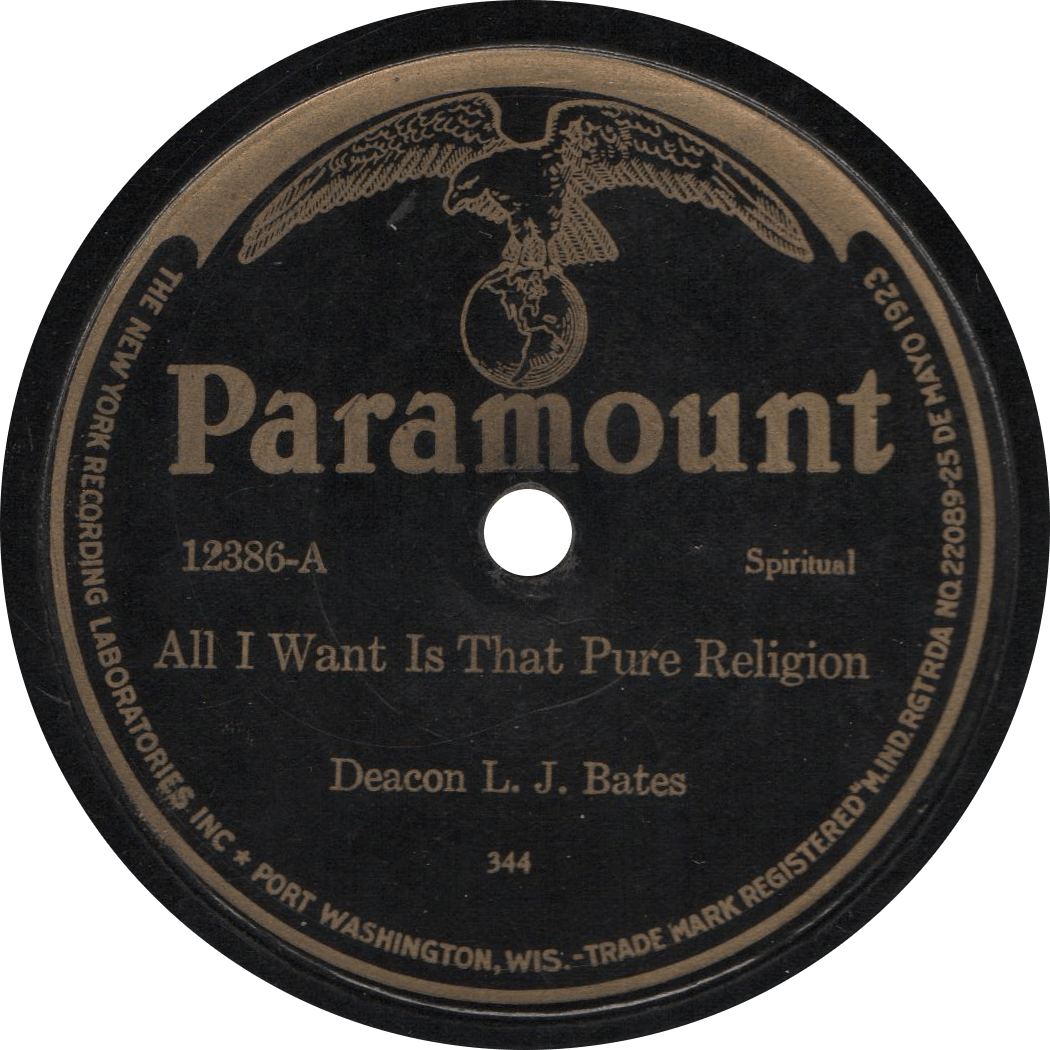
All I Want is That Pure Religion, recorded c. 1925/1926 by Deacon L. J. Bates.

Jefferson delivers a lighter, but no less effective performance of the traditional Negro spiritual “I Want to Be Like Jesus in My Heart” on the flip.  The popular sacred song was also recorded by slide guitarist Crying Sam Collins in 1927.
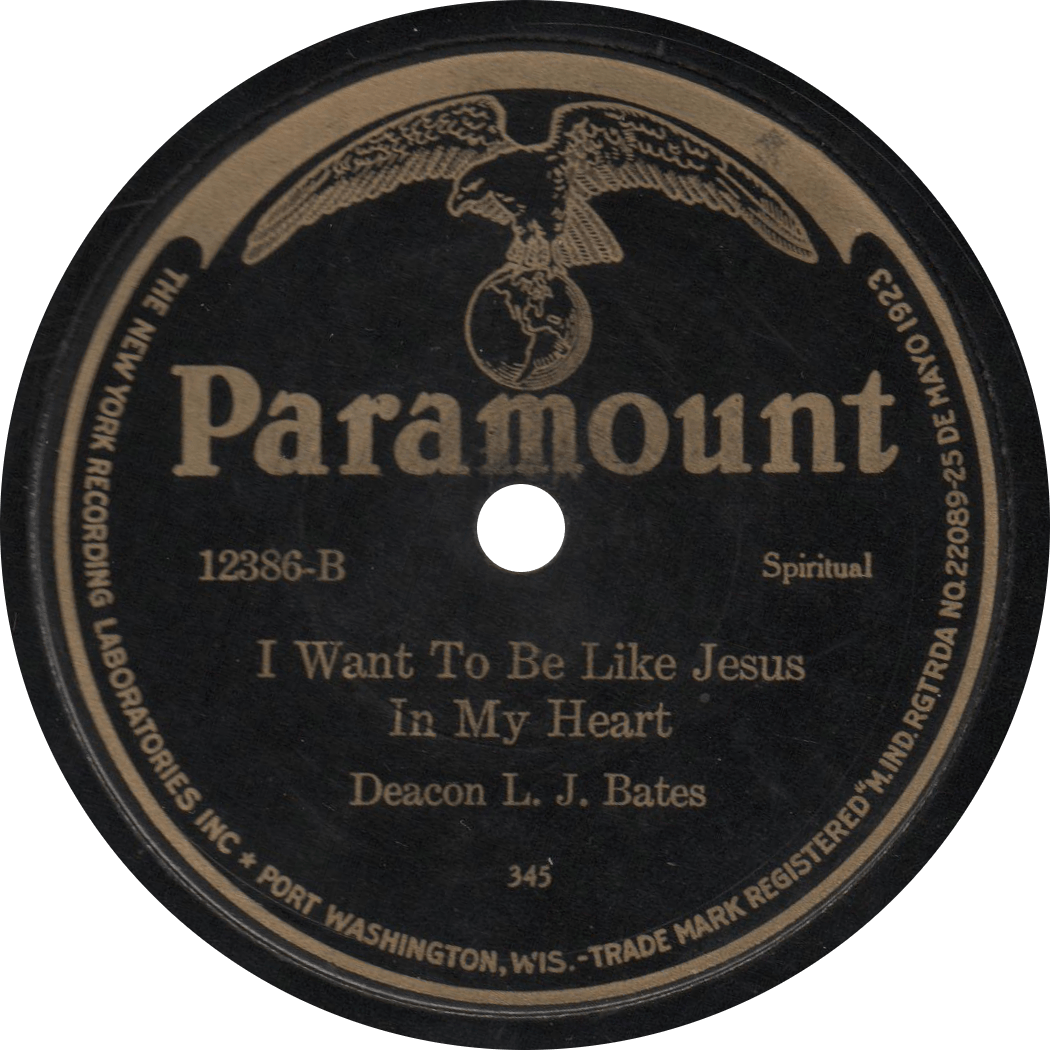
I Want to Be Like Jesus in My Heart, recorded c. 1925/1926 by Deacon. L. J. Bates.

Supertone 9393 – Freeman Stowers “The Cotton Belt Porter” – 1929

Of the multitude of artists who achieved regional fame in their day through radio and live performance, only to be forgotten after leaving the limelight, Texas-born harmonica player and animal imitationist Freeman Stowers was one of the lucky few whose work was preserved on record for future generations.  But while his recordings have been relatively well known among collector of pre-war blues, his biography has hitherto remained quite unexplored.

Freeman Stowers, pictured in the St. Louis Globe-Democrat, December 5, 1926, Page 59. via Newspapers.com, clip page by user puettjoshua. Photograph discovered by Ethan Kelly and Joshua Puett. Copyrighted image used under fair use doctrine (17 U.S.C. § 107).

Freeman Jefferson Stowers, son of George Stowers and the former Mary Menifee, was born in the vicinity of the Brazos River valley in central eastern Texas, most likely in either Grimes or Bell County, on the twenty-fifth of November in an uncertain year—variously reported as 1884, 1893, 1897, 1902, and other years in different documents.  He grew up near Anderson, Texas, and spent most of his early adult life working on farms around the small towns of nearby Falls County—Barclay, Lott, Rosebud, and the like.  Nicknamed “Shorty”, he was a man of small stature and dark complexion.  Surrounded by all manner of animals—both wild and domestic—in the agrarian country of east Texas, Stowers developed a knack for impersonating (imanimalating?) the sounds of said creatures with remarkable verisimilitude.  In 1908, Stowers married Miss Ethel Green in Marlin, Texas, and the couple had a daughter named Lillian the following year.  That marriage seems to have been rather short-lived, for around 1917 he married Pearl Smith and had two more daughters, Lucille and Bertha.  In the 1920s, Stowers began to draw some attention for his imitations of barnyard animals and train sounds, earning him an engagement entertaining the Texas Butter, Egg and Poultry Association at their 1924 convention in Fort Worth.  Around the middle part of the same decade, Stowers relocated to St. Louis, Missouri, where he worked as a porter on the St. Louis Southwestern Railway, better known as the Cotton Belt Route.  Soon after, his imitations were overheard by the publicity director of the railroad, Mr. A. Campbell McKibbin, who was sufficiently impressed to secure him a spot on the radio.  Called a “natural born mimic” and also a proficient harmonica player, Stowers could be heard on Mondays and Fridays at 8:00 P.M. over station KMOX as part of a Cotton Belt program, and he proved to be quite a hit with listeners (as well as their pets).  Working on the railroad also brought Stowers far and wide around the nation, and he was called upon to perform in various venues alongside the likewise company sponsored Cotton Belt Quartet (who themselves had made records for Vocalion and Paramount), including a series of appearances back in his home state of Texas at the Cotton Palace in Waco.  Around 1927, he remarried yet again, this time to a woman named Ella Strambler, with whom he had three more children: Freeman Jr., Gladys, and Louise.  In the early months of 1929, Stowers ventured to Richmond, Indiana. to record for the Starr Piano Company, manufacturers of Gennett Records.  Billed as “The Cotton Belt Porter”, he produced a total of five sides in two sessions, of which four were issued: the animal imitations “Texas Wild Cat Chase” and “Sunrise On the Farm”, and the harmonica instrumentals “Medley of Blues” and “Railroad Blues”.  The unissued side was an alternate take of “Texas Wild Cat Chase” titled “Texas Wild Cat Hunt” in the Gennett ledgers.  Later in the 1920s, he was employed by Purina Mills and continued to perform and broadcast under their sponsorship, adopting the name “Checkerboard Sam” after Purina’s famous logo.  At some point after 1934, Stowers took up residence in Fulton, Missouri—where he remained for at least the next two decades—and separated from Ella, who retained custody of their children and later remarried.  He was still appearing as “Checkerboard Sam” as late as 1958, and under that name evidently produced another record, a 45 RPM single containing “The Fox Chase” and “The Coon Chase” for Duncan and Gibbs Sales of Milledgeville, Illinois (aural identification indicates that the recording is indeed of Stowers).  He eventually returned to St. Louis, where he would remain for the rest of his life, working in later years as a maintenance man.  On December 6, 1972, Freeman Stowers died of arteriosclerosis at the St. Louis Chronic Hospital.  Though his age was listed as seventy on his death certificate, Social Security records reported it as eighty-eight, reflecting an 1884 birth date.  Stowers’s cousin Willie Menifee (1923-1997) of Navasota, Texas, was also a harmonica player and singer of some local repute, who recorded with Mance Lipscomb in the 1960s.

Supertone 9393 was recorded in two sessions in 1929, the first on January 19th, and the second on March 11th, both in Richmond, Indiana.  It features Freeman Stowers “The Cotton Belt Porter” playing two unaccompanied harmonica solos, with talking on the first.  It was also issued on Gennett 6814 and Champion 15837, and reissued (for some reason) on Supertone 9430.

With a tip-of-the-hat to his hometown of St. Louis, “Railroad Blues”—the first side Stowers recorded—is an archetypal (and quite excellent) train piece much in the vein of those made popular by contemporaneous harmonicists like William McCoy and DeFord Bailey.  Quite appropriate considering Stowers line of work at the time.

Railroad Blues, recorded January 19, 1929 by Freeman Stowers “The Cotton Belt Porter”.

On the “B” side, Stowers blows a dandy harp on his “Medley of Blues”, interpolating “All Out and Down”, “Old Time Blues”, and “Hog in the Mountain”.  To the average listener, Stowers’s harmonica recordings are considerably more palatable than those of his barking and howling solos.

Medley of Blues, recorded March 11, 1929 by Freeman Stowers “The Cotton Belt Porter”.

Timely 1003 – Otis Hinton – 1954

In our continuing examination of the Texas blues, we have taken a look at some of the most renowned figures—like Blind Lemon Jefferson, Lightnin’ Hopkins, and “Texas” Alexander—as well as some of the more obscure—like “Stick Horse” Hammond, Gene Campbell, and Jesse Lockett.  Now, let us turn our attention to one of the obscurest of them all, Dallas bluesman Otis Hinton, and his one record (which, in my opinion, is one of the greatest ever made).

Otis was born Odis Hinton in Jacksonville, Texas, on June 8, 1916 (or 1918), one of eleven children of the Reverend Claude A. and Mae Ollie Hinton.  Prior to revelatory research by blues historian Bob Eagle, he was believed to have hailed from Shreveport, Louisiana.  After receiving a third grade education, Hinton relocated to Dallas around the age of ten.  There, he was surely exposed to the blues scene flourishing in Deep Ellum and its surrounding neighborhoods.  As an adult, Hinton stood six feet tall, of dark complexion, and was blind in his right eye.  In the early 1940s, he married Rachael Mae Washom, the daughter of a family with whom he had lived for some time prior.  The couple had at least two children, Tommie and Odell, the former of whom died in infancy.  Though he evidently made his living working menial jobs in white folks’ yards, Hinton was a proficient musician in a style similar to many of his fellow Texas musicians.  His skills were presumably of some local renown, as they earned him a listing as a musician in the Dallas city directory.  He traveled to New York, purportedly in 1953, to wax four sides for Apollo Records—”No More to Roam”, “Railroad Woman” (or “Beloved Woman” per copyright filing), “Little Woman”, and “Hinton’s Boogie”—none of which ever saw release.  Copyrights were filed for all four unissued Apollo recordings on September 9, 1955, perhaps suggesting that they may at one time have been planned for release, or that they were recorded later than attributed (the latter, in my opinion, is the more likely scenario).  In 1954, he recorded two additional sides for Apollo founder Hy Siegel’s new record label, Timely, which were released this time around.  Back home in Texas, he found work for the Binyon-O’Keefe Company, a storage and moving business in Dallas-Fort Worth.  Just over three years after his only record’s release, Hinton was pronounced dead from pneumonia—the same ailment that had claimed his infant son years earlier—at Parkland Hospital on November 18, 1957.  He was interred at Lincoln Memorial Cemetery, where his father had previously been buried, as would many more of his family members in years to come.  Otis Hinton’s two released recordings have been featured on several reissue compilation since the folk-blues revival of the 1960s.  His younger brother “Little Joe” Hinton (1937-2022) was also a noted singer and songwriter, recording a series of soul singles in the 1960s and ’70s.

Timely 1003 was recorded in New York City, probably in early 1954.  The date has often been cited as July 7, 1954, however this seems improbable, as it was advertised as a “New R&B Record” in Billboard magazine on June 26, 1954.  Otis Hinton accompanies himself on guitar and is joined by an unidentified rhythm section consisting of bass and drums.

Hinton’s “Walkin’ Down Hill” is a loose variant of the classic “Big Road Blues”, made famous by Mississippi bluesman Tommy Johnson in the 1920s.  Billboard’s review opined that “Southern blues fans should enjoy this bright reading of a bouncy down-home effort sung by Otis Hinton.  He accompanies himself solidly on the guitar.  Side could catch loot in the South.”  This is one of my favorite sides of all time.

Walkin’ Down Hill, recorded 1954 by Otis Hinton.

“Emmaline” seems to be a variant of the blues standard popularized by Little Son Jackson as “Rockin’ and Rollin'”, also known as “Rock Me, Mama”.  Although Hinton’s country blues style might seem somewhat dated in the days of rock ‘n’ roll—and indeed, his record does not seem to have sold particularly well—it would foreshadow the revival of traditional blues that was on the horizon at the time.

Emmaline, recorded 1954 by Otis Hinton.

Paramount 12790 – Charlie Spand – 1929

Gaining fame in Detroit and Chicago during the Roaring Twenties, piano man Charlie Spand was both a pioneer of boogie-woogie and a highly regarded bluesman both during and after his life.  Yet as is too often the case with such musicians, despite his success and popularity, little is known of Spand outside of his sporadic recording career.

For many years, it was thought that Charlie Spand may have hailed from Alabama, Georgia, or Louisiana.  Thanks to the groundbreaking research of Bob Eagle and Eric LeBlanc, it is now believed that Spand was born on May 8, 1893, in Columbus, Mississippi.  The activities of his early life are largely unknown, but it is evident that he became a proficient piano player by young adulthood.  He may have served in the First World War; service records exist for one or more Charlie Spands, but it is difficult to ascertain if they are the same one.  A participant of the Great Migration, Spand had relocated to Detroit by the early 1920s, where he made a name for himself alongside Texas pianists Will Ezell and Hersal Thomas on the boogie-woogie scene burgeoning on Hastings and Brady Streets.  By the end of that decade, he had moved on to Chicago, where he lodged at 732 East 45th Street (to which he referred in his 1929 recording of “45th St. Blues”, a variant of James “Stump” Johnson’s popular “The Snitchers Blues” of the previous year).

Under the auspices of their race records manager Aletha Dickerson, Spand made his recording debut for Paramount Records on June 6, 1929, at the Richmond, Indiana, facilities of Gennett Records, waxing two sides of barrelhouse piano boogie-woogie, backed by stalwart guitarist Blind Blake.  His first record sold quite well, and he was called upon to record further for Paramount, subsequently returning to their recording laboratories every month until October of 1929 (and we know what happened at the end of that one), then in September of both 1930 and ’31, producing a grand total of twenty-six sides—notwithstanding alternate takes—of which all but three were issued, plus a guest spot on Paramount’s “Hometown Skiffle” record featuring their top stars.  His second session, on August 17, 1929, produced his most enduring recording, the rollicking “Hastings St.”, a piano and guitar duet with Blind Blake dedicated to the Detroit boogie hot spot of the same name.  There is debate as to the identity of Spand’s accompanist for the rest of the same session, with some proposing an early appearance by Josh White, and others suggesting Blake or another guitarist.  As the Great Depression hit bottom in the early 1930s, record companies were hit hard, and Paramount ceased operations in 1932, thus Spand would not record again for nearly a decade.  His activities over the course of that decade are largely unknown; blues and jazz researcher and later owner of the Paramount label John Steiner reported that Spand may have worked with Will Ezell and Blind Leroy Garnett at Cripple Clarence Lofton’s Big Apple Tavern on South State Street in Chicago during the 1930s.  When he finally did return to the microphone, the year was 1940, and it was for Okeh Records—just in time for the boogie-woogie craze.  In two sessions, one week apart, Spand produced his swan song of eight final titles, still in excellent form.  He was accompanied on guitar on the former date by Memphis Minnie’s husband Little Son Joe Lawlars, and on the latter by an unknown guitarist identified by some sources as Big Bill Broonzy.  Despite the concurrent success of fellow boogie pioneers like Meade “Lux” Lewis, these records did not seem to see big sales, and he returned to obscurity.

Spand’s later life and eventual fate are unknown; some said that he moved to California after World War II, while others have claimed that he lived in Chicago as late as the 1970s.  The 1940 census reported a Mississippi-born Charles Spand living at 4340 South Evans Avenue, employed as a “water man” and married to a woman named Elizabeth—ten years later she was still living at the same address and reported herself as widowed, so it is uncertain if this was the same Spand, though many details seem to be a match.  He was photographed at some point in the 1940s with piano great Jimmy Yancey at the latter’s Chicago apartment, looking rather gaunt but indeed still alive at that time.  Fellow pianist Little Brother Montgomery, who knew Spand in his earlier years, claimed that he was still active in Chicago as late as 1958.  A death certificate issued for one Charles Spand residing at 4055 South Ellis Avenue in Chicago, Illinois—born around 1899 in Columbus, Mississippi—shows that he died on March 31, 1959, and was buried five days later at Burr Oak Cemetery; while no positive identification has yet been made; it seems quite probable that this was indeed the “our” Spand.

Paramount 12790 was recorded June 6, 1929, at the Starr Piano Company (Gennett) studio in Richmond, Indiana, and was released aronbd August of  the same year.  It is both Spand’s first recorded and first released record.  Spand plays the piano and sings, accompanied on the guitar by Blind Blake (though some have cast doubt on this identification, proposing alternative possibilities including the elusive Freezone).  Apparently, Paramount, being the consummate professionals that they were, also issued the 12790 catalog number to a record by Hattie McDaniels (of future Gone With the Wind fame).

While perhaps overshadowed by the success of the other song, “Fetch Your Water” is a fine piece of piano blues, and certainly deserving of recognition.

Fetch Your Water, recorded June 6, 1929 by Charlie Spand

Although allotted to the record’s “B” side, “Soon This Morning Blues” was in fact Spand’s first recording, and a signature number of his.  It proved to be the more influential side of the two, becoming something of a barrelhouse standard, covered and adapted by many subsequent piano bluesmen (such as Walter Roland) and others, though—like perhaps most such songs—it drew heavily on earlier blues songs itself.  Spand himself followed it up with “Soon This Morning No. 2” in both 1930 and 1940.

Soon This Morning Blues, recorded June 6, 1929 by Charlie Spand.

Decca 7279 – Sleepy John Estes – 1935

Producing more than fifty recordings between 1929 and 1941, Sleepy John Estes ranks alongside Blind Boy Fuller, Big Bill Broonzy, Peetie Wheatstraw, and a few others as one of the most prolific of the pre-war bluesmen.  Though not considered the most capable guitarist, Estes amply made up for whatever he may have lacked in instrumental ability with his distinctive “crying” vocals and storytelling talent.  Estes’s songs—many of which were based on things that happened to him or people he knew—are considered by some to be among the best of their kind, and have proved influential among the generations of musicians that followed him.

Sleepy John Estes with Yank Rachell and Hammie Nixon in 1964. Photo by Len Kunstadt, published in Record Research magazine.

John Adams Estes (while his headstone and modern sources give his middle name as “Adam”, early documents seem to support the “s” as in our second president) was born on January 25 of either 1899 or 1900, in Ripley, Tennessee.  As a youth, he moved with his family to the nearby town of Brownsville, where he learned to play guitar with local musician Hambone Willie Newbern.  Though a farmer by trade, he established himself in the blues scene alongside the likes of Son Bonds, Charlie Pickett, and his frequent accompanists Hammie Nixon and James “Yank” Rachell.  In 1929, veteran blues artist Jim Jackson brought Estes and his compatriots to the attention of Ralph S. Peer of the Victor Talking Machine Company.  Thereafter, Estes made his debut recordings at a series of sessions in September and October of 1929 in Memphis, Tennessee, backed on most by his friend Yank Rachell on mandolin and pianist Jab Jones of the Memphis Jug Band.  He continued to record for Victor until late in 1930, producing sixteen sides including such excellent recordings as “Diving Duck Blues”, “Milk Cow Blues”, and “The Girl I Love She Got Long Curly Hair”, as well as four sides as a member of Noah Lewis’ Jug Band.  As the onset of the Great Depression largely quelled on-location recording activities, Estes had to travel to Chicago and New York to make further recordings, and he did so in 1935 for the fledgling Decca record company, initially appearing on their Champion subsidiary (which they had recently acquired from Gennett).  Joined on most by Hammie Nixon’s harmonica and on many others by Charlie Pickett’s guitar, Estes produced thirty vocal recordings for Decca between 1935 and 1940, as well as several more accompanying pianists Lee Brown and Lee Green, and fellow Brownsville bluesman Son Bonds   Among those thirty were many of his most famous songs, including “Someday Baby Blues”, “Floating Bridge”, “Everybody Oughta Make a Change”, and “Liquor Store Blues”.  Estes final pre-war session was on September 24, 1941, with Son Bonds and Raymond Thomas joining him to wax twelve sides for RCA Victor’s Bluebird label, three of which were credited to Estes, another three found him accompanying Bonds, and the rest were released under the name “The Delta Boys”.  After the war, Estes unsuccessfully attempted to revive his recording career with sessions for Ora Nelle in 1948 and Sun in 1952, but none of the recordings were issued, and he descended into obscurity.  As the folk music revival brought new fame to old blues musicians in the late 1950s and early ’60s, Estes’s recordings were reissued on several prominent compilations, but he was initially believed to be dead (thanks in no small part to the testimony of Big Bill Broonzy).  When he was eventually rediscovered by folkorists Sam Charters and Bob Koester, he was in fact very much alive, albeit blind and living in abject poverty.  Sounding much the same in old age as when he was a young man, Estes, along with Nixon and Rachell, returned to recording and touring with considerable success for the decade-and-a-half that followed.  On June 5, 1977, John Estes suffered a stroke, and died at his home in Brownsville, Tennessee, which has since been preserved for posterity as a museum.

Decca 7279 was recorded on July 9, 1935, in Chicago, Illinois, and was originally issued on Champion 50068 (which does not turn up very often).  This issue.was released in March of 1937.  It features Sleepy John Estes singing and playing guitar, accompanied by Hammie Nixon on harmonica.

On side “A”, Estes sings “Someday Baby Blues” backed by Nixon’s harmonica, an iconic performance if there ever was one (and that’s not a term I use lightly), which inspired numerous covers transcending the blues genre into jazz and country music.  Though Estes and Nixon are credited as the song’s composers and often considered the originators the song, Estes’s rendition was preceded by an unissued recording by Memphis Willie B. the previous year, which did not see the light of day until finally being remastered and released by John Tefteller’s Blues Images in 2022.

Someday Baby Blues, recorded July 9, 1935 by Sleepy John Estes.

On the reverse, he sings the far less famous, but also excellent “Who’s Been Tellin’ You Buddy Brown Blues”.  The titular character, (known to “eat his breakfast, and then lay back down”) has appeared in a few other blues songs, most notably “Texas” Alexander’s “Ninety-Eight Degree Blues” of 1929.

Who’s Been Tellin’ You Buddy Brown Blues, recorded July 9, 1935 by Sleepy John Estes.