Columbia 15510-D – Lubbock Texas Quartet – 1929

This record likely contains the earliest audio recordings of music from Lubbock, Texas, and quite possibly such from the Llano Estacado region in the Panhandle of west Texas (a number of southwest Texas “cowboy country” musicians had recorded previously, such as Jules Verne Allen).

Preceded by a number of earlier vocal groups in Lubbock town in the 1910s and beginning of the ’20s, the group known as the Lubbock Texas Quartet was formed in earnest around 1922 by Tony Q. Dyess a musical entrepreneur and promoter of the “shape note” tradition.  Dyess was born in Brazos County, Texas, on December 15, 1881, and lived in Vernon prior to taking up residence in Lubbock.  In its early years, the quartet was often known locally as the “Lubbock Peerless Quartet”, the “Home Brew Quartet”, or the ‘Lubbock Quartet”—or simply by the names of its members: Dyess, Holland, Wendell, and Wilson.  The group soon affiliated itself with the successful Stamps-Baxter music publishing company in Dallas, and were accordingly promoted variously as the “Lubbock Stamps Quartet” or sometimes simply “Stamps Quartet”, sharing the latter title with a number of other Stamps groups.  The quartet’s Personnel varied throughout its  years of existence, but from the late 1920s through the early 1940s members included Tony and Doc Dyess, Clyde Burleson, Cecil and Glenn Gunn, Wilson Carson, Minnis Meek, Louis Brooks, and Homer Garrison, with the occasional addition of pianist Marion Snider.  In December of 1929, the quartet traveled three-hundred miles to Dallas to record but a single phonograph record for Columbia, who were conducting a series of session in the city on one of their field trips south. The group never recorded again subsequently, but they continued to perform in the Texas Panhandle throughout the following decades, they sang on Lubbock’s KFYO and other stations, in addition to frequent live performances throughout Texas and the surrounding states, even venturing as far as West Virginia.  The group appears to have dissolved around 1943, as the war was escalating in Europe.

If you are interested in reading a more exhaustive examination of the Lubbock Texas Quartet and all of their history, I recommend a look at Curtis L. Peoples’s essay The Lubbock Texas Quartet and Odis “Pop” Echols: Promoting Southern Gospel Music on the High Plains of Texas, published in the Journal of Texas Music History in 2014, from which most of the information included in this article was sourced.

Columbia 15510-D was recorded on December 9, 1929, in Dallas, Texas; their only two recordings. The Lubbock Texas Quartet likely consists of tenors Clyde Rufus Burleson or possibly Cecil Lee Gunn, baritones Minnis Monroe Meek and Wilson Lloyd Carson, and possibly bass Louis M. Brooks, though all are unconfirmed; they are accompanied by an unknown guitarist, probably Carson.  It is reported to have sold a total of 12,776 copies, and remained in “print” until at least Columbia’s “Royal Blue” era around 1933-34; this pressing dates to around 1931.

Their first song, and without a doubt the better remembered of their two due to its appearance in several reissue compilations, is “Turn Away”, composed by prolific songwriter and Methodist Reverend B.B. Edmiaston and published by the Stamps-Baxter Music Company of Dallas, Texas.

Turn Away, recorded December 9, 1929 by Lubbock Texas Quartet.

The mournful “O Mother How We Miss You” is quite a lovely song in spite of its rather morose theme, and includes a brief solo guitar passage by the group’s accompanist.  It has been suggested that this song was the more popular of these two in its own day.

O Mother How We Miss You, recorded December 9, 1929 by Lubbock Texas Quartet.

Columbia 14624-D – Blind Willie Johnson – 1929

Against odds stacked against him, the guitar evangelist and musical visionary Blind Willie Johnson rightly secured his place as a gospel music pioneer and veritable legend in the annals of American music.  While he found neither great fame nor fortune during his life, his rousing religious songs and inspired slide guitar have received much admiration from music lovers, and the convoluted details surrounding his life have inspired much interest from researchers (and as such, some of the facts presented herein are of rather tenuous accuracy) in the decades since.

Willie Johnson was born to “Dock” (variously reported in source documents as Willie, Sr., or George) and Mary Johnson in Pendleton, Texas (though other sources have suggested Independence, some one-hundred miles southeast), in January of 1897; his draft card gave a date of the twenty-fifth, while his death certificate proffered the twenty-second.  He spent most of his life from childhood to adulthood in Marlin, Texas.  His mother died when he was four years old, and his father later remarried.  It is widely believed that Johnson became blind around the age of seven, though the cause of his blindness is not definitively known; the most popular story—based upon an account by his alleged widow Angeline—asserts that he was blinded by lye water thrown by his stepmother during a marital dispute with his father (and accounts differ as to whether the lye was meant for Willie or his father).  A perhaps more plausible theory suggests that he became blind from viewing a solar eclipse which would have been visible from Texas on August 30, 1905, through a piece of broken glass.  No matter the unfortunate circumstance, Johnson found religion and thus aspired preach the gospel.  Inspired by fiddling evangelist Blind Madkin Butler, he learned to play guitar in a distinctive style using a steel ring for a slide to accompany his coarse, false bass singing (though he naturally possessed a pleasant singing voice).  He traveled from town-to-town, playing and singing his religious songs on street corners around the Brazos Valley, sometimes sharing the space with Blind Lemon Jefferson and his blues songs.  Around the middle of the 1920s, Johnson met Willie B. Harris, who would soon become his (possibly second) wife and singing partner, and with whom he would have one daughter in 1931.  He made his first recordings on December 3, 1927—one day after fellow Texas gospel blues man Washington Phillips made his own debut—for Columbia, who had set up a temporary recording laboratory in Dallas, Texas, possibly at the Jefferson Hotel.  His religious songs proved quite successful, some records rivaling the popular Bessie Smith’s blues songs in sales figures.  Ultimately, Johnson had three more sessions in Dallas, New Orleans, and Atlanta, producing a total of thirty issued sides for the Columbia Phonograph Company—plus an additional two unreleased masters credited in the company ledgers to “Blind Texas Marlin”, which are speculated to have been pseudonymous recordings of secular material, or which may have simply been a clerical error—before the crush of the Great Depression curtailed their field recording activity and thus ended his recording career.  Sometime in the 1930s, Johnson left his family in Marlin for the Gulf Coast, where he eventually settled in Beaumount, evidently with a woman named Angeline (with whom he may have had relations concurrent to his marriage to Harris), purportedly the sister of blues guitarist L.C. Robinson.  He continued to sing on street corners in the vicinity, and may have appeared on the radio on KTEM in Temple in the early 1940s, according to an anecdote related by Houston folklorist Mack McCormick, and operated a “house of prayer” in Beaumont.  A decade after his recording career had concluded, John A. Lomax expressed interest in Johnson’s music in an interview with another Blind Willie in 1940, but McTell perplexingly informed the ballad hunter that the gospel singer was dead, according to a letter he had received from Johnson’s wife.  His house in Beaumont reportedly burned in the middle 1940s, and Blind Willie Johnson died on September 18, 1945, from a cause reported as malarial fever.

As with so many of history’s truest luminaries, Blind Willie Johnson’s greatest fame was achieved posthumously.  Only seven years after his demise, Harry Smith included his 1930 recording of “John the Revelator” in his influential Anthology of American Folk Music, presenting Johnson’s music to a new generation of folkies.  In 1977, Johnson’s instrumental “Dark Was the Night, Cold Was the Ground” was selected among the twenty-seven musical recordings included on the Voyager Golden Record, sending the blind pilgrim’s celestial music to an appropriate venue amongst the stars.

Columbia 14624-D was recorded in New Orleans, Louisiana, on December 10 and 11, 1929, respectively.  It was not released until October of 1931, making it Johnson’s last issued record.  Reportedly, only 900 copies were pressed, and it is the only of Johnson’s records to be listed in the “Rarest 78s” column of 78 Quarterly, with an estimate of fifteen or fewer copies known to exist (though whether or not it actually is his rarest record is debatable)—this copy, incidentally, appears to match the description of the one which formerly belonged to Mr. Roger Misiewicz.  Blind Willie Johnson sings both sides in his growling false bass voice and eschews his slide in favor of chording the frets with his bare fingers, he is joined by Willie B. Harris on the second side.

On the first side, recorded the former date, Willie sings “Sweeter as the Years Roll By”—an apt title for his final record—a folk interpretation of Lelia Naylor Morris’s 1912 hymn “Sweeter as the Years Go By” (which in fact are the lyrics Johnson sings in the evidently mis-titled song).

Sweeter as the Years Roll By, recorded December 10, 1929 by Blind Willie Johnson.

On the traditional spiritual “Take Your Stand”, Johnson’s vocals are complimented by the soprano of his wife Willie B. Harris.  The song was also recorded by Elders McIntorsh and Edwards in 1928, and by Charley Patton (under the pseudonym “Elder J.J. Hadley”) as the first part of his “Prayer of Death” in June of 1929.

Take Your Stand, recorded December 11, 1929 by Blind Willie Johnson.

Updated with improved audio on June 30, 2024.

Brunswick 4684 – George E. Lee and his Orchestra – 1929

Standing alongside Bennie Moten’s famous orchestra as one of the finest of the numerous distinguished jazz units active in Kansas City—though lacking the same enduring repute—is George E. Lee and his Novelty Singing (or “Singing Novelty”) Orchestra.

George Ewing Lee was born on April 28, 1896, in Boonville, Missouri, the son of George and Cathrine Lee, and the elder brother of Julia Lee, who would also go on to success as a singer and musician.  Growing up in a musical family, he got his musical start in his father’s string band as a child.  Prior to the first World War, he was employed as a porter, and served during the conflict in the United States Army, during which time he played in a band.  Following his discharge, Lee sang professionally, and organized first iteration of his Novelty Singing Orchestra with his sister Julia in 1920.  Often booked at Kansas City’s Lyric Hall, Lee’s orchestra soon came to rival Bennie Moten’s for the title of Kansas City’s favorite jazz band in “battle of the band” contests.  The Singing Novelty Orchestra recorded for the first time in 1926 or ’27, making two titles for Winston Holmes’ Kansas City-based Merritt label: “Down Home Syncopated Blues” (a re-arrangement of the “Royal Garden Blues”)  and “Merritt Stomp”.  Their next, and final, session came in late in 1929, when the Brunswick-Balke-Collender Company brought their equipment to Kansas City.  For Brunswick, Lee’s orchestra cut four sides, and an additional two accompanying Julia Lee’s singing.  Plagued by mediocre management and high member turnover, the Singing Novelty Orchestra disbanded a few years into the Great Depression, and was “raided” by Bennie Moten’s Kansas City Orchestra in 1933.  Lee nonetheless continued to play with and sometimes lead ensembles of varying size—including one the featured a young Charlie Parker—until retiring from music in 1941.  Relocating to Michigan, he managed a nightclub in Detroit in the 1940s before moving once again to California.  George E. Lee died in San Diego on October 2, 1958.  His sister Julia Lee, who had achieved considerable success with a series of rhythm and blues recordings for Capitol throughout the 1940s, survived him by only two months.

Brunswick 4684 was recorded around November 6, 1929, in Kansas City, Missouri.  The Singing Novelty Orchestra consists of George E. Lee directing Sam Utterbach and Harold Knox on trumpets, Jimmy Jones on trombone, Herman Walder on clarinet and alto sax, Clarence Taylor on soprano sax, alto sax, and maybe bass sax, Albert “Bud” Johnson on tenor sax, Jesse Stone on piano, Charles Russo on banjo and guitar, Clint Weaver, on tuba, and Pete Woods on drums.

First, Lee his own self provides the vocals on an outstanding rendition of the timeless “St. James Infirmary”—perhaps one of the finest—capturing the melancholy air of the lyrics which many recordings seem to eschew in favor of hot playing.

St. James Infirmary, recorded c.November 6, 1929 by George E. Lee and his Orchestra.

On the flip, they put forth an exemplary performance of pianist Jesse Stone’s hot instrumental composition “Ruff Scufflin'”.

Ruff Scufflin’, recorded c.November 6, 1929 by George E. Lee and his Orchestra.

Domino 4328 – The Pickard Family – 1929

The Carter Family was not the only family effort in early country music—far from it, in fact.  There was the venerable Stoneman Family, the pioneering Fiddlin’ Powers and Family, and, rivaling or perhaps exceeding the Carters’ popularity as radio entertainers in their time, the Pickard Family.

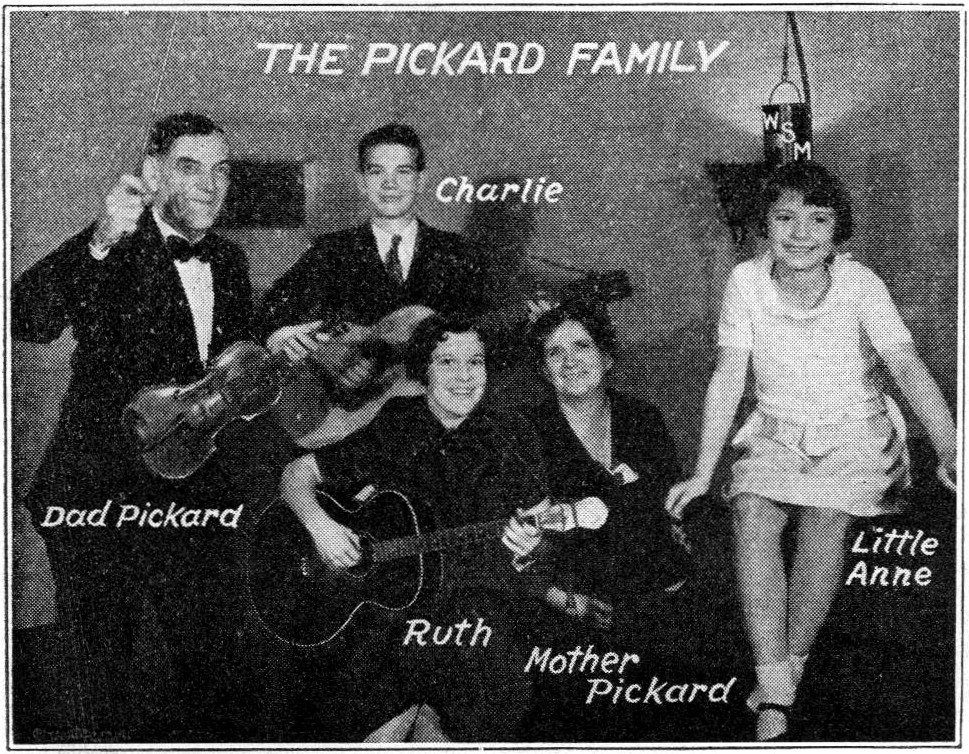
The Pickard Family, broadcasting from WSM, Nashville. Circa 1932.

The Pickards’ story begins with the birth of patriarch Obediah Orlando Pickard in Beardstown, Tennessee, on July 22, 1874.  He served in a non-combatant role in the Spanish American War, as a member of the First Regiment Tennessee Infantry Band, at which post he the distinction of playing for Admiral George Dewey.  At the turn of the century, he worked, along with the rest of his family, for the U.S. Census Office, and later gave his occupation as a traveling salesman for a collection agency (whatever that is).  He married Leila May Wilson on Christmas Day, 1906, and the couple brought Obed Orlando, Jr. (“Bubb”), into the family the very next year.  His birth was followed by Leila Mai in 1909, Ruth Carmen in 1912, James Phaney (“Charlie”) in 1914, and Margaret Ann in 1924.  Though they had played music amateurly, it was only after tragedy struck that the Pickards entered the music business; following the death of eldest daughter Leila Mai in a shooting accident in 1925, Obed reportedly heard the terrible news over the radio from WSM, Nashville, while traveling for work, and telephoned the station to extend his thanks for bringing the fact to his immediate attention, at which point he was said to have been hired by the “Solemn Old Judge”, George D. Hay.  An alternative account suggests that he was hired after Hay visited the bank in which Pickard worked and was recommended to the radio man by his brother Nixon.  In either event, Obed Pickard and his family began appearing on WSM in 1926, becoming one of the earliest stars of the program that would soon be known as the Grand Ole Opry.  “Dad” Pickard made his debut recordings on March 31, 1927, with four sides for the Columbia Phonograph Company.  The rest of the family did the same the following November for the Plaza Music Company, later the American Record Corporation, to whom they were contracted for a total of twenty-five sides between then and 1930, interrupted by a stint with Brunswick that produced an additional eleven.  In all, their released output amounted to sixteen records, many issued on a variety of labels with their sides in different configurations.  They departed from WSM for a time in 1928 and appeared on WJR in Detroit and WGAR in Buffalo before returning to the Opry in 1931.  Leaving the show again in 1933, the Pickards performed around the States for a while, eventually winding up on “goat gland doctor” John R. Brinkley’s border blaster radio station XERA in Villa Acuña, Mexico, just across the border from Del Rio, Texas.  Subsequently, they relocated permanently to California by the beginning of the 1940s.  There, they made appearances in several motion pictures, recorded again for the Coast label in 1947 and, in 1949, hosted a pioneering television program over KNBH in Los Angeles.  Dad Pickard died in Los Angeles on September 24, 1954, at the age of eighty.  After his passing, the Family continued to perform professionally at least until the late part of the decade, making some singles for Coral and an album on Verve.  Charlie Pickard was the next to go, at the young age of fifty-five on May 7, 1970.  Mom Pickard followed on May 5, 1972, back home in Nashville, Tennessee.  Bubb, Ruth, and Ann all survived well into their eighties, passing on March 20, 1997, March 13, 1995, and February 4, 2006, respectively.

Domino 4328 was recorded in New York City on February 18, and January 31, 1929, respectively.  It was also released on Broadway 8179 (as by the “Pleasant Family”—and that they were), Conqueror 7349 and 7736, Paramount 3231, QRS R.9006, Regal 8776, and with the sides split up on too many issued to list.  The Pickards playing here are “Dad” Obed, Sr., on harmonica and Jew’s harp, “Bubb” Obed, Jr., on guitar, and “Mom” Leila on piano, on side “A” only.  Dad, Mom, and Ruth sing on the first side, while Dad sings solo on the reverse.

Firstly Dad Pickard sings and picks his Jew’s harp in his take on the old-timer most commonly known as “Johnson’s Old Gray Mule”, rendered here as “Thompson’s Old Gray Mule”, with Mom and Ruth chiming in with a refrain from “Goodbye Liza Jane”.

Thompson’s Old Gray Mule, recorded February 18, 1929 by The Pickard Family.

On the flip, Obed sings solo on “The Little Red Caboose Behind the Train”, honoring the great American railroad men, and set to the tune of the 1871 minstrel standard “The Little Old Log Cabin in the Lane”.

The Little Red Caboose Behind the Train, recorded January 31, 1929 by The Pickard Family.

Okeh 45317 – W.T. Narmour & S.W. Smith – 1929

One of the truly outstanding acts of old-time music was the fiddle and guitar duo of Narmour and Smith, who were quite comparable—both in style and ability—to the Stripling Brothers of Alabama, personally I’d even go so far as to venture that I might like these two better.

The pair was made up of William Thomas Narmour, the fiddler, and Shellie Walton Smith, who played the guitar.  Narmour was born on March 22, 1889 and Smith on November 28, 1895, both in Carroll County, Mississippi, where they spent most of their lives.  Narmour learned his craft as a boy, on a fiddle fashioned for him by his father—also a fiddler—from a cigar box.  He joined forces with Smith, his neighbor, to provide music at local functions.  When Smith was unavailable, Narmour sometimes with the local blues musician Mississippi John Hurt.  At a 1927 fiddle contest in Winona, Narmour and Smith were discovered by record dealer, talent scout, and veterinarian Dr. A.M. Bailey, who referred them to the Okeh company to cut a record.  Thus, they traveled some hundred miles north to Memphis, Tennessee, to record their first six sides on February 15, 1928.  Those first thee discs proved a considerable success, and so the duo returned to the recording microphone the following year, this time traveling a longer distance to Atlanta, Georgia.  That session resulted in one of the most successful “hillbilly” records of the time, a two-sider featuring “Charleston No. 1” and “Carroll County Blues”.  Its popularity was so that six months later Narmour and Smith took a train all the way to New York City, where they put down another eight tunes on two September days, plus an appearance on Okeh’s “Medicine Show”, a musical skit record much like those made by the Skillet Lickers.  They concluded their Okeh engagement in 1930, with two sessions in San Antonio, Texas.  After four years of recording silence, Narmour and Smith returned to Atlanta for one final marathon session, this time for Bluebird, who had also poached the talents of fellow old-time stars Fiddlin’ John Carson and Gid Tanner’s Skillet Lickers for their respective last recordings.  In all, the duo of W.T. Narmour and S.W. Smith left behind a recorded legacy of nearly fifty sides.  Both Narmour and Smith remained in their native Carroll County for the rest of their lives, living primarily as farmers, and later finding work at the local school as a bus driver and janitor, respectively.  Narmour also operated a garage in Avalon.  Willie Narmour died on March 24, 1961, two days after his seventy-second birthday.  Shell Smith followed him seven years later on August 28, 1968.

Okeh 45317 was recorded March 11, 1929 in Atlanta, Georgia by W.T. Narmour and S.W. Smith, at their second session.  Narmour playing the fiddle, and Smith on guitar.  Unfortunately, this junk store copy is quite worn; both sides play fairly well for the first two-thirds or so, becoming quite crackly toward their ends (such that if I tried to clean them up, I’d surely lose my mind).  Nevertheless, both sides still put out a strong signal over the crackle.

“Charleston No. 1”, as its name would suggest, was the first in a series of “Charlestons” played by Narmour and Smith, up to “No. 3”.  They later re-recorded the three “Charlestons” for Bluebird in 1934 titled as “The New Charleston”.  The number is said to take its name from Charleston, Mississippi, rather than the popular dance or the likewise named cities in South Carolina or West Virginia.

Charleston No. 1, recorded March 11, 1929 by W.T. Narmour & S.W. Smith.

Narmour and Smith’s famous “Carroll County Blues” is a sublime performance, a prime example of just how these two really could get right.  Like with the previous number, they later followed up “Carroll County Blues No. 2” and “No. 3”, and re-made all three for Bluebird as “New Carroll County Blues”.

Carroll County Blues, recorded March 11, 1929 by W.T. Narmour & S.W. Smith.

Updated with improved audio on May 23, 2024.