About R. Connor Montgomery

R.C. Montgomery is a writer and folklore collector from North Texas, and the creative force and 78 RPM phonograph record collector behind Old Time Blues. Everything found here—for better or worse—is his doing. You may read more about his eccentric proclivities on the site's "About" page.

Vocalion 04145 – Shelly Lee Alley and his Alley Cats – 1938

Shelly Lee Alley pictured in the Hillbilly Hit Parade of 1941.

Though he never achieved the stardom of contemporaries like Bob Wills or Spade Cooley—or even Milton Brown—songwriter and fiddler Shelly Lee Alley left his mark on music history as one of the founding fathers of the Texas-born, jazz-inflected style of music now called western swing, despite hesitations toward so-called “hillbilly” music.

Shelly Lee Alley was born on July 6, 1894 on his father’s farm in Alleyton, Texas, descended from Stephen F. Austin’s original “old three hundred” settlers.  The Alleys being a musical family, Shelly learned to play the fiddle, and had reportedly composed his first song by the age of six.  During the First World War, Alley led a band at Camp Travis in San Antonio.  After the war, he led several successful dance bands in Dallas, and started out performing on the newly emerging medium of radio early in the 1920s.  Though initially focusing on popular music, by the end of the 1920s, Alley began to shift his focus to the burgeoning form that would later become known as western swing.  Alley was well-acquainted with Jimmie Rodgers, who recorded his “Travellin’ Blues” in 1931, with Alley and his brother Alvin accompanying on fiddles, and “Gambling Barroom Blues” the following year, backed by Clayton McMichen’s band.  In the first half of the 1930s, he played in various fiddle bands around South Texas, and in the middle of the decade, Alley organized a band called “Alley Cats”.  After sitting in on a session with Lummie Lewis and His Merry Makers, Alley began recording with his Alley Cats in 1937.  At various times, the Alley Cats included Cliff Bruner, Ted Daffan, Leon “Pappy” Selph, and Harry Choates, all of whom would become stars in their own right.  Between 1937 and 1940, Alley recorded sixty-seven titles for the Vocalion, most or all his own compositions, followed by a further six for Bluebird in 1941.  Alley disbanded the Alley Cats during World War II, but brought the group back to make one record for the Globe label in 1946.  A consistently sickly fellow who was known to imbibe paregoric, Shelly Lee Alley largely retired from performing in the 1940s.  Alley cut his last record in 1955 for Jet in Houston, singing two of his own compositions accompanied by the Jet Staff Band. Alley died on June 1, 1964 in Houston.

Vocalion 04145 was recorded on May 10th and 11th, 1938 in Dallas, Texas.  The Alley Cats are Shelly Lee Alley and Cliff Bruner on fiddles, Anthony Scanlin on clarinet and tenor sax, Ted Daffan on steel guitar, and on the “A” side Douglas Blaikie on piano and Lester J. Voss on string bass, replaced with an unknown pianist and Pinkie Dawson on “B”.  Alley provides the vocals on both sides.

First, the Alley Cats get low-down and dirty on Alley’s “Try it Once Again”.

Try it Once Again, recorded May 10, 1938 by Shelly Lee Alley and his Alley Cats.

On the back, they get real hot on another of Alley’s compositions: “You’ve Got It”.

You’ve Got It, recorded May 11, 1938 by Shelly Lee Alley and his Alley Cats.
Victor 19744 – Seger Ellis – 1925

Seger Ellis, pictured in an 1927 Okeh Records advertisement in Talking Machine World.

The United States of America isn’t the only one born on the fourth of July, for it’s also the birthday of Texas’ own Seger Ellis, popular crooner of the Jazz Age.  But perhaps Ellis’ greatest talent was on the piano that gave him his start down the road to fame.

Seger Pillot Ellis was born on Independence Day of 1904 in Houston, Texas.  He learned to play piano sometime in his early years from Jack Sharpe (who later recorded with the KXYZ Novelty Band) and began performing on local radio station KPRC in 1925.  He also played in Lloyd Finlay’s Houston-based jazz band, with whom he made his first records when Victor made their first field trip to Texas in March of ’25.  Aside from the seven sides with Finlay, Ellis recorded two solo sides playing piano: “Prairie Blues” and “Sweet Lovable You”, both compositions of his own.  Both masters were rejected, apparently for technical reasons, but Ellis was invited thereafter to come to Camden, New Jersey and re-make them, and that he did.  Between 1925 and 1930, Seger Ellis recorded a total of twenty-three piano solos for Victor, Columbia, and Okeh records, of which only ten were released, all of them excellent hard-driving rag pieces showcasing a strong left hand.  In spite of his outstanding piano abilities, Ellis’ real fame was to come from his warbly tenor croon.

After signing with Okeh in 1926 as something of their answer to successful Victor artist (and fellow Texan) Gene Austin, Ellis rose to become one of the label’s most heavily promoted artists.  He toured England in 1928, and the same year was granted a picture label devoted to his records, an honor previously bestowed to the likes of Paul Whiteman and Ted Lewis.  A jazzbo through-and-through, Ellis’ accompaniment often included the Dorsey Brothers, and for one session Louis Armstrong, and in addition to his popular vocals, he sang alongside jazz bands like Frankie Trumbauer’s, and occasionally made “hillbilly” records as “Bud Blue”.  In 1929, he starred in a Warner Brothers Vitaphone short titled How Can I Love You?  He retained his successful engagement with Okeh through the end of 1930, at which time he briefly signed with Brunswick.  The Great Depression found Ellis in a period of recording dormancy, though he continued to work.  As a radio personality on Cincinnati’s WLW, Ellis is remembered for giving the Mills Brothers their big break.  In the 1930s, Ellis married vocalist Irene Taylor (the “Mississippi Mud girl”).  Ellis resumed his recording career for Decca in 1936, at first singing with Jimmy Dorsey’s orchestra, but soon starting up a swing band of his own.  Two years later, he returned to Brunswick, this time as director of his “Choir of Brass” orchestra, featuring Taylor as vocalist.  That band lasted until 1941—moving to Vocalion and later Okeh following Brunswick’s demise—after which Ellis returned home to Texas and divorced Irene Taylor.  Ellis served his country during the war, and afterwards made a few more records for the Bullet label of Nashville in 1948, and a few more for Kapp in the 1950s, by which time his voice had matured into a robust baritone.  Through the following decades he remained active as a songwriter, for which he is remembered for “You’re All I Want For Christmas” (as well as “Shivery Stomp” from so many years earlier) and continued to perform locally, but disappeared from the national spotlight.  Seger Ellis died at the age of ninety-one on September 29, 1995, in his hometown of Houston.

Victor 19755 was recorded on August 10, 1925 at Victor’s headquarters in Camden, New Jersey.  It was released in November of ’25, and stayed in the Victor catalog until 1931.

Seger Ellis first recorded “Prairie Blues” during Victor’s field trip to Houston in March of 1925, a test recording which was apparently rejected for technical reasons.  He was thereafter invited to Camden to record the version featured here, a re-take made on the same matrix number (though with a “BVE” electric prefix rather than the original “B” acoustic prefix).  One of Ellis’ original compositions, the tune remained in his repertoire for quite a while, and he re-recorded in 1930 for Okeh.  It evidently gained some note in its day, being reprised in Okeh’s 1929 “hillbilly” variety record “The Medicine Show”.

Prairie Blues, recorded August 10, 1925 by Seger Ellis.

On the flip-side, Seger dishes out more of that same rambunctious raggy piano sounding straight out of a little honky-tonk in some Texas oil boom town on his “Sentimental Blues”.  Famed jazz pianist Willie “The Lion” Smith reported said of the piece: “I never thought I’d hear genuine whorehouse piano again!”

Sentimental Blues, recorded August 10, 1925 by Seger Ellis.

Gem 3522 – Dick Robertson and his Orchestra – 1933

Dick Robertson, as pictured on the cover of Decca’s 1941 catalog.

Alongside Chick Bullock as one of the most prolific vocalists of the 1930s, though perhaps even more so, the voice of Dick Robertson was near omnipresent during the years of the Great Depression.  Though easily dismissed due to his nature as a studio vocalist, and the sheer volume of his work, Robertson was a competent singer who contributed countless excellent performances over a career stretching more than twenty years.

Dick Robertson was born on July 3, 1903, in Brooklyn, New York (though some sources assert 1900).  Prior to entering the show business, he worked in construction as a foreman.  Robertson began his career in music in the second half of the 1920s, entering the recording industry in 1927, partnered with recording veteran and career duet partner Ed Smalle.  He continued to record with Smalle for a time before striking out on his own as a jack-of-all-trades vocalist.  At different times, he played most every role a singer could: crooner, jazz singer, hillbilly, and many others.  As did many, Robertson used a variety of pseudonyms throughout his career, some more memorable ones being “Bob Richardson”, “Bob Dickson”, and “Bobby Dix”.  He recorded as a solo vocalist for Brunswick in the last two years of the 1920s and Victor in the first few of the 1930s.  At the same time, Robertson began recording extensively with dance and jazz bands on virtually every label, with orchestras ranging from those of Leo Reisman and Ben Selvin to Duke Ellington and Fletcher Henderson, and frequently with Gene Kardos’ band.  In the early 1930s, he began fronting various bands to record as “Dick Robertson and his Orchestra”, first on the ARC and Crown dimestore labels, then for Bluebird from 1933 to ’35, and finally graduating to Decca in 1935, for whom he recorded steadily until 1944, promoted as one of their many top artists.  Still, he continued to sing as a studio vocalist with other groups all the while, up until the middle of the 1940s, racking up hundreds of vocal credits (and many more uncredited performances).  Robertson also proved to be quite a capable songwriter, his most notable composition being “We Three (My Echo, My Shadow and Me)”, which became a hit for the Ink Spots in 1940.  He made his last recordings in 1949 on Decca’s subsidiary label Coral, after which he disappeared into obscurity.  Dick Robertson reportedly died on July 13, 1979, ten days after his seventy-sixth birthday.

Gem 3522 was recorded in July of 1933 by Dick Robertson fronting a studio band, probably that of Walter Feldkamp.  It was also issued on Crown with the same catalog number.  Gem was a short-lived offshoot of the Crown label, which itself only existed for three years.  Much like RCA Victor’s Sunrise label, it lasted only for several months, and its purpose is uncertain.  Presumably it was pressed as a client label for some retailer, though, to my knowledge, no one knows for whom they were made.

First, Robertson gives a fine delivery of Billy Hill and Peter DeRose’s “Louisville Lady”, a haunting tale about a jilted lover who threw herself into the Ohio River, sung from the perspective of her man, who comes to the riverside to beg forgiveness from his lost love.  Certainly this must be one of Robertson’s best, at least of the sides he recorded under his own name.

Louisville Lady, recorded July 1933 by Dick Robertson and his Orchestra.

On the “B” side, Dick croons the Andy Razaf and Reginald Foresythe penned Dixie melody “Mississippi Basin”, another jim dandy.

Mississippi Basin, recorded July 1933 by Dick Robertson and his Orchestra.

Romeo 5025 – Sammy Sampson/Georgia Tom – 1930

Big Bill with his Gibson Style O guitar, as pictured in the 1941 Okeh race records catalog.

Previously on Old Time Blues, we took a look at one of the earliest records made by the illustrious Big Bill Broonzy, featuring the two rambunctious rags “Saturday Night Rub” and “Pig Meat Strut”.  Now that the time to pay birthday tributes to Mr. Broonzy has rolled around yet again, we turn our attention to another piece of work dating to one month earlier in Big Bill’s long and extensive career.

After his first 1927 and ’28 Paramount records brought little commercial success, Big Bill took a hiatus from recording.  Come 1930 however, he made his triumphant return, sitting in on an American Record Corporation session on April 8th, backing Frank Brasswell on two characteristic blues sides, then joining with the “Famous Hokum Boys”, under the auspices of founding member Georgia Tom Dorsey, to cut a re-do of the classic “Somebody’s Been Using That Thing” and three hot guitar rags.  The following day, Bill got his own time in the limelight—after a fashion—when he recorded three solo efforts of his own, “I Can’t Be Satisfied”, “Grandma’s Farm”, and “Skoodle Do Do”, all released under the pseudonym “Sammy Sampson”.  Bill continued to record under that name—excluding the results his three or four excursions to Richmond, and one to Grafton—until 1932, when the ARC (and Bluebird, for a time) finally decided to start putting out his records under his own name, albeit without his last name credited, which didn’t make it onto labels until he started recording for Mercury in 1949 (save for composer credits, which were often attributed to “Willie Broonzy” of “Williard Broonzy”).

Romeo 5025 was recorded on April 9 and 10, 1930 in New York City.  “Sammy Sampson” is, of course, a pseudonym for Big Bill Broonzy. It was also issued on Oriole 8025 and Jewel 20025, and side “A” also appeared on Perfect 157 backed with “Skoodle Do Do”.  The 78 Quarterly speculated “more than thirty [copies] on all labels,” making it perhaps not quite rare, but rather scarce nonetheless (if we’re going to split hairs), while the Perfect issue was estimated at “less than fifteen”.

On his outstanding “I Can’t Be Satisfied”, Big Bill is accompanied by his usual partner in his early days, the flatpicking Frank Brasswell, on second guitar.  To be frank, Big Bill’s earliest works were sometimes rather hit or miss; this one’s a hit—enough of one that it was covered by Bob Wills’ Texas Playboys about six years later.  It’s like rock ‘n’ roll twenty years early, only better—one of Bill’s best recordings, in my opinion.

I Can’t Be Satisfied, recorded April 9, 1930 bu Sammy Sampson.

On the flip-side, Georgia Tom Dorsey sings “Mama’s Leaving Town” in a characteristic style much in the same vein as his “Grievin’ Me Blues”—in fact, the two have very similar melodies.  He is accompanied by Broonzy on guitar.  If the song was a little peppier and hokumier, it probably would’ve been credited to the “Famous Hokum Boys”.

Mama’s Leaving Town, recorded April 10, 1930 by Georgia Tom.

Updated with improved audio on May 3, 2024.

Vocalion 1191 – Leroy Carr – 1928

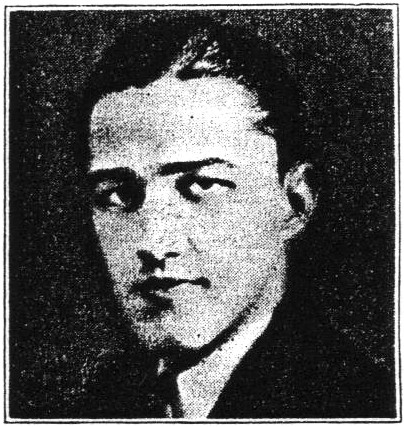
Leroy Carr, as pictured in the 1937 Bluebird catalog.

Perhaps the most popular “race” artist of his time, smooth city-slicker Leroy Carr played the blues in a more sophisticated style than his more country counterparts.  Beginning with his “How Long – How Long Blues”, Carr’s music steered the blues away from its rural roots toward a new and more urbane direction, followed by countless budding artists in his wake.

Leroy Carr was born on March 27, 1905 in Nashville, Tennessee, but not long after wound up in Indianapolis to stay.  Carr taught himself to play piano and left to join a traveling circus—then the Army—in his young adulthood, but by 1922, he came back to Indianapolis and settled down with a wife and child.  There, he teamed up with guitarist Francis “Scrapper” Blackwell and gained a reputation for playing the blues at rent parties and nightclubs.  Carr also became a part time bootlegger and a full time alcoholic.  In the summer of 1928, the Vocalion record company traveled to Indianapolis in search of new marketable talent, presenting Carr with the opportunity to make his first record.  Scrapper Blackwell did so first, recording “Kokomo Blues” and “Penal Farm Blues” on June 16, and Carr joined him in the studio three days later to cut “How Long – How Long Blues” and “My Own Lonesome Blues”.  That record turned out to be a smash success, covered even by down home country blues hit maker Blind Lemon Jefferson, and soon Carr was in high demand.  He traveled with Blackwell to Chicago two months later to make more records for his return to the Vocalion studio, with whom he continued to record through 1934.  As one of the best-selling “race” artists, he recorded prolifically, and had another big hit with “Blues Before Sunrise” in 1934, and he also toured successfully with Blackwell.  At the beginning of 1935, Carr switched to Bluebird Records, starting out with the successful “When the Sun Goes Down”, which fast became a blues standard.  Unfortunately, Carr’s alcoholism took its toll on his health, and his habitual drunkenness caused a rift between him and Blackwell, who parted with him acrimoniously in the middle of his first Bluebird session.  That session also turned out to be his last, for Carr soon after fell ill with nephritis and died on April 29, 1935, a little more than a month after his thirtieth birthday.  His legacy was carried on by artists like Bumble Bee Slim and Peetie Wheatstraw, who modeled their careers after his influential piano and guitar style, and in later years by Nat King Cole and Ray Charles, who drew inspiration from his smooth and laid back blues.

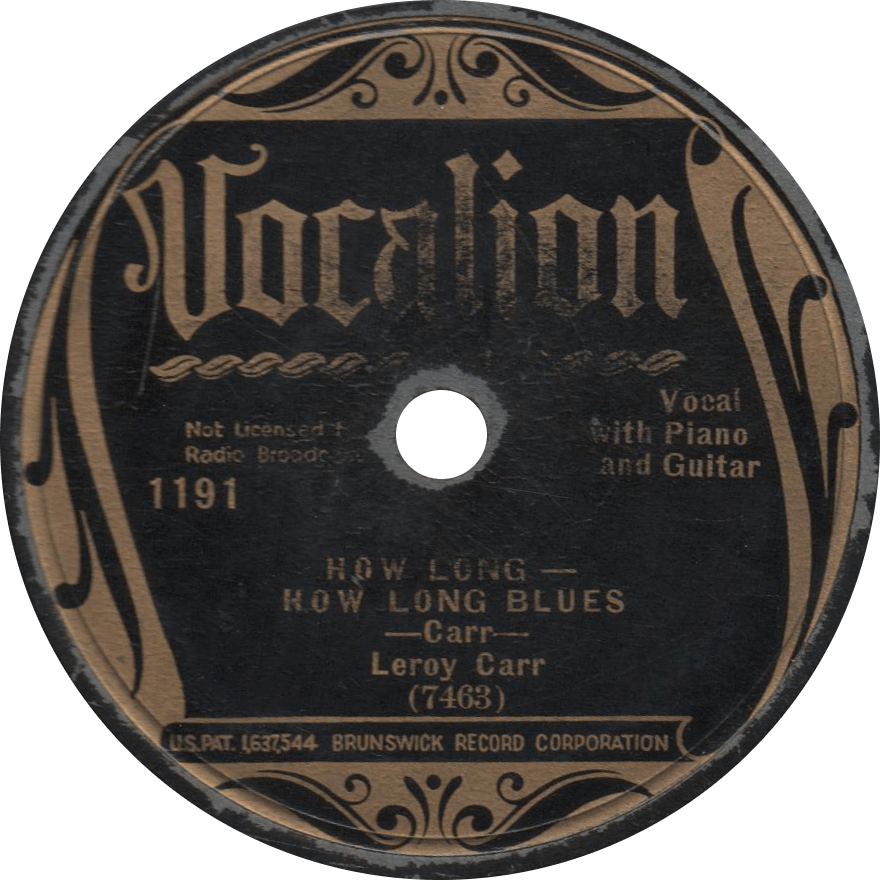
Vocalion 1191 was recorded on June 19, 1928 in Indianapolis, Indiana by Leroy Carr, singing and piano, backed by Scrapper Blackwell on guitar.  It was Carr and Blackwell’s first record, together or separately.  This copy was pressed in 1935 or ’36, as indicated by the black and gold “scroll” style label.  It was also reissued on Banner 32557, Oriole 8166, and Romeo 5166.  That it was still for sale nearly a decade after it was originally made—combined with its well-worn condition—present a testament to just how popular this record was.

First, Leroy Carr sings his big hit, the immortal “How Long – How Long Blues”, later covered many times over by countless artists, even breaking out of the blues genre and into jazz, and others.  Though known as a Carr original, the song has its roots in earlier songs, such as Ida Cox and Papa Charlie Jackson’s “How Long, Daddy, How Long?”, and shares a common melody with “Sitting On Top of the World” and its many offshoots.  It’s success was so that Carr followed up with “How Long How Long Blues-Part 2” and “Part 3”, “The New How Long How Long Blues” and “Part 2”, and “How Long Has That Evening Train Been Gone “.

How Long – How Long Blues, recorded June 19, 1928 by Leroy Carr.

On the reverse, Carr sings “My Own Lonesome Blues”.  As you can probably tell, Sadie must’ve enjoyed it quite a bit—at least until she decided to sell it for ten cents!

My Own Lonesome Blues, recorded June 19, 1928 by Leroy Carr.

Updated with improved audio on June 20, 2024.