Paramount 12417 – Elzadie Robinson – 1926

Elzadie Robinson, pictured in the Paramount Book of Blues, circa 1927.

When asked to imagine “country blues,” what image springs to mind?  Probably that of a lone man with an acoustic guitar busking on some southern street corner, or hiking down a lonesome dusty road.  But ubiquitous as that description may seem, a woman and a piano can make for just as much of “country” blues as a man and a guitar, as proven by Elzadie Robinson on the pair of haunting, down home blues songs herein.

Elzadie Robinson is believed to have been born on the twenty-fourth of April in either 1897 or 1900, and in Logansport, Louisiana, right on the border with Texas.  Little is known of her early life, or what brought her into the world of the blues.  Paramount promotional material reported that she began singing professionally around the age of twelve, and was popular in Houston and Galveston area cabarets.  She and her accompanist Will Ezell were discovered in 1926 by Art Laibly of Paramount Records and referred to Chicago record.  From then until 1929, she sang for the label, making a total of sixteen records.  Singing mostly songs of her own composition, Robinson was most often accompanied by pianists such as Will Ezell or Bob Call, sometimes joined by more musicians such as Blind Blake or Johnny Dodds.  She was distinguished alongside Ma Rainey and Ida Cox as one of Paramount’s most prominent blues ladies, and as such was honored with a segment dedicated to her in their circa 1927 publication The Paramount Book of Blues.  She married Perry Henderson of Flint, Michigan, in 1928, and retired from music the following year.  As with her upbringing, details surrounding her later life are obscure.  Many years later, Ezadie Henderson died on January 17, 1975.

William Ezell, Robinson’s most frequent accompanist, hailed from the eastern half of Texas; he was born in the town of Brenham on December 23, 1892.  He got his start as an itinerant pianist in turpentine camp barrelhouses and the like deep in the Piney Woods of east Texas, the birthplace of the musical style known as boogie woogie.  Traveling with Elzadie Robinson to Chicago in 1926, Ezell began recording extensively for Paramount Records in the five years that followed, both as an accompanist to singers like Robinson, Lucille Bogan, and others, and as a solo pianist and occasional vocalist, making several recordings with Blind Roosevelt Graves.  Recordings such as “Pitchin’ Boogie” and “Heifer Dust” helped to define the boogie woogie genre in its early years on records.  It has been reported that following the death of Blind Lemon Jefferson in the winter of 1929, Ezell accompanied the musician’s body as it was transported by train back from Chicago to Wortham, Texas.  He made his final recordings in 1931, as Paramount was faltering under the burden of the Great Depression, accompanying vaudevillian vocalist Slim Tarpley.  He is said to have returned south to Louisiana after the demise of Paramount Records, but soon came back to Chicago, and continued playing professionally until at least the 1940s, at which time he was reportedly employed by the WPA as a watchman.  Will Ezell died in Chiago on August 2, 1963.

Paramount 12417 was recorded around October of 1926 in Chicago, Illinois.  Of the two takes issued for both sides, these are “1” and “2”, respectively.  It is the first record of both Robinson and Ezell.

First, Robinson and Ezell make a blues straight out of the East Texas lumber camps: “Sawmill Blues”.  Robinson’s lazy vocals, seeming to hang behind Ezell’s piano playing, lend a candid, even dreamlike quality to the recording, as if we just stepped into a Piney Woods juke joint at the end of the night following a hard working day.

Sawmill Blues, recorded c. October 1926 by Elzadie Robinson.

On the reverse, Elzadie’s vocal drifts in and out on the classic “Barrel House Man”—the melody of which was later appropriated for Lucille Bogan’s “Sloppy Drunk Blues” (this one’s better though, I say)—to Ezell’s strong accompaniment, making ample use of the sustain pedal for that genuine barrelhouse sound.

Barrel House Man, recorded c. October 1926 by Elzadie Robinson.

Updated with improved audio on June 29, 2024.

Silvertone 4042 – Daddy Stove Pipe – 1924

The illustrious “Daddy Stove Pipe” (not to be confused with “Stove Pipe No. 1” or “Sweet Papa Stovepipe”) holds a number of important distinctions; he was one of the earliest male country blues performers to record, he may have been the oldest, and while definitely not the most prolific, he was surely among the longest-lived.

The man ‘neath the stove pipe, Johnny Watson, was reputedly born on April 12, 1867, in Mobile, Alabama.  He’s said to have begun his musical life in Mexico around the turn of the twentieth century, playing twelve-string guitar in a mariachi band.  Later, he trouped with the Rabbit’s Foot Minstrels, which produced a fair number of prominent black entertainers of the era, including “Ma” Rainey, Bessie Smith, and Butterbeans and Susie.  By the 1920s, he had taken up performing on Chicago’s Maxwell Street as a one-man band, playing guitar and harmonica and singing.  In the spring of 1924, Stove Pipe traveled to Richmond, Indiana, to cut a record at the Starr Piano Company’s “shack by the track” studio.  There, he laid down three sides, “Sundown Blues”, “Stove Pipe Blues”, and “Tidewater Blues”, of which only the first two were released.  It is evident that he hit the road after his first session, because by the time he recorded again, in 1927, he was in Birmingham, Alabama, where he waxed three more sides (of which, again, only two were issued) for Starr when they brought down their mobile recording unit.  This time around, he was billed as “Sunny Jim” and was joined by an unidentified whistler known only as “Whistlin’ Pete”.  In the 1930s, Stove Pipe settled down in Greenville, Mississippi with his wife Sarah, who joined him on the remainder of his pre-World War II recordings as Mississippi Sarah, singing and blowing the jug.  They made their first records as a duo for Vocalion in Chicago in October of 1931, waxing eight sides, all of which were released this time.  They returned to Chicago four years later for another session—which turned out to be their last—this time for Bluebird, yielding four sides, two more records.  Sarah met an untimely demise in 1937, and Daddy Stove Pipe took to traveling again, playing with Cajuns in Louisiana and Texas and returning to Mexico.  Eventually, he returned to Chicago’s Maxwell Street, and he became known as a fixture there.  He was recorded once last time in 1960 by Björn Englund and Donald R. Hill, playing and singing songs such as “The Tennessee Waltz”, producing four tracks which were released on the Heritage label LP Blues From Maxwell Street (later reissued on a number of other labels).  Watson contracted pneumonia following a gallbladder operation, and he died in Chicago on November 1, 1963.

Silvertone 4042 was recorded in Richmond, Indiana, on May 10, 1924, and originally released on Gennett 5459.  It was also issued on Claxtonola 40335.  Unfortunately, it is recorded rather faintly, which causes the harmonica and guitar to be somewhat drowned out by the surface noise on this worn copy, especially near the beginning of each side, though Watson’s vocals are still relatively prominent.  I will defend its merits in saying that I have never yet encountered a particularly clean-playing example of these sides.

On the “A” side, Watson plays and sings the delightful “Sundown Blues”.  Examination of the contemporaneous photograph depicting Daddy Stove Pipe seated next to an acoustical recording horn reveals him holding an unusual nine-string guitar, with the first, second, and third strings doubled as would be on a twelve-string guitar (as opposed to Big Joe Williams’ unique configuration), which may be the instrument played herein.

Sundown Blues, recorded May 10, 1924 by Daddy Stove Pipe.

On the reverse, Stove Pipe sings his eponymous “Stove Pipe Blues”, another arrangement of “floating” verses.  “Got the Stove Pipe Blues [and] I can’t be satisfied.”

Stove Pipe Blues, recorded May 10, 1924 by Daddy Stove Pipe.

Updated with improved audio on February 21, 2023.

Okeh 4890 – Fiddlin’ John Carson – 1923

If there is a figure more deserving of the title of “Father of Country Music” than Jimmie Rodgers, perhaps the top contender is Fiddlin’ John Carson, who, while not the first to make records of what could be called “country music,” was undoubtedly one of the first to find great success doing it.

Fiddlin’ John Carson. 1920s Okeh catalog picture reprinted in Record Research magazine.

John William Carson was born in the north of Georgia—county of Cobb or Fannin—on the twenty-third of March, though there is dispute as to which year, probably 1874, though some sources suggest 1868 (earlier census documents, as well as his death certificate, agree with the later date, while later ones support the earlier year).  Before turning to life as a musician, Carson found work on the farm and railroad, as a jockey, making moonshine, and in an cotton mill.  In 1913, Carson participated in the first Georgia Old-Time Fiddlers’ Convention, coming in fourth in the fiddling contest.  He went on to take home first prize from the Convention a total of seven times between 1914 and 1922, earning him the nickname “Fiddlin’ John”.  In the cradle days of radio broadcasting, Carson made his debut on the Atlanta Journal station WSB on September 9, 1922 to great public acclaim.  Soon after, he was noticed by Atlanta furniture dealer and Okeh record distributor Polk C. Brockman, who spotted Carson in a newsreel of a fidders’ convention, and persuaded Okeh record man Ralph S. Peer to record the fiddler.  On the fourteenth of June, 1923, Fiddlin’ John Carson made his first record at 24 Nassau Street (now 152 Nassau Street NW) in Atlanta, cutting only three sides, the first of which was unreleased and presumably destroyed.  Peer reportedly thought the two tunes were “plu-perfect awful,” but released the record nonetheless, and was surprised when sales took off like a skyrocket.  Whatever Peer’s personal taste, he was too smart to pass up a sure thing, and it was clear that the people wanted what Carson had to offer.  Before Carson’s recording career began, fiddlers Don Richardson and A.C. “Eck” Robertson had made records of “country” music, in 1914 and 1922 respectively, but both did so only sporadically and without enormous success.  Carson, on the other hand, began recording prolifically in the wake of his debut session.  Five months after cutting his first two sides, Fiddlin’ John traveled to New York City for another session, this time laying down a total of twelve sides, a number of which, like “You Will Never Miss Your Mother Till She’s Gone” and “Be Kind To a Man When He’s Down”, achieved considerable success.

Though far from the most skilled fiddler or talented singer, Carson appealed to record-buyers of the 1920s with his folksy manner and archaic sound that evoked memories of simpler times, which many longed for in the days of fast living, T-Model Fords, and New South industrialization.  Carson was also politically active within his state of Georgia, and used his music as a tool to further those ends, such as to promote the populist Democrat Tom Watson, or to condemn the accused Leo Frank for the 1913 murder of thirteen-year-old Mary Phagan.  He continued to record for Okeh until 1931, producing a total of 155 sides, of which all but seventeen were released.  Many of those featured his daughter Rosa Lee Carson, better known as Moonshine Kate, and band the Virginia Reelers.  Three years after concluding his engagement with Okeh, Carson went to Camden, New Jersey, to begin a new series of recordings for RCA Victor’s Bluebird label, an arrangement which only lasted but two consecutive sessions in February of 1934.  In those two marathon sessions, Carson, with Moonshine Kate, guitarist Bill Willard, and banjoist Marion “Peanut” Brown, recorded twenty-four sides, all of which but four were released, many of which were re-dos of his popular Okeh recordings.  Thereafter, he retired from professional musicianship.  In his later years he worked as an elevator operator in the state capitol of Georgia.  Fiddlin’ John Carson died in Atlanta on December 11, 1949.

Okeh 4890 was recorded around June 14, 1923, in Atlanta, Georgia.  These are takes “B” and “A”, respectively, both the earlier of two released takes of each side (only the latter of which are listed as issued in the DAHR).

Firstly we hear Carson’s history-making performance of the once-popular 1871 minstrel song by Will S. Hays: “The Little Old Log Cabin in the Lane”.

The Little Old Log Cabin in the Lane, recorded c. June 14, 1923 by Fiddlin’ John Carson.

Nextly, Fiddlin’ John delivers an equally rustic performance of “The Old Hen Cackled and the Rooster’s Going to Crow”.

The Old Hen Cackled and the Rooster’s Going to Crow, recorded c. June 14, 1923 by Fiddlin’ John Carson.

Updated with improved audio on January 5, 2025.

Okeh 45317 – W.T. Narmour & S.W. Smith – 1929

One of the truly outstanding acts of old-time music was the fiddle and guitar duo of Narmour and Smith, who were quite comparable—both in style and ability—to the Stripling Brothers of Alabama, personally I’d even go so far as to venture that I might like these two better.

The pair was made up of William Thomas Narmour, the fiddler, and Shellie Walton Smith, who played the guitar.  Narmour was born on March 22, 1889 and Smith on November 28, 1895, both in Carroll County, Mississippi, where they spent most of their lives.  Narmour learned his craft as a boy, on a fiddle fashioned for him by his father—also a fiddler—from a cigar box.  He joined forces with Smith, his neighbor, to provide music at local functions.  When Smith was unavailable, Narmour sometimes with the local blues musician Mississippi John Hurt.  At a 1927 fiddle contest in Winona, Narmour and Smith were discovered by record dealer, talent scout, and veterinarian Dr. A.M. Bailey, who referred them to the Okeh company to cut a record.  Thus, they traveled some hundred miles north to Memphis, Tennessee, to record their first six sides on February 15, 1928.  Those first thee discs proved a considerable success, and so the duo returned to the recording microphone the following year, this time traveling a longer distance to Atlanta, Georgia.  That session resulted in one of the most successful “hillbilly” records of the time, a two-sider featuring “Charleston No. 1” and “Carroll County Blues”.  Its popularity was so that six months later Narmour and Smith took a train all the way to New York City, where they put down another eight tunes on two September days, plus an appearance on Okeh’s “Medicine Show”, a musical skit record much like those made by the Skillet Lickers.  They concluded their Okeh engagement in 1930, with two sessions in San Antonio, Texas.  After four years of recording silence, Narmour and Smith returned to Atlanta for one final marathon session, this time for Bluebird, who had also poached the talents of fellow old-time stars Fiddlin’ John Carson and Gid Tanner’s Skillet Lickers for their respective last recordings.  In all, the duo of W.T. Narmour and S.W. Smith left behind a recorded legacy of nearly fifty sides.  Both Narmour and Smith remained in their native Carroll County for the rest of their lives, living primarily as farmers, and later finding work at the local school as a bus driver and janitor, respectively.  Narmour also operated a garage in Avalon.  Willie Narmour died on March 24, 1961, two days after his seventy-second birthday.  Shell Smith followed him seven years later on August 28, 1968.

Okeh 45317 was recorded March 11, 1929 in Atlanta, Georgia by W.T. Narmour and S.W. Smith, at their second session.  Narmour playing the fiddle, and Smith on guitar.  Unfortunately, this junk store copy is quite worn; both sides play fairly well for the first two-thirds or so, becoming quite crackly toward their ends (such that if I tried to clean them up, I’d surely lose my mind).  Nevertheless, both sides still put out a strong signal over the crackle.

“Charleston No. 1”, as its name would suggest, was the first in a series of “Charlestons” played by Narmour and Smith, up to “No. 3”.  They later re-recorded the three “Charlestons” for Bluebird in 1934 titled as “The New Charleston”.  The number is said to take its name from Charleston, Mississippi, rather than the popular dance or the likewise named cities in South Carolina or West Virginia.

Charleston No. 1, recorded March 11, 1929 by W.T. Narmour & S.W. Smith.

Narmour and Smith’s famous “Carroll County Blues” is a sublime performance, a prime example of just how these two really could get right.  Like with the previous number, they later followed up “Carroll County Blues No. 2” and “No. 3”, and re-made all three for Bluebird as “New Carroll County Blues”.

Carroll County Blues, recorded March 11, 1929 by W.T. Narmour & S.W. Smith.

Updated with improved audio on May 23, 2024.

Vocalion 1111 – Furry Lewis – 1927

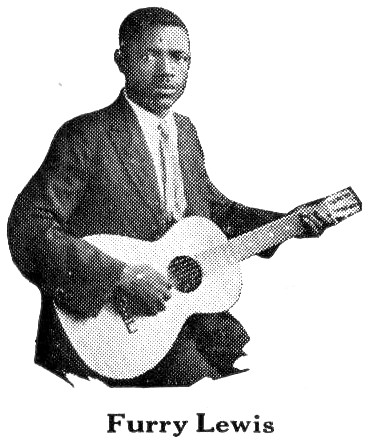
There are some folks who say that seeing two “elevens” in a row holds some supernatural or otherworldly significance.  Well, I don’t claim to know a thing about that, but I would say that this record does little to refute that proposition, for it constitutes the earliest musical document of a man who would in later years become one of the most beloved ambassadors of the blues during the its latter-day revival: Furry Lewis.

Furry Lewis, pictured in the 1930 Victor race records catalog.

Walter E. Lewis is said to have been born on the sixth of March, likely in 1899 (as suggested by the U.S. Census of 1900), though the man himself claimed to have been born in 1893, and many (older) sources agree with that date.  He hailed originally from the Mississippi Delta town of Greenwood, but grew up in Memphis, Tennessee, where he was nicknamed “Furry” from a young age for reasons now lost to time.  It was probably around the same time that he took up music, starting out on a homemade cigar box guitar.  He claimed that his first “proper” instrument was given to him by the Father of the Blues himself: W.C. Handy.  In his youth, Furry took to a life of hoboing, which cost him his left leg in 1917, after he got it caught in a coupling between train cars in an ill-fated attempt to ride the blinds.  Thereafter, he returned home to Memphis and played around Beale Street.  Sometime in the early 1920s, Furry encountered songster extraordinaire Jim Jackson, who hooked him up with a job performing in Dr. Willie Lewis’s traveling medicine show.

In April of 1927, Furry traveled to Chicago to cut his first two-and-a-half records (and one unissued side) for Vocalion, who promoted him as singing “blues in a real Southern style.” He returned there in October of the same year to make three more records, plus an unreleased recording of “Casey Jones Blues”.  Finally, when the Victor Talking Machine Company made one of their excursions south, Furry cut eight more sides at the Memphis Auditorium on August 28, 1928, which included some of his finest and best known works.  Though perhaps not the most technically sophisticated guitar player of his time, he was a master of his own style with relaxed competence, often employing open tunings, and his natural showmanship, combined with exceptional diction and an amiable personality, made him a magnetic performer.  A career in music did not put food on Furry’s table however, and he spent most of his life in obscurity, working odd jobs for the city of Memphis, primarily as a street sweeper.  He still played music professionally—if only part time—at least as late as 1940, at which time he was enumerated by the U.S. Census in Missouri as a forty-four-year-old musician working for the “carnival”, and married to a blues singer by the name of Anny Mae Bell (though in later years he was quoted as saying “what do I need with a wife as long as the other man’s got one”).

In 1952, Harry Smith included Lewis’s two-part Victor recording of “Kassie Jones” in his influential Anthology of American Folk Music, and when the white folks at large finally came around to appreciating the musical merits of the Afro-American blues during the folk music revival of the late 1950s and early ’60s, Furry was among the first of the drove of still-living bluesmen of the genre’s first generation on records to be “rediscovered” (though really he was there all along).  He was recorded in his Memphis home by Samuel B. Charters in 1959, resulting in a Folkways LP which bring him into a greater spotlight than he had ever known before.  As his style of music enjoyed a surge of popularity the likes of which it had never known before, Furry rose to a position of stardom that exceeded that of his contemporaries; while most of the rediscovered blues greats mostly found their greatest success at folk music festivals and such affairs, Furry’s fame brought him a guest spot on The Tonight Show Starring Johnny Carson in 1974 and a small role in the 1975 Burt Reynolds movie W.W. and the Dixie Dancekings, and he opened for the Rolling Stones on two occasions.  After enjoying his newfound fame for more than a decade, Furry Lewis died in Memphis of heart failure, complicated by pneumonia, on September 14, 1981.

Vocalion 1111 was recorded on April 20, 1927 in Chicago, Illinois.  Furry Lewis accompanies himself on his own guitar on side “A”, but on “B” is instead accompanied by Landers Waller on guitar and Charles Johnson on mandolin (one of whom can be heard in the background making comments).

Though some discographies suggest otherwise, the guitar playing on “Rock Island Blues” is unmistakably Furry’s own handiwork, and the melody closely mirrors that of his “Furry’s Blues” and “Good Looking Girl Blues”.

Rock Island Blues, recorded April 20, 1927 by Furry Lewis.

On the “B” side, Johnson’s mandolin and Waller’s guitar lend an entirely different atmosphere to “Everybody’s Blues”.

Everybody’s Blues, recorded April 20, 1927 by Furry Lewis.

Updated with improved audio on April 10, 2025.