
Sunrise S-3269 – The Girls of the Golden West – 1933

The Girls of the Golden West, Dolly and Millie Good, pictured on an advertisement for XER, Villa Acuña, Mexico, circa 1932-’33.  Possibly previously unpublished online.

Probably the obscurest of any of Victor’s Depression-era offshoot labels, Sunrise was produced by the RCA Victor Company in conjunction with Bluebird and Electradisk for a period of nine months, from August of 1933 up to May of ’34.  Timely Tunes—Victor’s previous foray into the world of budget records—supposedly lasted only three, but they seem to turn up a whole lot more often!  No one seems to really know for certain exactly why they were made at all.  Electradisks were produced for Woolworth’s stores, so perhaps they were made for sale at some store that folded because of the Depression.  Another leading hypothesis suggests that they were made for sale at gigs by the artists appearing on the label, a known practice in the 78 era.  What is known about them is that they are exceedingly difficult to find.  There are a total of 386 issues assigned to the label according to the DAHR, including popular, jazz, blues, and hillbilly music, but not all of them have been confirmed to have any existing copies—eight of them are explicitly noted as “not issued.”

That’s not to say, however, that the appeal of the label outweighs the musical content of the record.  The Girls of the Golden West were top names in radio game of the Great Depression-era, when America got bit by the Western bug.  Sisters Mildred and Dorothy Goad, born April 11, 1913 and December 11, 1915, respectively, were born in southern Illinois and reared in East St. Louis (though they later claimed to hail from the west Texas town of Muleshoe). They took up singing while children, and when they turned professional they changed their names to Millie and Dolly Good, and a family friend proffered that they call themselves the “Girls of the Golden West”, probably after the 1905 play of the same name or any of the three motion picture adaptations of it.  While still teenagers, the Girls of the Golden West began singing on local St. Louis radio stations KIL and KMOX, before taking their act to goat gland doctor John R. Brinkley’s “border blaster” station XER in Villa Acuña, Coahuila, Mexico, which was powerful enough to broadcast their music across most of the United States.  The Girls’ big break came in 1933, when they got a ritzier gig on the Prairie Farmer Station, Sears-Roebuck’s WLS, in Chicago to perform on the National Barn Dance, a predecessor to the WSM’s Grand Ole Opry.  Along with that came their first recording session for RCA Victor, in which the duo cut nine sides to be released on the company’s new Bluebird label.  They continued to record for RCA Victor through the end of 1935, after which they had a session with the American Record Corporation in 1938.  Their success on the Barn Dance brought them as guests onto Rudy Vallée’s NBC radio program, and they stayed on WLS’s roster until 1937, after which they moved to Cincinatti’s WLW to appear on the new Boone County Jamboree, where they remained until after World War II, by which time the show had become the Midwestern Hayride.  The Girls of the Golden West continued singing professionally until their retirement in 1949, after which they focused on homemaking for their families.  They recorded a final time, late in life, for the Fort Worth, Texas-based Bluebonnet Recording Studios.  Millie Good died on November 12, 1967; Dolly survived her by fifteen years, passing on August 4, 1982

Sunrise S-3269 was recorded in Suite 1143 of the Merchandise Mart in Chicago, Illinois on July 28, 1933 by the Girls of the Golden West: Dolly—who plays the guitar—and Millie Good; their first session for RCA Victor.  As suggested by the label, it also appears on Bluebird B-5189, as well as Electradisk 2082, and Montgomery Ward M-4412.

On the first side—with Dolly strumming that guitar like an automobile engine—the Girls sing “Listen to the Story of Sleepy Hollow Bill”, a fun little prohibition-era outlaw ditty written by the “Melody Man” Joe Davis and published under the pseudonym “Harry Lowe”.

Listen to the Story of Sleepy Hollow Bill, recorded July 28, 1933 by the Girls of the Golden West.

On the flip, the Girls sing a classic song of the Golden West right out of John A. Lomax’s Cowboy Songs and Other Frontier Ballads, Harry Stephens’ “Hi O, Hi O (The Night Herding Song)”, in an arrangement by one V. Adams, as Lomax’s published song included no written melody.

Hi O, Hi O (The Night Herding Song), recorded July 28, 1933 by the Girls of the Golden West.
Domino 4328 – The Pickard Family – 1929

The Carter Family was not the only family effort in early country music—far from it, in fact.  There was the venerable Stoneman Family, the pioneering Fiddlin’ Powers and Family, and, rivaling or perhaps exceeding the Carters’ popularity as radio entertainers in their time, the Pickard Family.

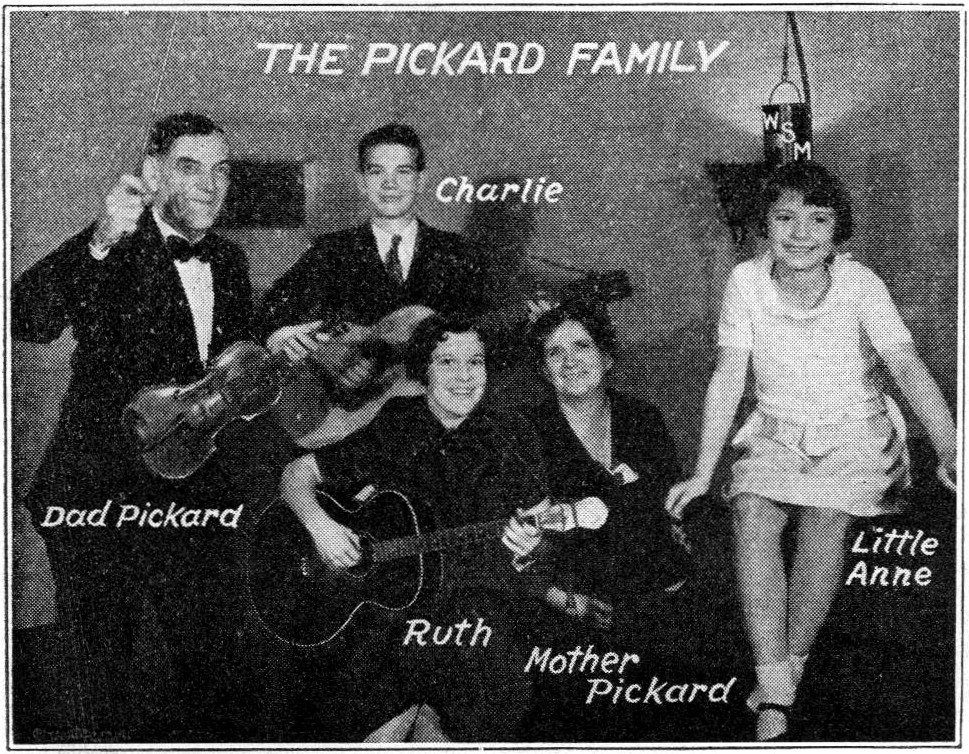
The Pickard Family, broadcasting from WSM, Nashville. Circa 1932.

The Pickards’ story begins with the birth of patriarch Obediah Orlando Pickard in Beardstown, Tennessee, on July 22, 1874.  He served in a non-combatant role in the Spanish American War, as a member of the First Regiment Tennessee Infantry Band, at which post he the distinction of playing for Admiral George Dewey.  At the turn of the century, he worked, along with the rest of his family, for the U.S. Census Office, and later gave his occupation as a traveling salesman for a collection agency (whatever that is).  He married Leila May Wilson on Christmas Day, 1906, and the couple brought Obed Orlando, Jr. (“Bubb”), into the family the very next year.  His birth was followed by Leila Mai in 1909, Ruth Carmen in 1912, James Phaney (“Charlie”) in 1914, and Margaret Ann in 1924.  Though they had played music amateurly, it was only after tragedy struck that the Pickards entered the music business; following the death of eldest daughter Leila Mai in a shooting accident in 1925, Obed reportedly heard the terrible news over the radio from WSM, Nashville, while traveling for work, and telephoned the station to extend his thanks for bringing the fact to his immediate attention, at which point he was said to have been hired by the “Solemn Old Judge”, George D. Hay.  An alternative account suggests that he was hired after Hay visited the bank in which Pickard worked and was recommended to the radio man by his brother Nixon.  In either event, Obed Pickard and his family began appearing on WSM in 1926, becoming one of the earliest stars of the program that would soon be known as the Grand Ole Opry.  “Dad” Pickard made his debut recordings on March 31, 1927, with four sides for the Columbia Phonograph Company.  The rest of the family did the same the following November for the Plaza Music Company, later the American Record Corporation, to whom they were contracted for a total of twenty-five sides between then and 1930, interrupted by a stint with Brunswick that produced an additional eleven.  In all, their released output amounted to sixteen records, many issued on a variety of labels with their sides in different configurations.  They departed from WSM for a time in 1928 and appeared on WJR in Detroit and WGAR in Buffalo before returning to the Opry in 1931.  Leaving the show again in 1933, the Pickards performed around the States for a while, eventually winding up on “goat gland doctor” John R. Brinkley’s border blaster radio station XERA in Villa Acuña, Mexico, just across the border from Del Rio, Texas.  Subsequently, they relocated permanently to California by the beginning of the 1940s.  There, they made appearances in several motion pictures, recorded again for the Coast label in 1947 and, in 1949, hosted a pioneering television program over KNBH in Los Angeles.  Dad Pickard died in Los Angeles on September 24, 1954, at the age of eighty.  After his passing, the Family continued to perform professionally at least until the late part of the decade, making some singles for Coral and an album on Verve.  Charlie Pickard was the next to go, at the young age of fifty-five on May 7, 1970.  Mom Pickard followed on May 5, 1972, back home in Nashville, Tennessee.  Bubb, Ruth, and Ann all survived well into their eighties, passing on March 20, 1997, March 13, 1995, and February 4, 2006, respectively.

Domino 4328 was recorded in New York City on February 18, and January 31, 1929, respectively.  It was also released on Broadway 8179 (as by the “Pleasant Family”—and that they were), Conqueror 7349 and 7736, Paramount 3231, QRS R.9006, Regal 8776, and with the sides split up on too many issued to list.  The Pickards playing here are “Dad” Obed, Sr., on harmonica and Jew’s harp, “Bubb” Obed, Jr., on guitar, and “Mom” Leila on piano, on side “A” only.  Dad, Mom, and Ruth sing on the first side, while Dad sings solo on the reverse.

Firstly Dad Pickard sings and picks his Jew’s harp in his take on the old-timer most commonly known as “Johnson’s Old Gray Mule”, rendered here as “Thompson’s Old Gray Mule”, with Mom and Ruth chiming in with a refrain from “Goodbye Liza Jane”.

Thompson’s Old Gray Mule, recorded February 18, 1929 by The Pickard Family.

On the flip, Obed sings solo on “The Little Red Caboose Behind the Train”, honoring the great American railroad men, and set to the tune of the 1871 minstrel standard “The Little Old Log Cabin in the Lane”.

The Little Red Caboose Behind the Train, recorded January 31, 1929 by The Pickard Family.

Supertone 9208 – Bradley Kincaid (W L S Artist) – 1928/1927

One of the truly great folksingers to record in the 1920s—years before the folk revivals of the early 1940s or 1960s—was Bradley Kincaid.  Popular on radio and records, and with a successful series of songbooks, he helped to disseminate the numerous American folk songs he had collected and bring them to the listening public in a way that academics like John A. Lomax and Carl Sandburg could not approach, and he always he did so in a most respectful and dignified manner.  We have briefly discussed Kincaid once before on Old Time Blues, but that was in the early days, before the now high standard of quality had been established, and the accompanying text was rather lacking, so now let us direct our attention once again to the “Kentucky Mountain Boy”.

Bradley Kincaid, as pictured in Favorite Mountain Ballads and Old Time Songs, 1928.

William Bradley Kincaid was born on July 13, 1895, in the village of Point Leavell in Garrard County, Kentucky, in the foothills of the Appalachian mountain range.  One of the ten children of poor farmer William P. Kincaid, he received little formal education in his early years, but began his musical pursuits at a very young age, when his father—an amateur musician himself—traded one of their hound dogs for a guitar to give to young Bradley (or so the story goes).  When old enough to work, he got a job at a lunch counter in nearby Stanford, Kentucky, but soon left the position to fight for Uncle Sam in the German War.  On his return home, he took a job at a Cincinnati tailoring firm.  He also continued his education at Berea College, having attended their Foundation School for two years prior to his service to complete the sixth through eighth grades.  While there, he began to collect songs and became more seriously interested in folk music; he also met music teacher Irma Forman, whom he would later marry.  From Berea, Kincaid moved onward and upward to the YMCA College in Chicago in 1924, where he earned a four year degree in 1928.  As a singer in the YMCA College Quartet, he made his radio debut on Sear-Roebuck’s radio station WLS in Chicago in 1926.  Soon afterward, he began appearing on the station regularly as a cast member of the National Barn Dance program on the recommendation of the Quartet’s manager.  Soon, the fan mail began to pour in—Kincaid reportedly received 100,000 letters in every year of his time on the Barn Dance.

As a professional singer, Kincaid repudiated the “hillbilly” stereotype (or “Hilly Billy,” as he put it) that was so prevalent since country music styles first found commercial success, instead presenting himself as an educated and sophisticated folksinger—pioneering (alongside Buell Kazee and Bascom Lamar Lunsford) a similar mold to that in which folk musicians like Pete Seeger would model themselves in subsequent decades.  A year into his tenure on the National Barn Dance, Kincaid made his recording debut for the Starr Piano Company, manufacturers of Gennett records and their numerous client labels.  The year after that, he published his first songbook, titled Favorite Mountain Ballads and Old Time Songs, the success of which made it the first in a series of thirteen, and which purportedly made him the first of many country singing stars to do so.  Additionally, “Bradley Kincaid Houn’ Dog” guitars, manufactured by Harmony, were sold by Sears-Roebuck, the proprietors of the station that hosted the National Barn Dance.  Kincaid departed WLS and the Barn Dance in 1929 and made for WLW in Cincinnati and a Brunswick Records deal.  Subsequently, he performed on WGY, Schenectady, and WHAM, Rochester, in New York, and began recording for RCA Victor’s Bluebird label in 1933, and for Decca in ’34.  For the latter, he made a series of Irish records rather outside of his typical repertoire.  After leaving completing his Decca recordings in 1935, Kincaid did not record again for quite some time.  While appearing on WBZ in Boston alongside banjo player Marshall Jones, he nicknamed the young musician “Grandpa” for his cantankerous demeanor.  In 1944, Kincaid joined the Grand Ole Opry on WSM in Nashville, Tennessee, holding that position for five years.  After World War Two, he recorded again for Majestic Records in 1947 and ’47, and briefly for Captiol around 1950.  Thereafter, he bought and owned WWSO in Springfield, Ohio, from 1949 until 1953, at which point he retired from performing professionally and opened a music store.  He recorded occasionally during his retirement, in 1963 and ’73, and sang for small audiences, but mostly enjoyed a quiet life.  In 1988, at the age of ninety-three, Bradley Kincaid was seriously injured in a car accident, from which he never fully recovered.  He died the following year, on September 23, 1989, in Springfield, Ohio, the town he had called home for some forty years.

Supertone 9208 was recorded around February 28, 1928, and December 19, 1927, respectively, in Chicago, Illinois.  Bradley Kincaid sings and accompanies himself on his “Houn’ Dog Guitar”.  It was also issued on Silvertone 5187 and 8218.  Split up, side “A” also appeared on Superior 2588, while side “B” appeared on Gennett 6363 and Champion 15502, and on Melotone 45008 in Canada.

Firstly, Kincaid sings a charming rendition of one of my favorite cowboy songs: “Bury Me On the Prairie”.  Kincaid’s pleasant tenor voice and straightforward delivery afforded him widespread appeal with early radio audiences.

Bury Me On the Prairie, recorded c. February 28, 1928 by Bradley Kincaid.

Nextly is the old folk song “Sweet Kitty Wells”, notably the namesake of the popular country singer of the 1950s onward, recorded at Kincaid’s very first recording session.

Sweet Kitty Wells, recorded c. December 19, 1927 by Bradley Kincaid.