
Victor V-40001 – Vaughan Happy Two – 1928

The following record is something a bit different from the run-of-the-mill—by any measure.  But if it’s that so-called “old, weird America” you’re looking for, as Greil Marcus put it, then you’ll hardly find much weirder and older than this.

The musical selections on these two sides are performed by the Vaughan Happy Two, a duo related to the Vaughan Quartet, a popular and prolific sacred singing group, though its members did not sing with the quartet.  The Vaughan Quartet, Happy Two, and several other associated groups were sponsored by the James D. Vaughan Music Company of Lawrenceburg, Tennessee, a successful publisher of sacred music, the namesake founder of which also established the Vaughan School of Music in 1911 and radio station WOAN in 1922.  Vaughan’s Quartet first recorded in 1921 and did so extensively thereafter.  Many of their recordings were issued on Vaughan’s own private record label, as well as Victor and Paramount.  The Vaughan Happy Two—Arthur B. Sebren and Cullie G. Wilson—was formed in 1925, and made their first records in 1928, which they followed up with five more sessions between then and 1930, making for a total of four sessions for the Vaughan label and two for Victor, twenty-two sides in all.  Their recorded repertoire included both sacred and secular songs, and their traveling stage act reportedly extended to monologues and musical saw.  The recordings they left behind, at least the ones on this disc, are rather reminiscent of the parlor music from so long ago, an old fashioned style that unsurprisingly proved popular with many rural listeners in the 1920s, longing for simpler times as the modern world rapidly advanced around them.

Victor V-40001 was recorded on October 20, 1928 in Atlanta, Georgia.  It is the second release in Victor’s “Native American Melodies” series, as they dubbed their V-40000 rural series prior to May of 1930.  It was probably released early in 1929, and was cut from the catalog in 1930.  The Vaughan Happy Two are tenor C.G. Wilson and baritone A.B. Sebren, accompanied on piano by M.B. Stroud.

They first sing “A Married Man in Trouble”, a song composed by prolific gospel songwriter James Rowe and Vaughan Quartet member Adger M. Pace. Though called the “Happy Two”, this song is quite the opposite (“how sad, how sad”), though indeed it is delivered in good humor.
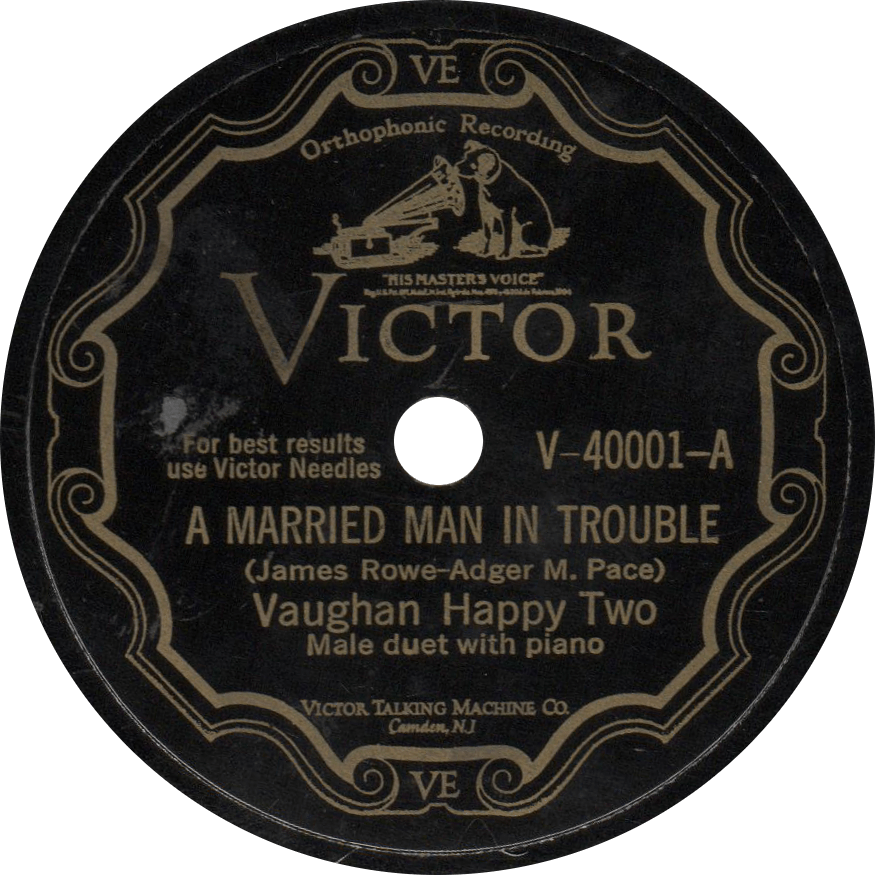
A Married Man in Trouble, recorded October 20, 1928 by Vaughan Happy Two.

On the “B” side, Sebren and Wilson sing “Chicken”, which, while credited to J. Porter Thomason and Charles W. Vaughan, is an adaptation of the old minstrel song “Chicken Don’t Roost Too High for Me”, performed by artists as diverse as Riley Puckett and Gid Tanner and the Beale Street Sheiks (Frank Stokes and Dan Sane, as “Chicken You Can Roost Behind the Moon”).

Chicken, recorded October 20, 1928 by Vaughan Happy Two.

Nordskog 3004 – Herb Weidoeft’s Famous Orchestra – 1922

The following disc comes from the Old Time Blues Collection’s selection of rare and unusual record labels.  It is one that while seldom encountered holds a unique and important place in the history of the recording industry, and bears a rather unusual, Scandinavian name: Nordskog.

The Nordskog Phonograph Company was founded by Andrae Nordskog in 1921 in Santa Monica, California.  As was emblazoned so proudly on their labels, they were the first  record label based on the United States’ West Coast.  Although their material was recorded locally in Los Angeles, they contracted an East Coast company, The Arto Company, to take care of pressing.  This setup meant they had to ship their wax master from one coast to the other, by railroad.  Unfortunately, many masters didn’t survive the journey.  In spite of their rather makeshift manufacturing process, Nordskog managed to attract some significant talent, including “Queen of Vaudeville” Eva Tanguay and jazz legend Kid Ory and his Sunshine Band, and they had the distinction of producing the first recordings of several notable West Coast dance bands, such as those of Abe Lyman, Henry Halstead, and Herb Wiedoeft.  Others included material by popular East Coast artists like Arthur Fields and Charles Harrison, drawing from Arto’s catalog.  Trouble came in 1923, when Arto went out of business while in possession of all Nordskog’s masters.  The company filed suit for the return of their property, but nothing materialized, and it was all too little and too late for Nordskog, for they too folded soon after, having released little more than fifty records.

Nordskog 3004, the fourth release on the fledgling label, was recorded early in 1922 in Los Angeles, California.  Herb Wiedoeft’s name is misspelled “Weidoeft” on the label.  Although not listed in either Rust’s Jazz and Ragtime Records or American Dance Band Discography, the personnel probably resembles that of Wiedoeft’s recordings for Brunswick the following year, which featured Herb Wiedoeft on trumpet, Joseph Nemoli on cornet and viola, Jesse Stafford on trombone and baritone horn, Larry Abbott, Gene Siegrist, and Fred Bibesheimer on reeds (clarinet, alto sax, tenor sax, and oboe), Vincent Rose on piano, Jose Sucedo on banjo, Guy Wiedoeft on tuba and string bass, and, Adolph Wiedoeft on drums and xylophone.

First up, they play a nicely orchestrated rendition of the popular 1922 jazz hit, “Virginia Blues”, perhaps most famously recorded by Ladd’s Black Aces featuring the recording debut of Cliff Edwards.

Virginia Blues, recorded in 1922 by Herb Weidoeft’s [sic] Famous Orchestra.

On the “B” side, they play Nacio Herb Brown and Gene Rose’s oriental fox trot “Persian Nights”.  This appears to be the only version of this tune to have been recorded.

Persian Nights, recorded in 1922 by Herb Weidoeft’s [sic] Famous Orchestra.