
As the years continue to fly by and 2025 gives way to 2026, we come upon a historic milestone which we cannot afford to miss: the centenary of Blind Lemon Jefferson’s first recordings.

The only known photograph of Blind Lemon Jefferson, as pictured on the cover of King of the Country Blues (Yazoo 1069).
By the time of the First World War, Lemon Jefferson had moved from his pastoral home place in Freestone County, Texas, to the big city of Dallas. There, he set about a reputation for himself in the local music scene, particularly around the neighborhood known as Central Track, or Deep Ellum. Eventually, Lemon’s powerful singing and virtuosic guitar picking earned him an opportunity rare at the time for a “country” blues singer such as himself—a chance to make a phonograph record. At the time, “on-location” recording in the southern states was quite new, and hadn’t yet commenced in earnest, so it was still essentially necessary for southern artists to travel to the big cities up north if they wished to pursue a fruitful recording career. Prior to Jefferson’s recording debut, a small few Texas blues musicians had made records—such as Sippie Wallace—but the state’s blues tradition had been hitherto largely unexplored. The precise circumstances that precipitated Lemon’s first recordings are likely lost to time. It is widely understood that he was “discovered” by fellow musician Sammy Price (later a widely known and respected blues and jazz musician in his own right), who was then-employed by R.T. Ashford’s Music Store at 409 North Central Avenue in Dallas. Price had been familiar with Lemon prior to arriving in Dallas, having seen him perform in Waco when the former was a youth there. Ashford—the store’s proprietor—was a local dealer and “agent” for Black Swan and subsequently Paramount Records, and served as a talent scout for the latter; he was later responsible for bringing several other Dallas singers to the attention of record companies, including Willard “Ramblin'” Thomas and Lillian Glinn. In any event, it is evident that Jefferson made the journey north to Chicago around the end of 1925 to make his debut recordings for the New York Recording Laboratories of Port Washington, Wisconsin, manufacturers of Paramount Records. On one fateful day in December of 1925 or January of ’26—the exact date being unknown—Lemon Jefferson stepped before the recording horn (as acoustical recordings were still in use at the time) for the first time and waxed two religious numbers: “All I Want is That Pure Religion” and “I Want to Be Like Jesus in My Heart”. Those two sides were held back from release for the better part of a year, with his first disc being released in early April of 1926 and consisting of the blues songs “Booster Blues” and “Dry Southern Blues” (Paramount 12347), which he had recorded at his second session the preceding March. When the products of his first session were finally released in October of that year, the name that appeared on the record was not “Blind Lemon Jefferson”, but “Deacon L. J. Bates”. Presumably, Paramount’s executives thought that “sanctified” record buyers might be put off if they knew that their church music was being made by a singer of the devil’s music; they released one other sacred record by Jefferson under the same pseudonym, and used the same tactic a few years later when marketing Charley Patton’s sacred music under the name “Elder J.J.’ Hadley”. (In spite of false information published by the Smithsonian Institution—or rather whoever is in charge of their social media—”Deacon L.J. Bates” was not Lemon Jefferson’s real name.)
Paramount 12386 was recorded at Rodeheaver Recording Laboratories in Chicago, Illinois, in late December of 1925 or early January of the following year, and was released around October 2, 1926. Its two sides (Paramount matrices 11040 and 11041) comprise the first recordings ever made by Blind Lemon Jefferson, though it was his fifth to be issued. It is also the first of two discs to be released under Jefferson’s “sanctified” pseudonym “Deacon L. J. Bates”. It was later issued on Herwin 93031, credited to “Deacon Jackson”.
In a performance somewhat evocative of his later and more famous “See That My Grave is Kept Clean”, Lemon’s rendition of the gospel song “All I Want is That Pure Religion” is haunting to say the least, showing us that the blues singer could preach fire and brimstone nearly as effectively as his contemporary Blind Willie Johnson.
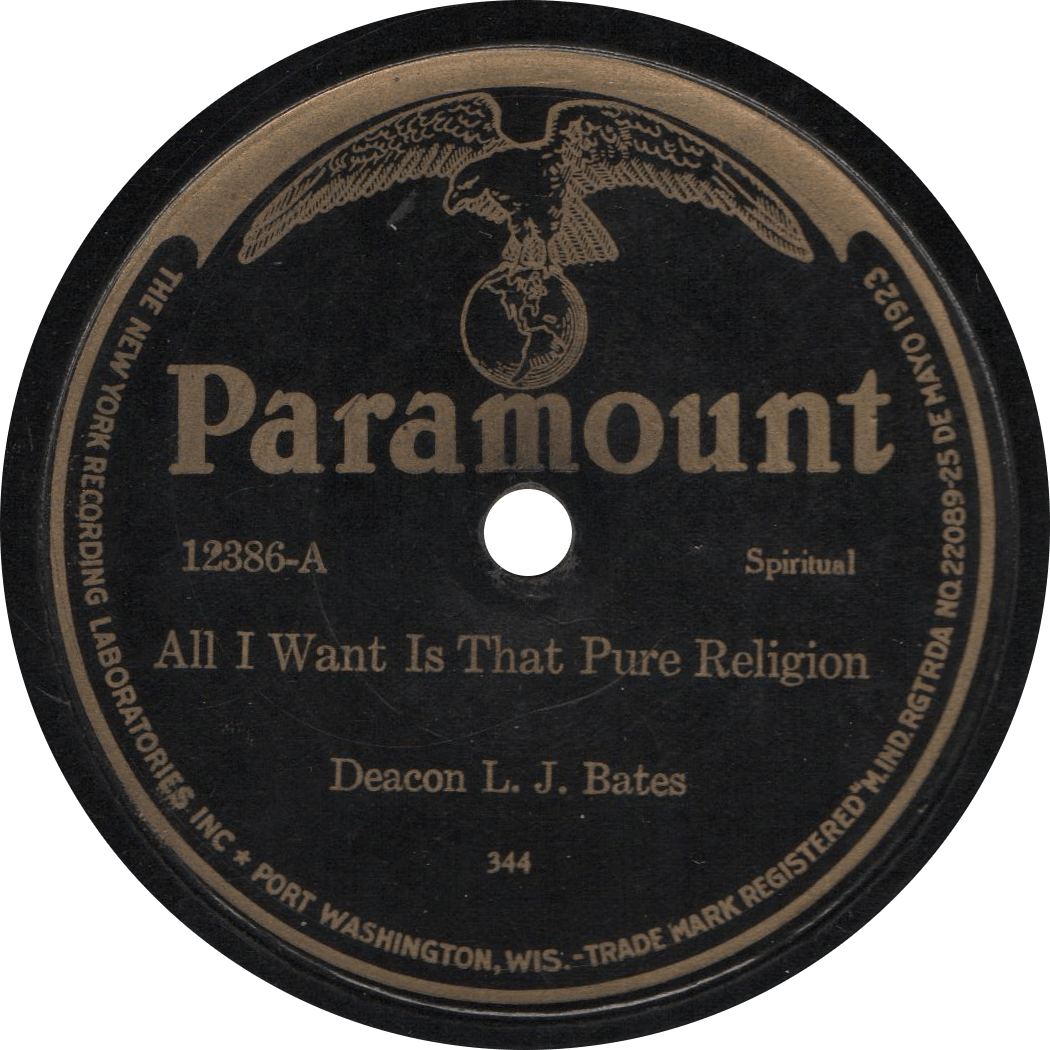
All I Want is That Pure Religion, recorded c. 1925/1926 by Deacon L. J. Bates.
Jefferson delivers a lighter, but no less effective performance of the traditional Negro spiritual “I Want to Be Like Jesus in My Heart” on the flip. The popular sacred song was also recorded by slide guitarist Crying Sam Collins in 1927.
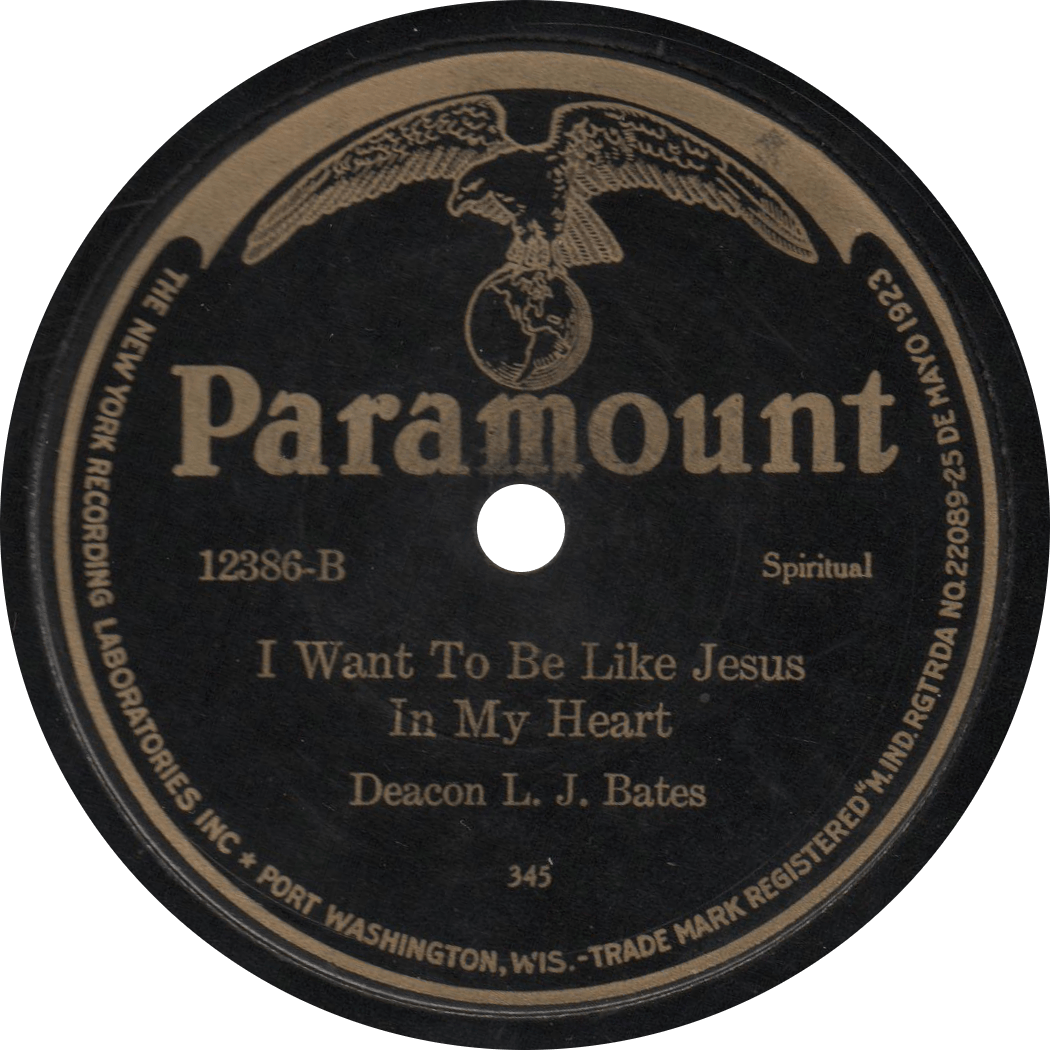
I Want to Be Like Jesus in My Heart, recorded c. 1925/1926 by Deacon. L. J. Bates.