
Vocalion 1111 – Furry Lewis – 1927

There are some folks who say that seeing two “elevens” in a row holds some supernatural or otherworldly significance.  Well, I don’t claim to know a thing about that, but I would say that this record does little to refute that proposition, for it constitutes the earliest musical document of a man who would in later years become one of the most beloved ambassadors of the blues during the its latter-day revival: Furry Lewis.
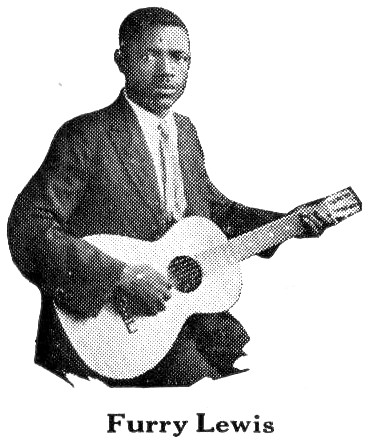
Furry Lewis, pictured in the 1930 Victor race records catalog.

Walter E. Lewis is said to have been born on the sixth of March, likely in 1899 (as suggested by the U.S. Census of 1900), though the man himself claimed to have been born in 1893, and many (older) sources agree with that date.  He hailed originally from the Mississippi Delta town of Greenwood, but grew up in Memphis, Tennessee, where he was nicknamed “Furry” from a young age for reasons now lost to time.  It was probably around the same time that he took up music, starting out on a homemade cigar box guitar.  He claimed that his first “proper” instrument was given to him by the Father of the Blues himself: W.C. Handy.  In his youth, Furry took to a life of hoboing, which cost him his left leg in 1917, after he got it caught in a coupling between train cars in an ill-fated attempt to ride the blinds.  Thereafter, he returned home to Memphis and played around Beale Street.  Sometime in the early 1920s, Furry encountered songster extraordinaire Jim Jackson, who hooked him up with a job performing in Dr. Willie Lewis’s traveling medicine show.

In April of 1927, Furry traveled to Chicago to cut his first two-and-a-half records (and one unissued side) for Vocalion, who promoted him as singing “blues in a real Southern style.” He returned there in October of the same year to make three more records, plus an unreleased recording of “Casey Jones Blues”.  Finally, when the Victor Talking Machine Company made one of their excursions south, Furry cut eight more sides at the Memphis Auditorium on August 28, 1928, which included some of his finest and best known works.  Though perhaps not the most technically sophisticated guitar player of his time, he was a master of his own style with relaxed competence, often employing open tunings, and his natural showmanship, combined with exceptional diction and an amiable personality, made him a magnetic performer.  A career in music did not put food on Furry’s table however, and he spent most of his life in obscurity, working odd jobs for the city of Memphis, primarily as a street sweeper.  He still played music professionally—if only part time—at least as late as 1940, at which time he was enumerated by the U.S. Census in Missouri as a forty-four-year-old musician working for the “carnival”, and married to a blues singer by the name of Anny Mae Bell (though in later years he was quoted as saying “what do I need with a wife as long as the other man’s got one”).

In 1952, Harry Smith included Lewis’s two-part Victor recording of “Kassie Jones” in his influential Anthology of American Folk Music, and when the white folks at large finally came around to appreciating the musical merits of the Afro-American blues during the folk music revival of the late 1950s and early ’60s, Furry was among the first of the drove of still-living bluesmen of the genre’s first generation on records to be “rediscovered” (though really he was there all along).  He was recorded in his Memphis home by Samuel B. Charters in 1959, resulting in a Folkways LP which bring him into a greater spotlight than he had ever known before.  As his style of music enjoyed a surge of popularity the likes of which it had never known before, Furry rose to a position of stardom that exceeded that of his contemporaries; while most of the rediscovered blues greats mostly found their greatest success at folk music festivals and such affairs, Furry’s fame brought him a guest spot on The Tonight Show Starring Johnny Carson in 1974 and a small role in the 1975 Burt Reynolds movie W.W. and the Dixie Dancekings, and he opened for the Rolling Stones on two occasions.  After enjoying his newfound fame for more than a decade, Furry Lewis died in Memphis of heart failure, complicated by pneumonia, on September 14, 1981.

Vocalion 1111 was recorded on April 20, 1927 in Chicago, Illinois.  Furry Lewis accompanies himself on his own guitar on side “A”, but on “B” is instead accompanied by Landers Waller on guitar and Charles Johnson on mandolin (one of whom can be heard in the background making comments).

Though some discographies suggest otherwise, the guitar playing on “Rock Island Blues” is unmistakably Furry’s own handiwork, and the melody closely mirrors that of his “Furry’s Blues” and “Good Looking Girl Blues”.

Rock Island Blues, recorded April 20, 1927 by Furry Lewis.

On the “B” side, Johnson’s mandolin and Waller’s guitar lend an entirely different atmosphere to “Everybody’s Blues”.

Everybody’s Blues, recorded April 20, 1927 by Furry Lewis.

Updated with improved audio on April 10, 2025.

Vocalion 5250 – Otto Gray and his Cowboy Band – 1928

Nearly a decade before the days of Bob Wills and Milton Brown created the mold for the western swing band, the Oklahoma Cowboy Band, under leader Otto Gray, paved the way for their style of showmanship with their barnstorming nation-wide touring, widespread radio exposure, exuberant stage presence, and extraordinarily large ten-gallon hats.

Otto Gray and his Oklahoma Cowboys on a promotional postcard. Circa 1930.

Officially, the venerable Oklahoma Cowboy Band was founded in 1924 by real cowboy Billy McGinty, born January 1, 1871, who served in Teddy Roosevelt’s Rough Riders and starred in Buffalo Bill’s Wild West Show.  However, it seems that inklings of the organization existed as early as 1921.  Under McGinty, the band made one record, including the first recording of “Midnight Special”, for Okeh in 1926.  Soon after, McGinty retired from music to focus on his ranch and his duties as postmaster of Ripley, Oklahoma, and the band’s manager and announcer Otto Gray assumed leadership.  Gray was a Stillwater man, born March 2, 1884.  On the side he raised midget cattle on his Oklahoma ranch.

Members came in and out throughout their run, but in their heyday, the band had a fairly steady lineup consisting of three Gray family members: Otto; his wife, the former Florence Opal Powell, known as “Mommie” (February 27, 1888 to November 14, 1950), who sang occasionally; his son Owen (February 3, 1908 to August 12, 1947), who sang and played guitar; the Allen brothers: fiddler Lee “Zeke” and left-handed banjo picker Wade “Hy” Allen (not the same Allen Brothers as the “Chattanooga Boys”); “Chief” Sanders; and Rex, the “wonderful police dog,” the “bark of the air,” who barked in rhythm on their radio shows.  Most of the band members were competent on more than one instrument, and one of their novelties was to “finger one instrument and play another.”

Under Gray’s leadership, the Oklahoma Cowboys toured the vaudeville circuit, and reportedly appeared on over 130 radio station across the States.  On the record, they recorded fifteen sides for Gennett in 1928, of which seven were issued, with an additional two in 1930, followed by eighteen sides for Brunswick/Vocalion from 1928 to 1931, all of which were issued.  In spite of their relatively prolific recording career, their records are quite scarce today.  They shot a one-reeler, titled Otto Gray and his Oklahoma Cowboys, for Veribest Pictures in 1929 or ’30.  In November, 1930, they published and official songbook, titled Songs: Otto Gray and his Oklahoma Cowboys, which sold for fifty cents a copy and included some hits from their repertoire, such as “Midnight Special” and “Adam and Eve”.  On June 6, 1931, they became the first Western band to be featured on the cover of Billboard magazine. The Oklahoma Cowboys continued to perform into the late 1930s; Otto Gray retired from music in 1936.

Vocalion 5250 was recorded on September 17, 1928 in Chicago, Illinois.  The personnel at this session is unconfirmed, but likely includes “Chief” Sanders on fiddle, Wade “Hy” Allen on left handed tenor banjo, Owen “Zeb” Gray on guitar, and another unknown guitarist—quite possibly Lee “Zeke” Allen, seeing as he’s only official band member not accounted for in that listing aside from “Mommie”, but I’m not sure if she played an instrument, and he did play second guitar in their 1929 short film.  Owen Gray performs the vocals on both sides.

First, Zeb tells the story of mankind from Adam to Ford on the humorous “Adam and Eve”.

Adam and Eve, recorded September 17, 1928 by Otto Gray and his Cowboy Band.

Next, on a popular hillbilly song and staple of the Oklahoma Cowboys’ repertoire, Zeb tells us all that we shouldn’t—or couldn’t—be doing: (don’t try it, ’cause) “It Can’t Be Done”.

It Can’t Be Done, recorded September 17, 1928 by Otto Gray and his Cowboy Band.

Never-Before-Seen Footage of Jimmie Rodgers Discovered?

In my spare time, and when the thought occurs to me, I enjoy browsing the Digital Video Repository of the Moving Image Research Collections (or MIRC) at the University of South Carolina, a vast online archive of historical film footage, much of which consists of newsreels footage.  Often, I’ll just enter some different search terms and see if I can find anything interesting.  It was on one such online excursion that I stumbled across a newsreel (or rather outtakes thereof) depicting the arrival of the famed humorist, movie star, and cowboy philosopher Will Rogers in San Antonio, Texas, that caught my attention.  I am (as any red-blooded American surely must be) counted among Will Rogers’ legion of admirers, but his presence was not what attracted my interest to the video.  Rather, it was the appearance of a background character that struck me as a familiar face.

Continue reading

Decca 7340 – Black Ace (B. K. Turner) – 1937

Of all the countless musical artists active before the Second World War, only a fraction were fortunate enough to have their art preserved on records, and an even smaller fraction recorded prolifically, leaving whatever magical music they produced mostly unheard.  That however, does not necessarily imply that those artists who left behind few, if any, recordings were not popular within their own domain.  One such artist who achieved considerable note with audiences in his homeland of Texas, but only left behind a precious few recordings was a peculiar, but quite remarkable, bluesman (and my own fourth personal favorite Texas blues musician) known as the Black Ace.

B.K. Turner, circa 1930s. Erroneously identified as J.T.’ “Funny Paper” Smith on the cover of Yazoo L-1031 (1972).

The man later called the “Black Ace” was born Babe Kyro Lemon Turner on the twenty-first of December, 1907 (some sources state 1905), on his family’s farm in the small settlement of Hughes Springs, deep in the farthest northeast reach of the state of Texas—the same region that brought up the likes of Little Hat Jones and Lead Belly.  He took up playing the guitar sometime in his youth and began playing the blues by the end of the 1920s in the vicinity of his hometown, and teamed up with the younger Andrew “Smokey” Hogg in the decade that followed.   Evidently inspired by Hawaiian-styled blues player Oscar “Buddy” Woods, Turner bought a square-necked National tricone resonator guitar and learned to play steel guitar, using an old medicine bottle as a slide.  In the 1930s, he relocated to Fort Worth and began performing on the radio.  There, he made his first recordings on April 5, 1936: two sides for the American Record Corporation including his eponymous theme song “Black Ace Blues”, from which he adopted the nickname, but both were unissued and are considered lost.  When the Decca record company made a field trip to Dallas early in 1937, Turner recorded again, cutting six sides, all of which were issued this time around (some sources suggest that he traveled to Chicago with Smokey Hogg and Whistling Alex Moore for the session, but they are erroneous).  The resulting three records proved to be the entirety of Black Ace’s pre-war recording career, and he would not record again for twenty-three years.  In spite of his scant recorded legacy, Turner seems to have enjoyed considerable regional popularity; his radio program lasted into up until the outbreak of World War II, and, remarkably for an early blues musician, he boasted a (very brief) motion picture career.  In 1941, Turner had a bit part in Spencer Williams’ race movie The Blood of Jesus, ostensibly portraying himself, first being heard-and-not-seen playing “Golden Slippers Blues”, then appearing as a member of a band performing on the back of a flatbed truck with the devil at the wheel.  He was drafted into the Army in 1943, and continued to play music while in the service, but retired from professional musicianship after returning from the war.  He was coaxed back in front of the microphone in 1960 by Chris Strachwitz and Paul Oliver to record an album for Strachwitz’s Arhoolie Records, thus preserving a further seventeen pieces of his repertoire for posterity.  Around three years later, he was filmed by Strachwitz and German documentarian Dietrich Wawzyn at his home in Fort Worth, in which he reprised his theme song “The Black Ace” one last time.  After suffering from cancer, B.K. Turner died in Fort Worth on November 7, 1972.

Decca 7340 was recorded on February 15, 1937 in Dallas, Texas.  It is the second released of Black Ace’s three records.  B.K. Turner sings and plays his own Hawaiian guitar; he is accompanied by an unidentified rhythm guitar player (possibly Andrew “Smokey” Hogg).

Firstly, the Black Ace plays and sings “You Gonna Need My Help Some Day”, loosely covering Big Bill Broonzy’s “You May Need My Help Some Day” from a year prior—which in turn echoes some elements from Kokomo Arnold’s “Milk Cow Blues” of 1935.

You Gonna Need My Help Some Day, recorded February 15, 1937 by the Black Ace (B.K. Turner).

On the reverse, he does “Whiskey and Women”, showcasing a bit more of the Black Ace’s Hawaiian-styled blues playing.

Whiskey and Women, recorded February 15, 1937 by the Black Ace (B.K. Turner).

Okeh 8554 – “Mooch” Richardson – 1928

Like old Seth Richard, “Mooch” Richardson is one of the countless blues musicians whose life and times are shrouded in obscurity.  He showed up for two sessions while the Okeh company was in Memphis, producing a series of outstanding country blues recordings, then disappeared back into obscurity once they were complete.

Perhaps the only really concrete fact known about “Mooch” is that he was really James Richardson.  It has been supposed based upon his “Helena Blues”, that he hailed from Helena, Arkansas.  Historian Paul Oliver, in his Barrelhouse Blues: Location Recording and the Early Traditions of the Blues, suggested that Richardson was a pianist, based apparently upon his two-part recording of “‘Mooch’ Richardson’s Low Down Barrel House Blues”, and implying that Richardson played piano on those recordings (though he in fact did not).  In February of 1928, Richardson appeared at two consecutive sessions in Memphis for Okeh, resulting in a total of nine recordings, six of which were released.  He was backed by Lonnie Johnson either on the latter session or both, accounts differ.  Whether or not Richardson was a resident of Memphis is another unknown.  Those two record dates serve as the only hard evidence of “Mooch” Richardson, whatever became of him afterward is anyone’s guess (unless they’ve got access to better information than me).

Okeh 8554 was recorded on February 13, 1928 in Memphis, Tennessee.  There is question as to whether the guitar accompaniment is played by Richardson himself or by Lonnie Johnson; some sources state that Richardson accompanied himself on his first record date (which produced these two), and Johnson on his second, while others indicate that all of his recordings feature Johnson.  To my ear, while the guitar playing sounds a bit more “standard country blues” than Johnson’s usual style of playing—which tended to be heavy on bent notes and elaborate melodic single-string runs—it at the same time could indeed quite plausibly be him; certainly Johnson was a skilled enough musician to play in such a style.  The DAHR lists Lonnie Johnson on the first side and Richardson on the second, but both sound to be the same player, and if anything the “B” side sounds more like Johnson than the first.  The more I listen to it, the more I think it is Johnson.  It’s beautiful playing one way or the other.  Contributors to the 78 Quarterly suggested “twenty-five or more” extant copies, with this copy being one of the ones reported (at which time it was in the collection of George Paulus).

First up is the excellent “T and T Blues”, a mostly, if not entirely floating verse song drawing its name from the line “well it’s ‘T’ for Texas, lawd, I got a ‘T’ for Tennessee,” also heard in “Jim Jackson’s Kansas City Blues”, and famously in Jimmie Rodgers’ “Blue Yodel”, as well as others, including Willie Brown’s “Future Blues”.

T and T Blues, recorded February 13, 1928 by “Mooch” Richardson.

Another floating verse song, Richardson next sings “‘Mooch’ Richardson’s Low Down Barrel House Blues Part 1”.  You gotta buy another record if you want to hear part two.

“Mooch” Richardson’s Low Down Barrel House Blues Part 1, recorded February 13, 1928 by “Mooch” Richardson.